In December 2025, the Redding Consortium for Educational Equity voted 19-2 to recommend merging the four school districts that share Wilmington's students into a single consolidated district. The proposal would dissolve Christina School District↗ET, the district at the center of the debate, and fold it into a countywide system serving more than 43,000 students.
Christina's four-year graduation rate helps explain why. At 73.2% for the class of 2023, it is the lowest in the state, 15.7 percentage points below Delaware's 88.9% average. That gap is not new. It is not narrowing. And it is not evenly distributed across students.
A rate that climbed, then collapsed
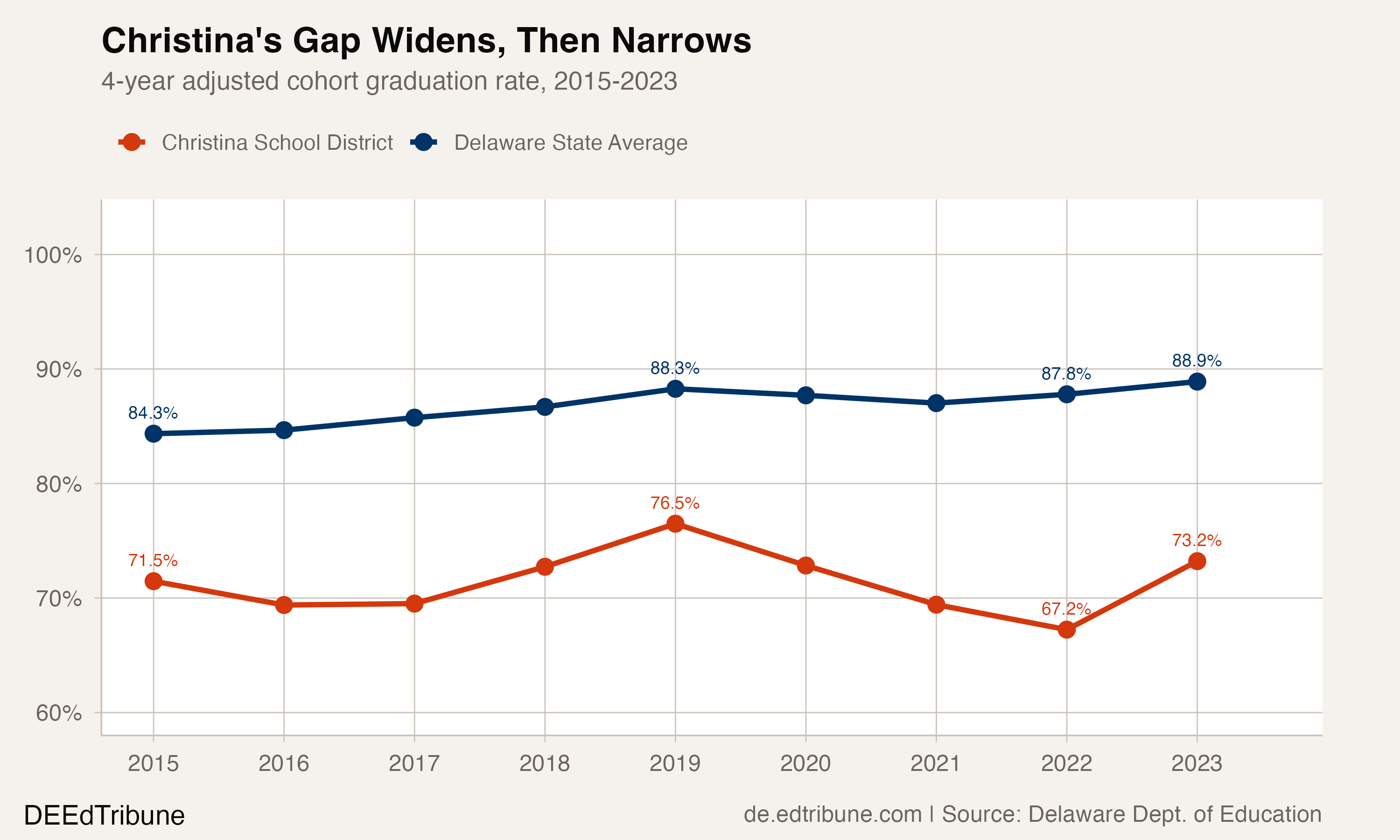
Christina's graduation trajectory over nine years traces a shape more like a heartbeat than a decline: up, then sharply down, then a partial recovery. The district climbed from 71.5% in 2015 to a peak of 76.5% in 2019, a four-year improvement that suggested its interventions were working. Then the rate fell in three consecutive years, bottoming at 67.2% in 2022, a 9.3 percentage-point drop that erased all prior gains and then some.
The class of 2023 rebounded six points to 73.2%, but that leaves Christina barely above where it started nine years earlier. Meanwhile, the state average rose steadily from 84.4% to 88.9% over the same period. The gap between Christina and the state hit its widest point in 2022, at 20.6 percentage points, before narrowing back to 15.7.
Every other traditional district in Delaware graduated at least 74.0% of its students. Seaford↗ET, the next-lowest at 74.0%, has a fraction of Christina's enrollment.
The desegregation architecture
The story of why Christina exists at all starts in 1978, when a federal court ordered the desegregation of New Castle County's schools. The remedy split Wilmington's students across four suburban districts: Brandywine↗ET, Christina, Colonial↗ET, and Red Clay Consolidated↗ET. Each district received a slice of the city alongside its suburban schools, creating hybrid systems that span urban neighborhoods and outlying communities.
"That's all we were, we were bulldozed. You had the powers to be, the white suburban parents, white politicians, against the city folks." -- Maria Matos, president/CEO of the Latin American Community Center, Spotlight Delaware, August 2024
Nearly five decades later, the four districts that share Wilmington produce markedly different graduation outcomes.
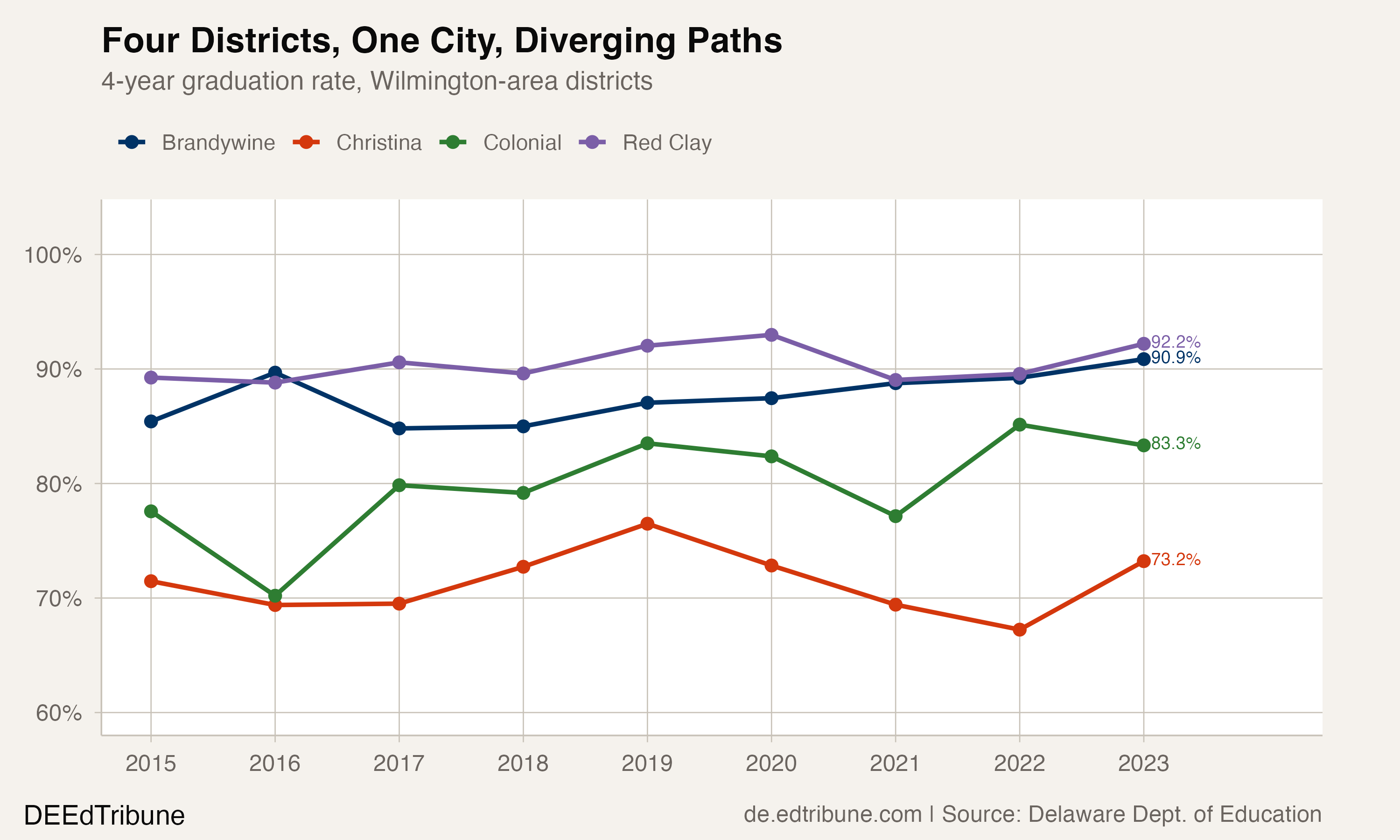
Red Clay graduated 92.2% of its 2023 cohort. Brandywine reached 90.9%. Colonial came in at 83.3%. Christina, at 73.2%, trails the next-closest Wilmington district by more than 10 points. All four serve portions of the same city, draw from overlapping labor markets, and operate under the same state funding formula. The divergence is structural, not demographic destiny: Brandywine's Black graduation rate (86.9%) exceeds Christina's overall rate by nearly 14 points.
Who is not graduating
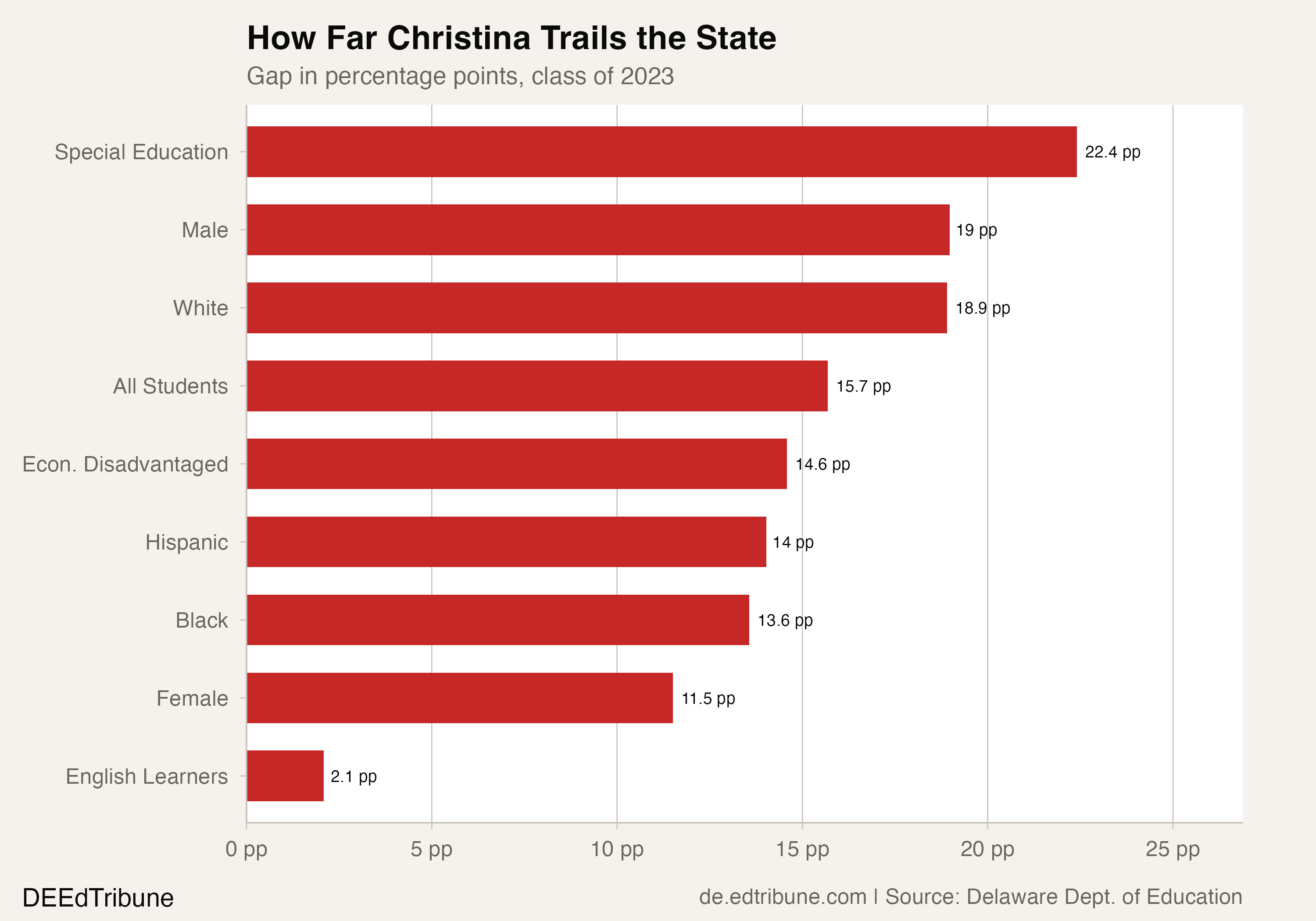
The 15.7-point headline gap understates the problem for several student groups. Christina's special education students graduate at 50.9%, trailing the state's special education rate by 22.4 points. Male students graduate at 67.3%, nearly 19 points below the state male average. White students at Christina (72.6%) trail the state white rate (91.5%) by 18.9 points, a gap wider than the one for Black students (74.2% vs. 87.8%, a 13.6-point difference).
That last finding is counterintuitive. In most districts where graduation rates lag, racial gaps run in the expected direction: Black and Hispanic rates trail white rates. At Christina, the overall rate is so depressed that every subgroup underperforms its statewide counterpart by double digits. The gap is not primarily racial. It is institutional.
Hispanic students graduate at 69.2%, and economically disadvantaged students at 67.0%. But even Christina's highest-performing major subgroup, female students at 80.1%, falls 11.5 points short of the state female average.
The poverty gradient
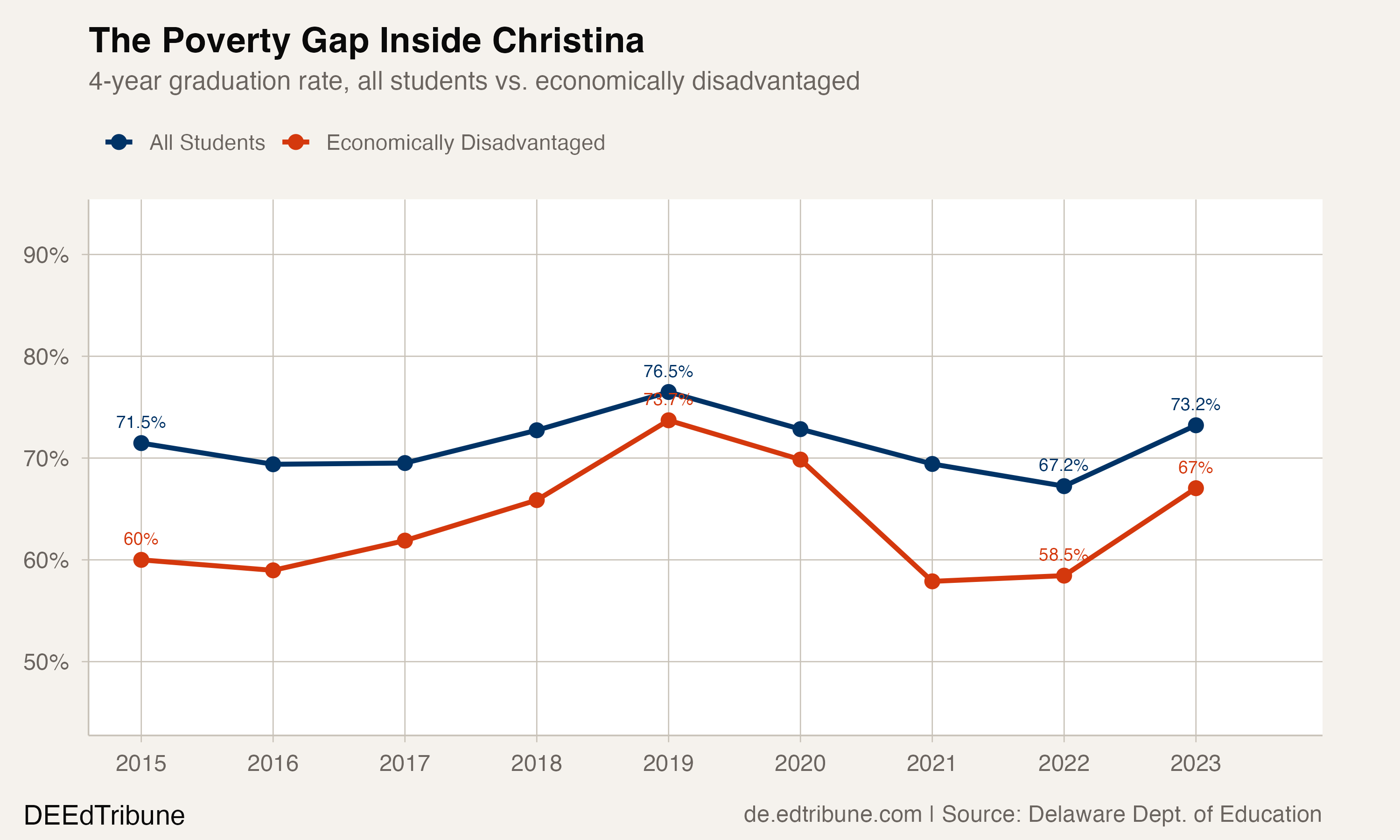
The gap between Christina's overall rate and its economically disadvantaged rate tells its own story. In 2019, the two lines nearly converged: 76.5% for all students, 73.7% for economically disadvantaged students, a spread of just 2.8 points. By 2021, the economically disadvantaged rate had crashed to 57.9% while the overall rate fell to 69.4%, opening a gap of 11.5 points.
The class of 2023 narrowed the spread to 6.2 points (73.2% vs. 67.0%), but the economically disadvantaged rate remains seven points below where it was in 2019. That 2019 peak now looks less like a turning point and more like a brief window that closed.
Wilmington students from low-income families who are bused to Christina's suburban high schools face a different calculus than their peers assigned to Brandywine or Red Clay, where economically disadvantaged students graduate at 82.1% and 86.7% respectively. The district boundary a student falls within can mean a 15 to 20 percentage-point difference in the likelihood of graduating on time.
What the consolidation plan does and does not address
The Redding Consortium's December 2025 vote launched a formal study of merging all four Wilmington-area districts into the Northern New Castle County Consolidated School District. The plan, which would cost an estimated $20 million to implement, has the backing of Governor Matt Meyer but faces steep opposition from suburban parents, particularly in the Brandywine district, where a town hall drew roughly 1,000 attendees.
The timeline has already slipped. The Redding Consortium pushed its deadline for a detailed proposal from June 2026 to the end of the calendar year, with the American Institutes for Research, the contracted consultancy, requesting additional time. The earliest a legislative vote could occur is 2027.
"Nothing is going to change if we aren't willing to change. I know that we need to go big." -- Mike Mathews, Red Clay teacher, WHYY, December 2025
Consolidation would eliminate the boundary lines that assign some Wilmington students to a district where 73.2% graduate and others to districts where 91% or 92% do. But it would not automatically fix the instructional conditions that produce a 50.9% special education graduation rate or a 67.0% economically disadvantaged rate. Merging four districts into one creates a single governance structure. Whether that structure produces better outcomes depends on decisions that have not yet been made: staffing models, school assignment patterns, and how much money the legislature is willing to commit.
The district ranking, in full
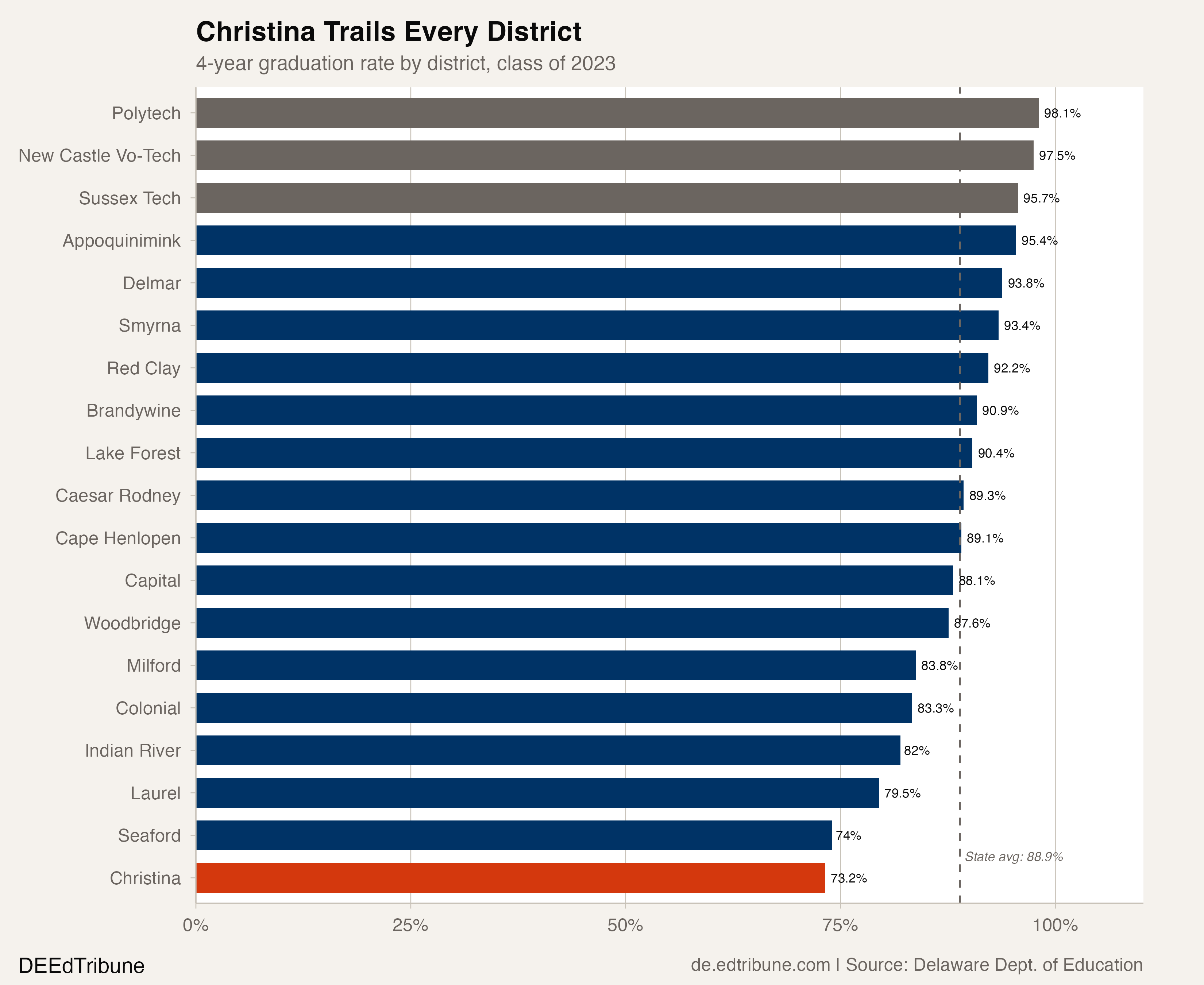
Delaware's three vocational-technical districts, which select students by application, cluster between 95.7% and 98.1%. Among the 16 traditional districts, the range runs from Christina's 73.2% to Appoquinimink's 95.4%, a 22.2-point spread. The four Wilmington-area districts span nearly the full range of that distribution: Red Clay near the top, Christina at the bottom, Colonial and Brandywine in between.
Christina teacher Michelle Suchyj captured the tension at the December Redding vote: "I don't want my kids in the city of Wilmington to get lost in an even bigger pool than they're already lost in." The question the data raises but cannot answer is whether four separate pools, with one this shallow, serve those students any better.
Detailed code that reproduces the analysis and figures in this article is available exclusively to EdTribune subscribers.
Discussion
Sign in to join the discussion.
Loading comments...