For the class of 2023, 88.9% of Delaware's public high school students earned a diploma within four years. That is the highest four-year adjusted cohort graduation rate the state has ever recorded, 4.6 percentage points above where it stood in 2015, and nearly two points above the national average of 87%.
It is also, still, below 90%.
That threshold matters because the Delaware Department of Education has never cleared it. Not once in nine years of data. And it matters because the DOE's 2025-2028 strategic plan has set 91% as a formal target, meaning the state needs to gain more than two points in roughly five years. At its average pace of 0.6 points per year since 2015, Delaware would need about two more years just to touch 90%. But the state has been in this neighborhood before, at 88.3% in 2019, and then watched the rate slide backward for two consecutive years.
The shape of the climb
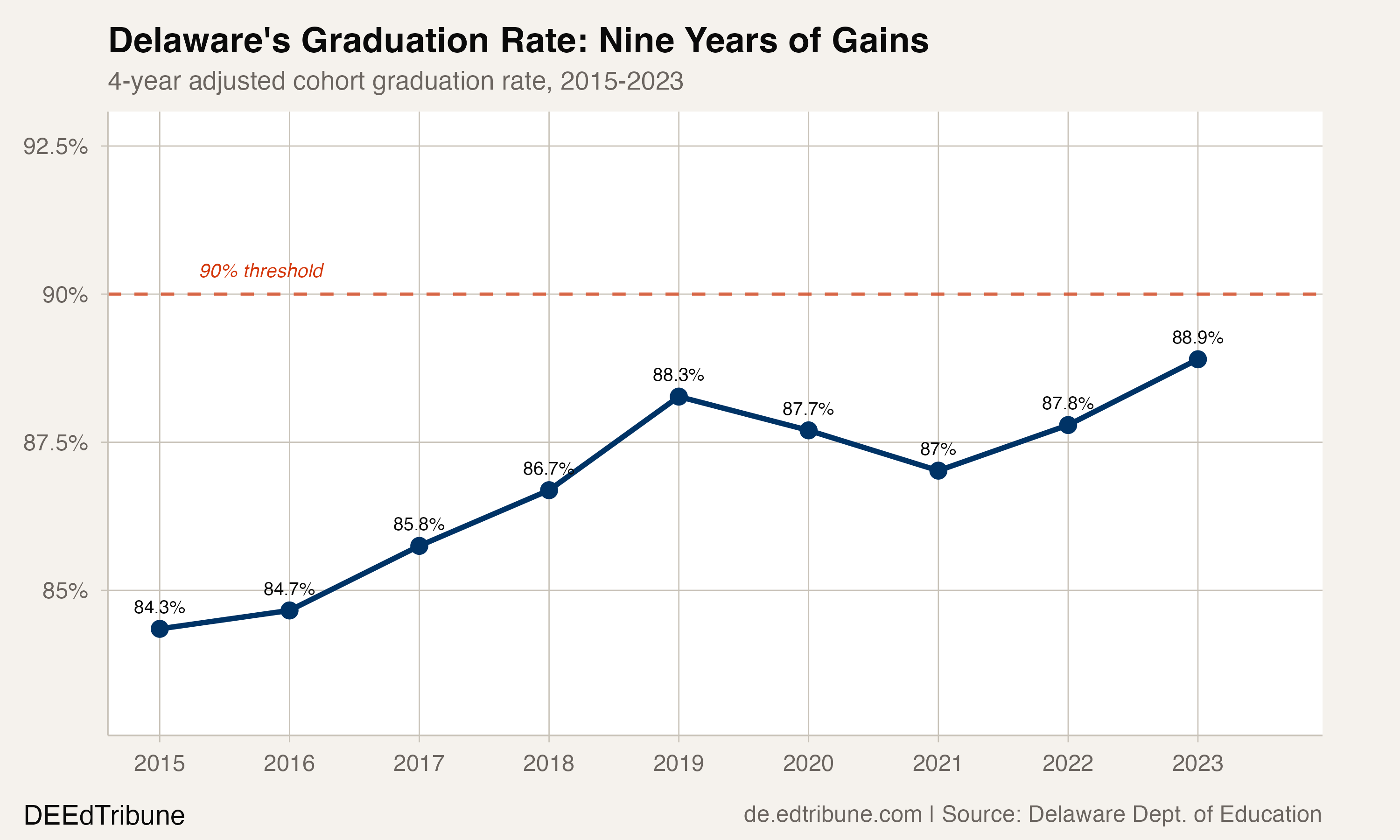
The trajectory from 84.4% to 88.9% was not a straight line. From 2015 to 2019, gains accelerated: +0.3 points, then +1.1, +0.9, and +1.6. The class of 2019 graduated at 88.3%, the previous high, and the state appeared to be on a path to cross 90% by 2021.
Then COVID intervened. The class of 2020 dipped to 87.7%, and the class of 2021 fell further to 87.0%, erasing two years of progress. Unlike many states that saw graduation rates inflate during the pandemic as districts relaxed requirements, Delaware's rate actually declined, a pattern that reflects the state's decision not to adopt blanket grade-forgiveness policies.
Recovery took until 2023. The class of 2022 regained most of the lost ground at 87.8%, and the class of 2023 added another 1.1 points to set the record.
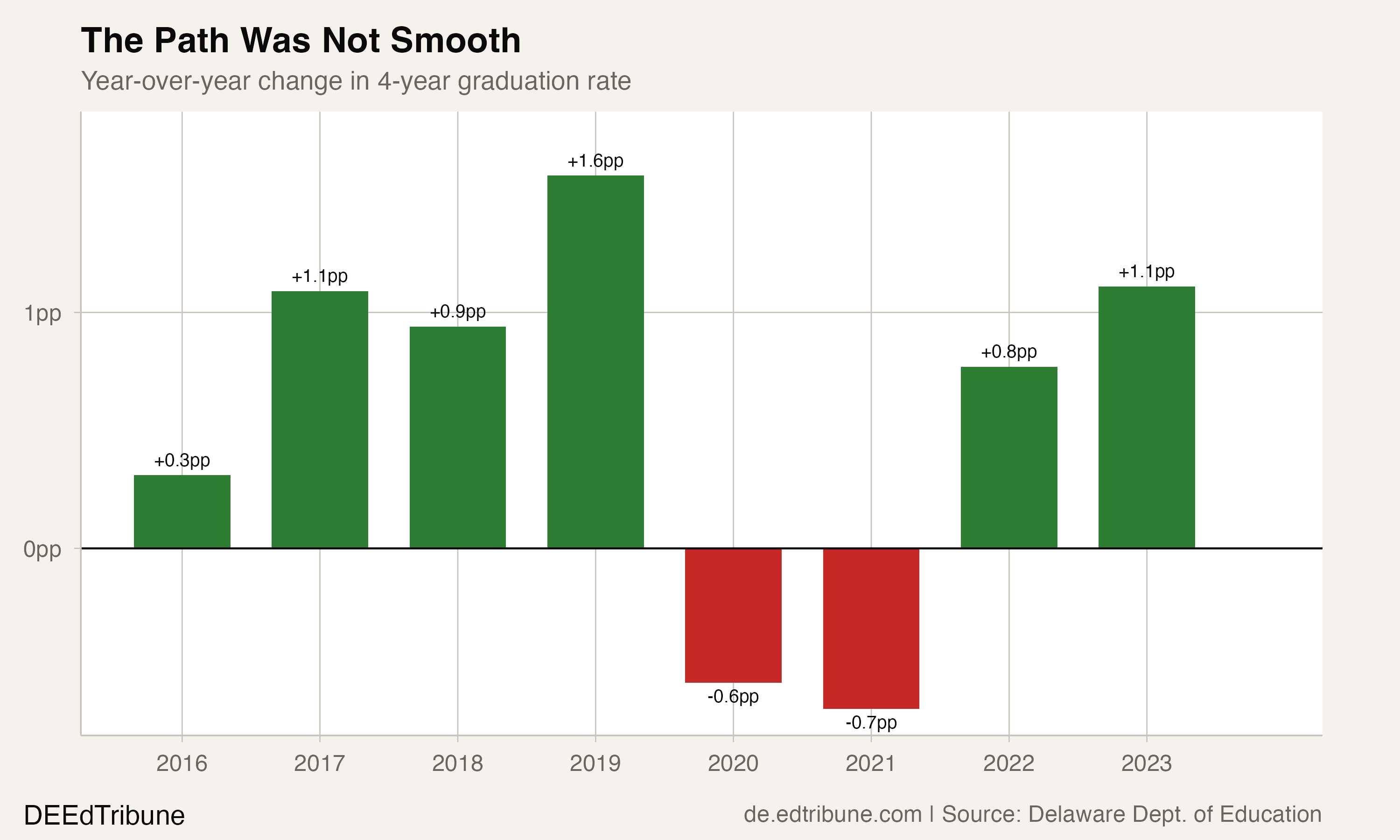
The year-over-year pattern reveals something worth watching: the post-COVID rebound (+0.8 and +1.1 points in 2022 and 2023) matches the pre-COVID pace. Whether that momentum continues or flattens, as it did before 2019, will determine whether the DOE's 91% target is realistic.
Nine districts clear 90%. Three are stuck below 80%.
The statewide number obscures a 25-point spread across Delaware's 19 districts. Nine already exceed 90%, but three remain below 80%: Christina School District↗ET at 73.2%, Seaford↗ET at 74.0%, and Laurel at 79.5%.
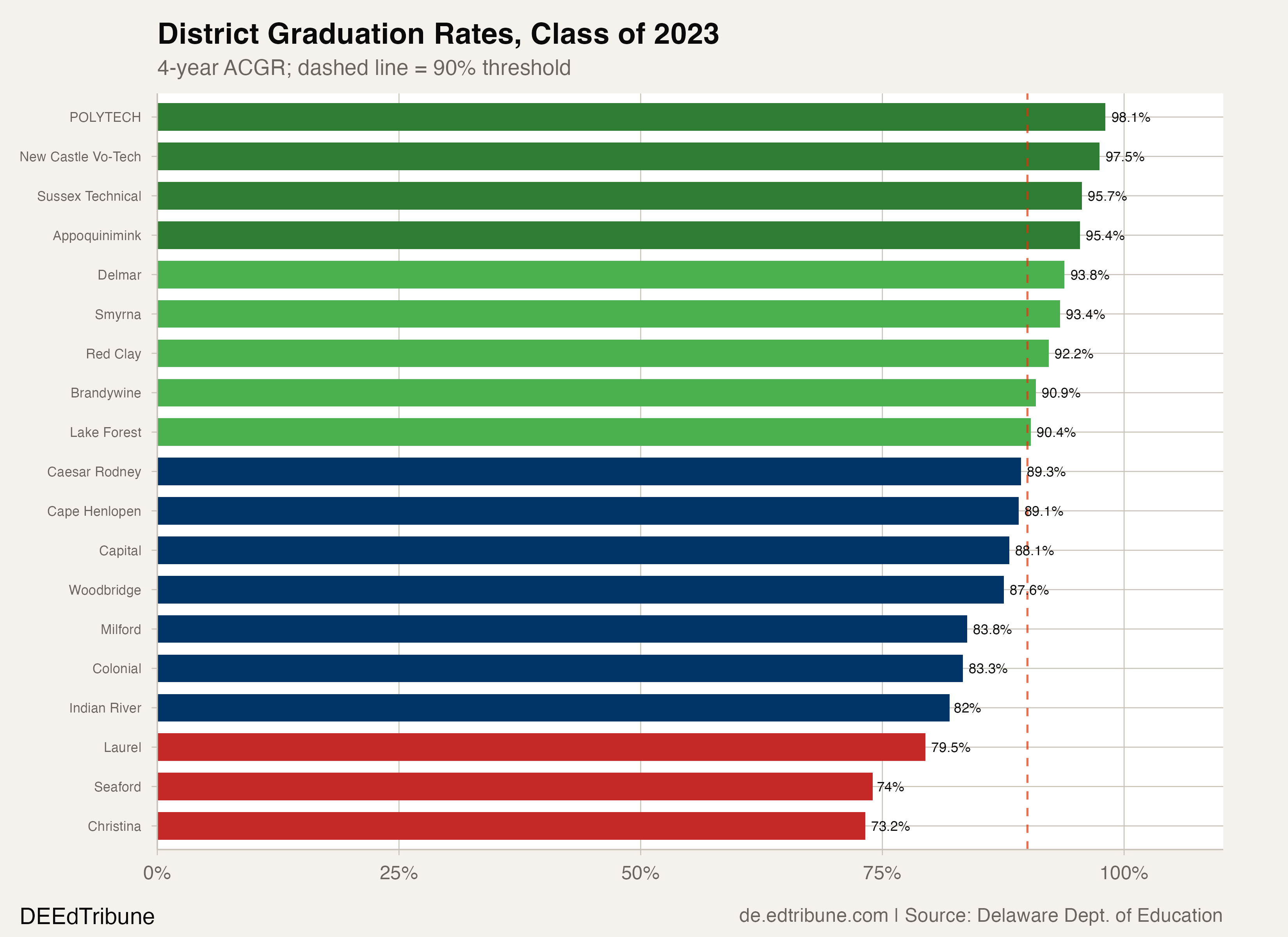
The three vocational-technical districts, POLYTECH (98.1%), New Castle County Vo-Tech (97.5%), and Sussex Technical (95.7%), occupy the top three positions, though their selective admissions and specialized programming make direct comparison with traditional districts unreliable.
Among traditional districts, Appoquinimink↗ET leads at 95.4%, followed by Delmar↗ET (93.8%) and Smyrna↗ET (93.4%). All three sit in central or southern Delaware, away from Wilmington's boundary complexities.
The bottom of the distribution is where the 90% target faces its stiffest resistance. Christina at 73.2% and Seaford at 74.0% would each need to gain 16 to 17 points to reach 90%. Christina has improved just 1.8 points since 2015, a pace that would take decades. Seaford has moved in the wrong direction, dropping 5.8 points over the same period.
The Wilmington gap
The four districts that share responsibility for Wilmington's students tell divergent stories. Red Clay↗ET graduates 92.2%, firmly above 90%. Brandywine↗ET crossed 90% for the first time, reaching 90.9%. Colonial↗ET improved substantially, from 77.6% to 83.3%, a 5.8-point gain, but remains well below the threshold. And Christina, which serves the largest share of the city's low-income students, sits nearly 20 points behind Red Clay.
That disparity is at the center of the Redding Consortium for Educational Equity's redistricting deliberations. The consortium, a state task force created in 2019 to address inequities rooted in Delaware's 1981 desegregation-era district boundaries, voted in late 2025 to study merging some or all of Wilmington's districts into a unified system. One option under consideration would consolidate Brandywine, Christina, Colonial, and Red Clay into a single district serving more than 20,000 students.
Whether consolidation would raise Christina's graduation rate is an open question. Christina's challenges, including a 23.8% chronic absenteeism rate and the lowest proficiency scores among the four Wilmington districts, reflect concentrated poverty and decades of boundary decisions that sorted students by neighborhood income. Merging district lines does not automatically merge outcomes. But it would make the 20-point gap between Red Clay and Christina a problem that one superintendent, one school board, and one budget would have to own.
Where the gains came from, and where they did not
The equity story in Delaware's graduation data is more complicated than the topline suggests.
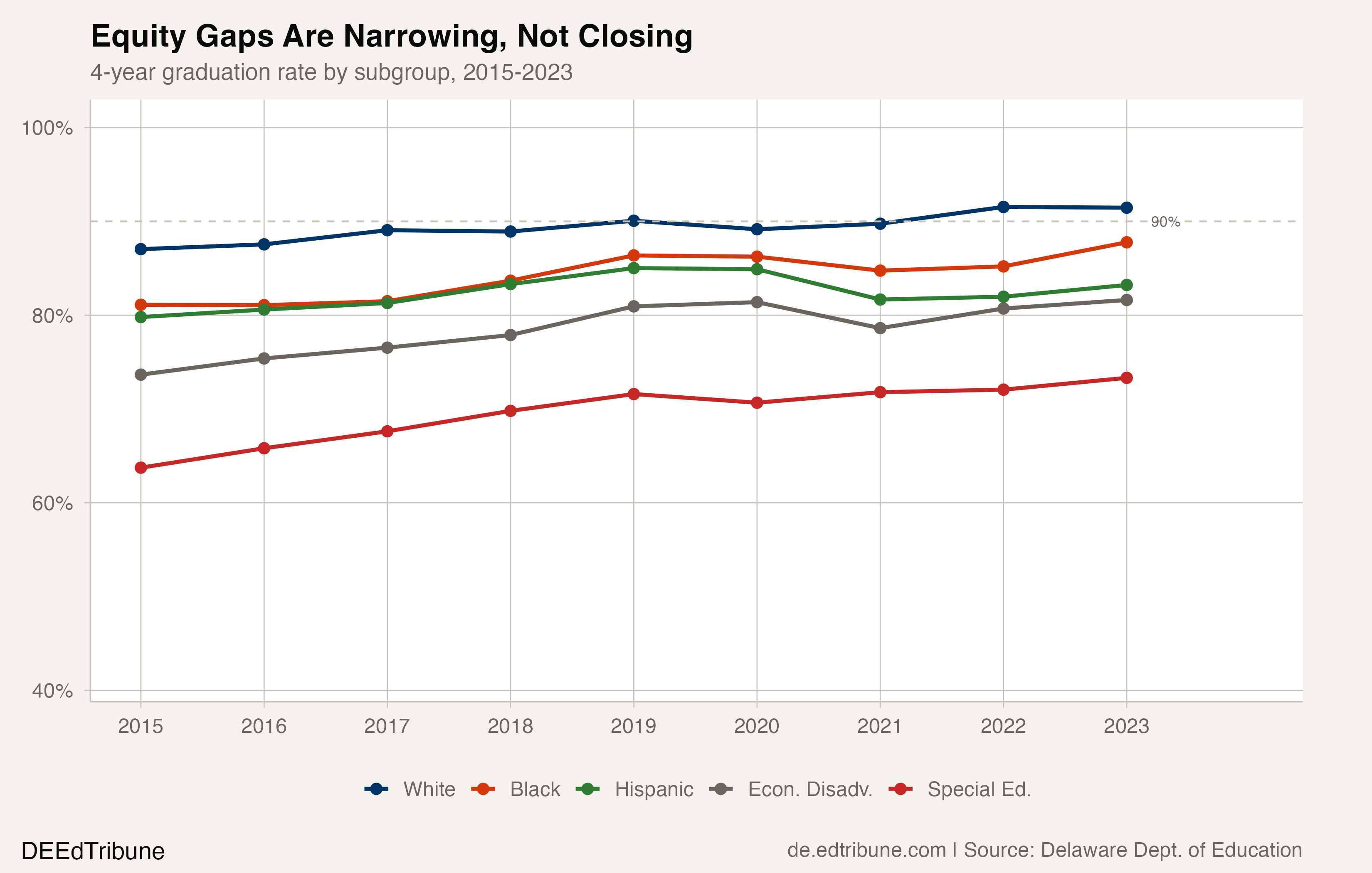
Black students made the largest gains of any racial group, climbing 6.7 points from 81.1% to 87.8%. The white-Black graduation gap narrowed from 5.9 points to 3.7 points, the smallest in the dataset. That is a meaningful improvement, and it puts Black students within a point of the statewide average.
Economically disadvantaged students gained 8.0 points, from 73.7% to 81.6%, and students with disabilities gained 9.6 points, from 63.7% to 73.3%. In both cases, the gap with white students narrowed by several points.
But two groups have not kept pace. Hispanic students gained just 3.4 points over nine years, less than the statewide average, and the white-Hispanic gap actually widened from 7.2 to 8.2 points. English learners improved 4.9 points to 73.5%, but remain nearly 18 points below white students, a gap that has barely moved since 2015.
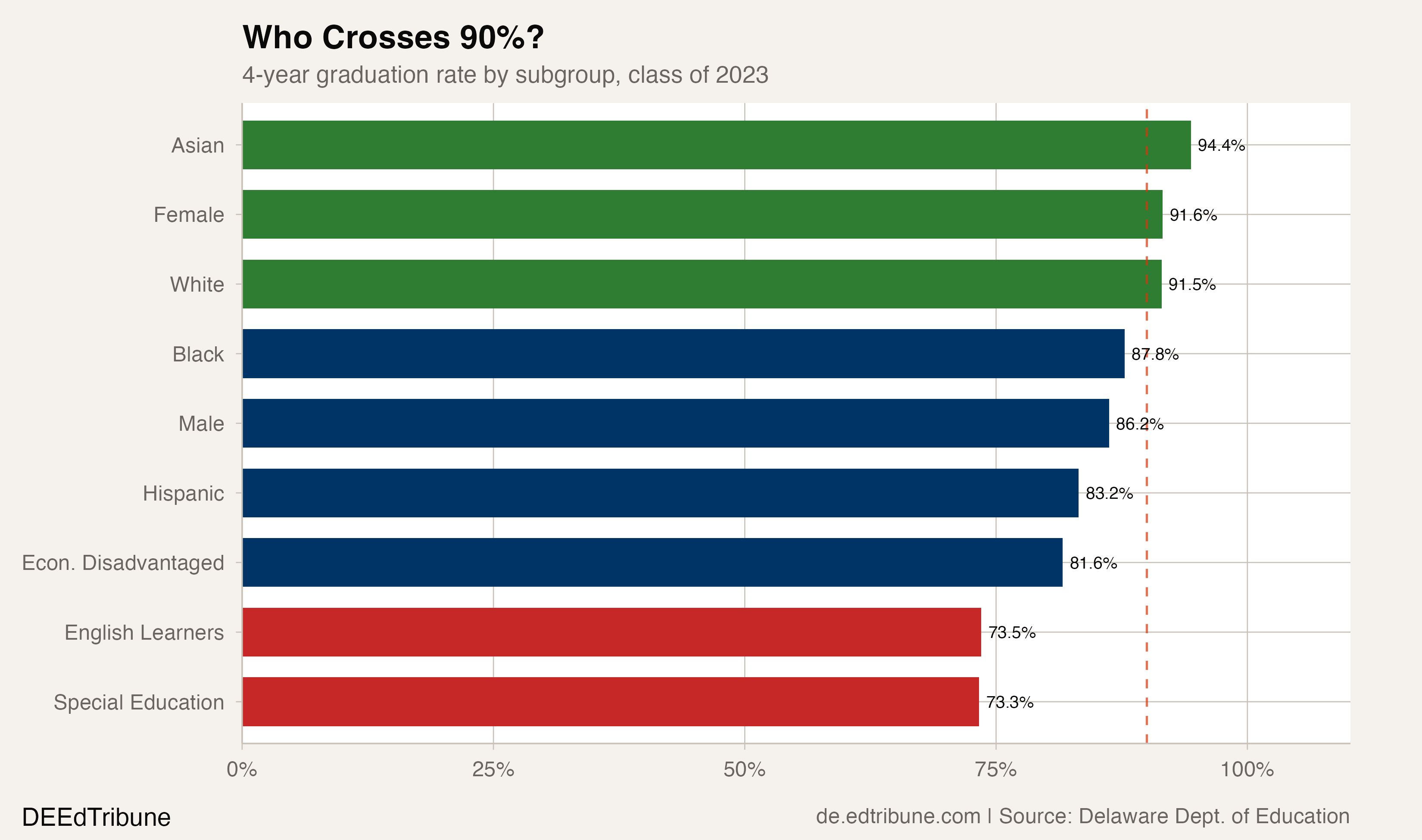
Three subgroups have already crossed 90%: Asian students (94.4%), female students (91.6%), and white students (91.5%). Three others are below 75%: students with disabilities (73.3%), English learners (73.5%), and students experiencing homelessness (72.8%). The gap between the top and bottom of that distribution is nearly 22 points.
The gender gap is also persistent. Female students have graduated above 90% since 2019. Male students have never crossed 87%, reaching a high of 86.2% in 2023, a 5.3-point gap that has held roughly steady for nine years.
What 91% would require
Secretary of Education Cindy Marten's strategic plan frames the 91% target alongside other goals: raising third-grade reading proficiency from 38% to 53%, reducing chronic absenteeism from 15% to 13%, and expanding early education access from 25% to 40% of eligible families.
"If only 38% of our third-graders are reading at grade level and chronic absenteeism is at 15%, we have to get past admiring the problem and just naming it." -- Secretary Cindy Marten, WDEL, March 2026
The absenteeism connection matters because it is the most direct operational lever for graduation rates. A 2024 truancy needs assessment by the National Center for School Engagement found that 23% of Delaware students were chronically absent in 2022-23, up from pre-pandemic levels of about 15%. Students who miss more than 10% of school days are substantially less likely to graduate on time. The districts with the lowest graduation rates, Christina, Seaford, and Colonial, also report some of the state's highest absenteeism.
At its post-COVID pace of about 0.9 points per year, Delaware could cross 90% with the class of 2025 and reach 91% a year or two after that. But this projection assumes the rate keeps climbing at a speed it has sustained only in the two post-COVID recovery years, not across the full nine-year trend. The longer average suggests 91% would arrive closer to 2029 or 2030.
The harder math involves Christina. If Christina's rate stays near 73%, it pulls the state average down by roughly half a point. For Delaware to reach 91% statewide, either Christina must dramatically accelerate, which nothing in its nine-year trajectory suggests is imminent, or every other district must overperform to compensate.
Lake Forest↗ET offers one model for what rapid improvement looks like. The district gained 8.2 points in nine years, climbing from 82.2% to 90.4%, and has stayed above 90% for two consecutive years. But Lake Forest is a small, rural district in Kent County. Its pathway, whatever it was, may not translate to the urban poverty and fragmented governance that define Wilmington's schools.
The next graduation data release, covering the class of 2024, will show whether Delaware's record is a launching pad or another false summit. The state has been within two points of 90% before. It has never gotten through.
Detailed code that reproduces the analysis and figures in this article is available exclusively to EdTribune subscribers.
Discussion
Sign in to join the discussion.
Loading comments...