In a state where most traditional school districts are shrinking, Appoquinimink↗ET keeps building schools. The southern New Castle County district added 3,867 students over the past decade, a 39.9% surge that lifted it from Delaware's sixth-largest district to its third-largest. In April 2024, voters approved a $289.8 million referendum to construct two more schools on a new Summit Campus. The district's own materials framed the need bluntly: the buildings are for students already enrolled, not projections.
But the 13,558 students in Appoquinimink's seats in 2024-25 looked nothing like the 9,691 who sat there in 2014-15. White enrollment dropped from 64.4% to 44.9% of the student body, a 19.5-percentage-point decline, even as the raw count of white students barely changed. Appoquinimink did not diversify by losing white families. It diversified by adding everyone else.
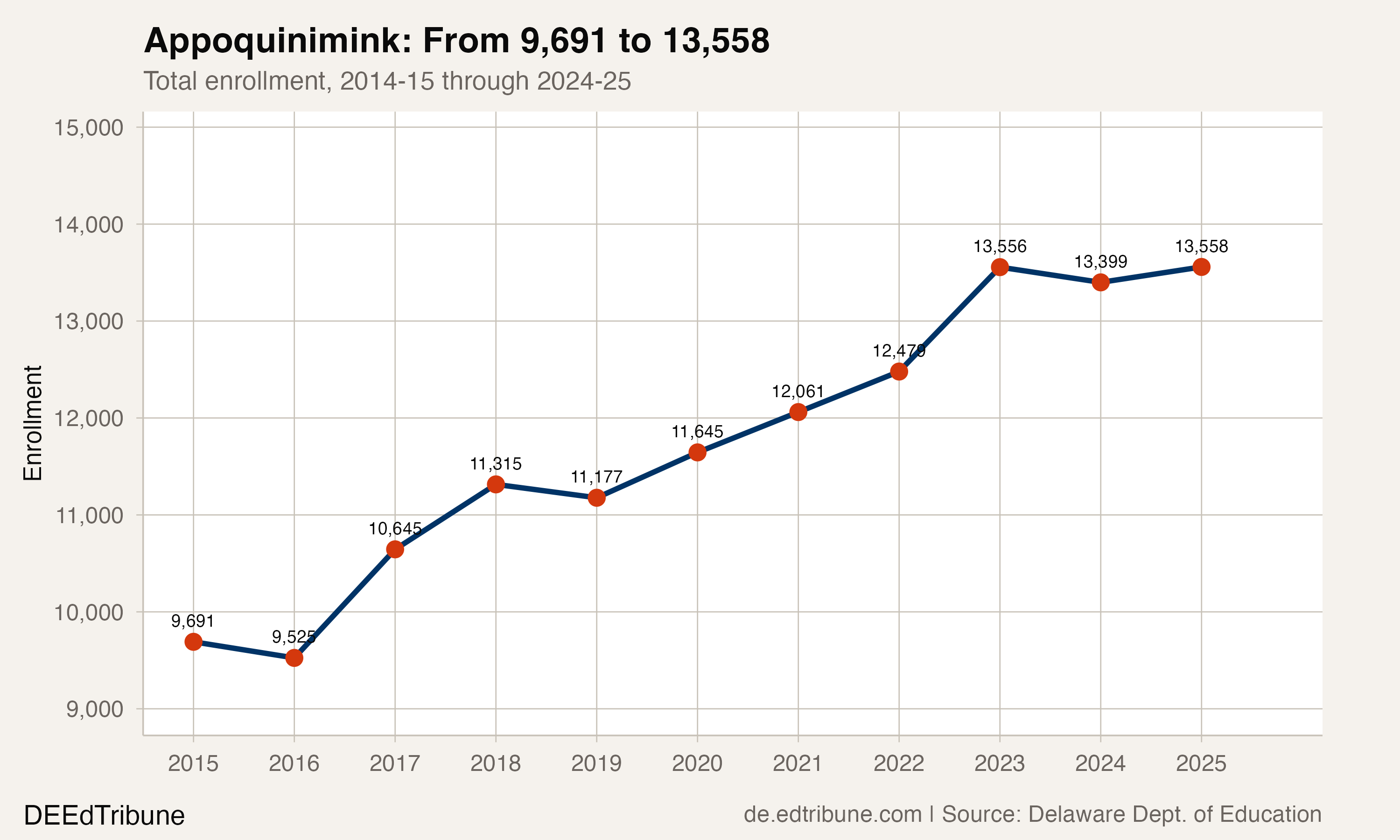
A district that rose three ranks
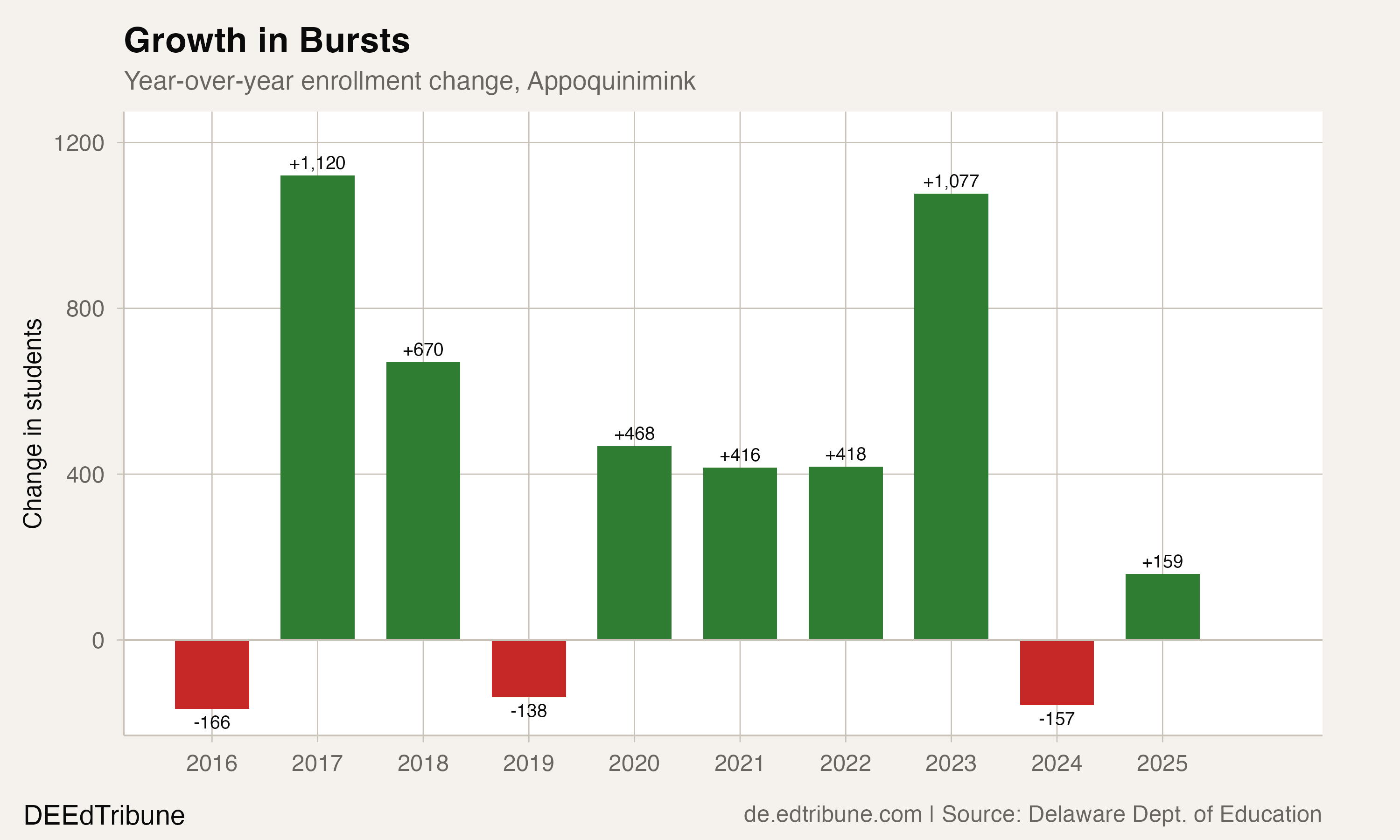
Appoquinimink's growth has been uneven but relentless. Two years stand out: 2016-17 (+1,120 students) and 2022-23 (+1,077), each adding roughly a full elementary school's worth of students in a single year. Between those surges, the district sustained a baseline growth rate of roughly 400 to 470 students per year from 2019-20 through 2021-22.
The result is a district that captured a third of Delaware's entire enrollment growth over the decade. The state added 11,546 students from 2014-15 to 2024-25, an 8.3% increase. Appoquinimink alone accounted for 3,867 of those, or 33.5%. Its share of statewide enrollment rose from 7.0% to 9.0%.
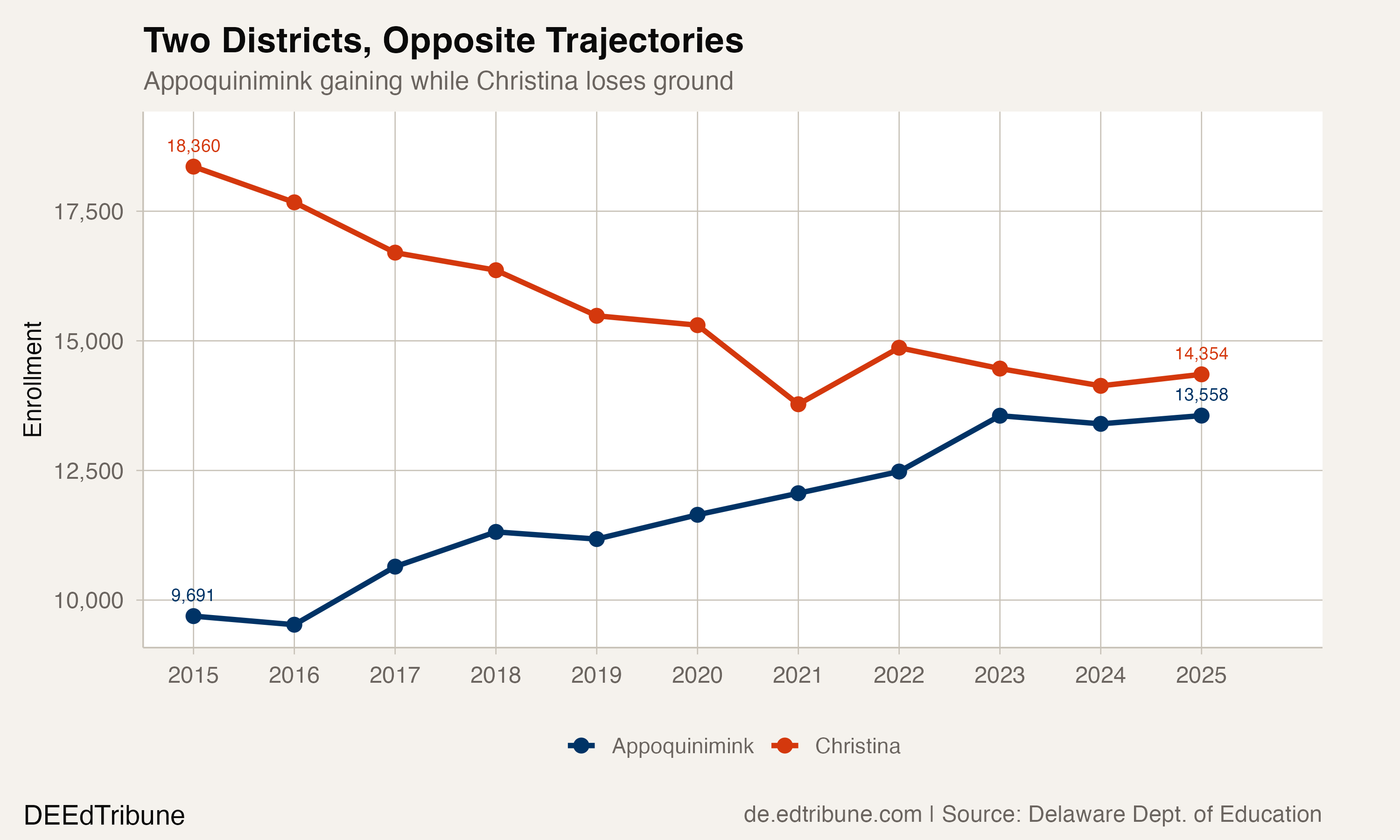
That growth came at the expense of its northern neighbors' market share, if not their students directly. Christina↗ET, which enrolled 18,360 students in 2014-15, fell to 14,354 by 2024-25, a 21.8% decline. The gap between the two districts collapsed from 8,669 students to just 796. Red Clay↗ET, Colonial↗ET, and Brandywine↗ET all lost ground too: those four northern New Castle County districts shed a combined 6,476 students over the same period.
The Middletown corridor's pull
The mechanism is residential development. Middletown's population increased more than 550% between 1990 and 2023, driven by out-of-state families from New Jersey, New York, and Pennsylvania drawn by lower taxes and newer housing stock. The Middletown-Odessa-Townsend area is projected to nearly double its population again over the next two decades, according to New Castle County projections.
That growth pipeline feeds directly into Appoquinimink. Unlike Delaware's open-enrollment choice system, where students can apply into other districts, Appoquinimink's growth is overwhelmingly residential. The district has noted that demand for choice-in transfers from other districts exceeds available seats.
Christina's decline has a different, more complex origin. The district's boundaries stretch from suburban Newark to a noncontiguous section of downtown Wilmington, a legacy of 1980s desegregation orders. Approximately 1,600 city students attend Christina schools despite living outside the district's primary service area, and the Redding Consortium is now studying proposals that would remove Christina's footprint from Wilmington entirely. School choice compounds the loss: Newark Charter School↗ET alone drew 3,115 students in 2024-25, many from Christina's suburban attendance zones.
A new demographic profile
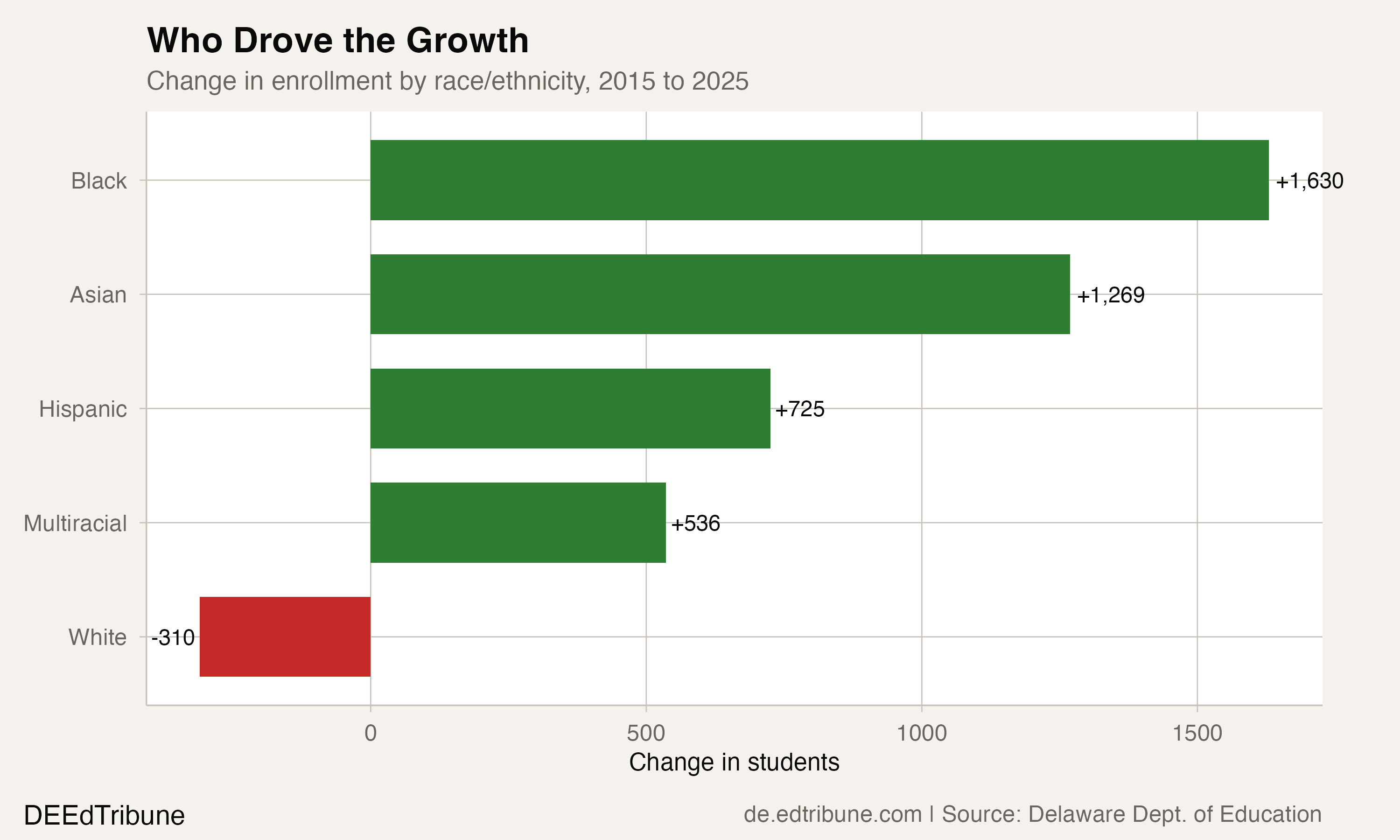
The families moving to Middletown are more diverse than the community they joined. Black enrollment in Appoquinimink grew by 1,675 students, from 2,641 to 4,316, the largest absolute gain of any racial group. Asian enrollment more than quadrupled, rising from 375 to 1,698 students, a 352.8% increase that pushed the Asian share from 3.9% to 12.5%. Hispanic enrollment more than doubled, from 595 to 1,396. Students identifying as multiracial grew from 154 to 746.
White enrollment, meanwhile, dropped modestly in absolute terms, from 6,244 to 6,090, a loss of just 154 students. The 19.5-percentage-point decline in white share, from 64.4% to 44.9%, is almost entirely a dilution effect: white families did not leave, but they were vastly outnumbered by arriving families of color.
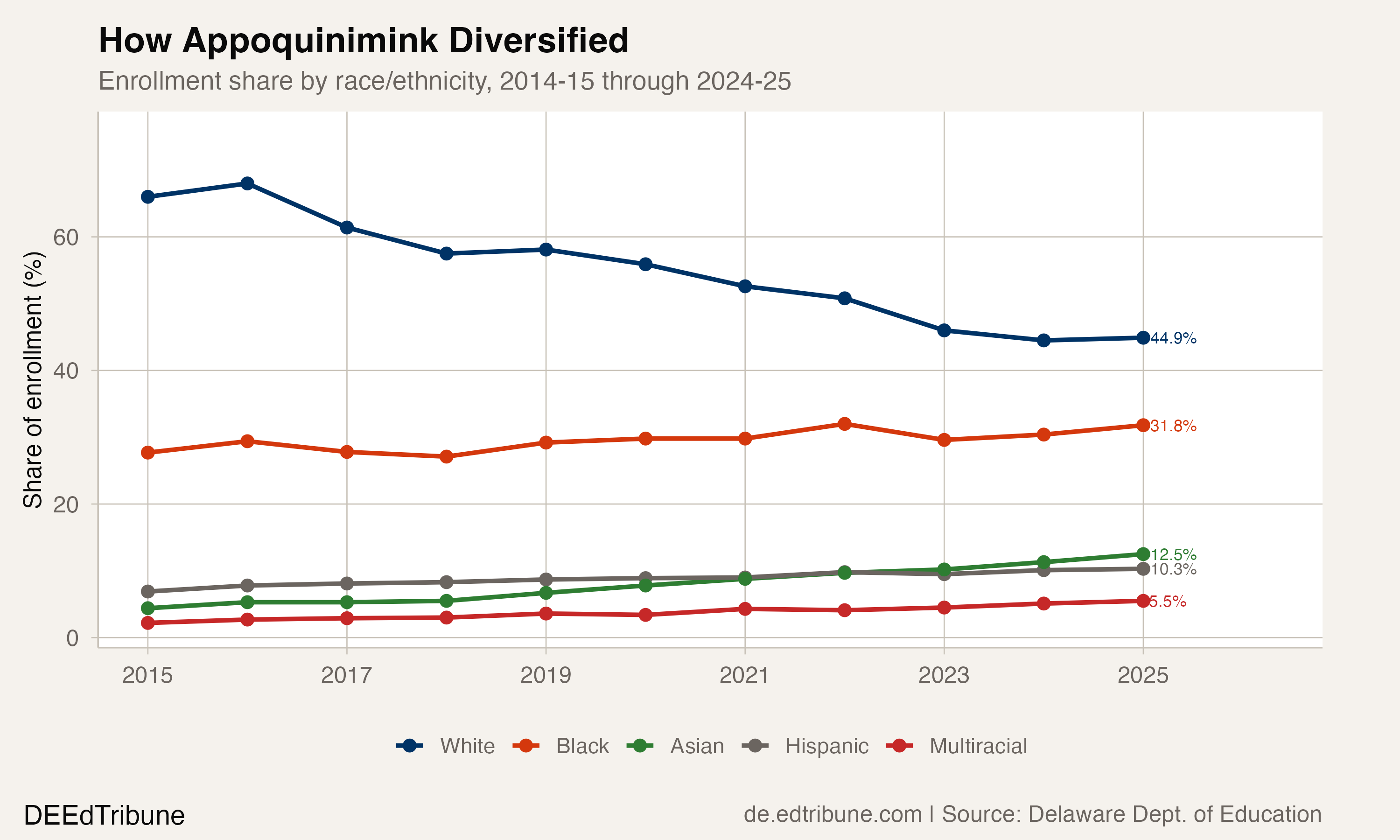
Appoquinimink crossed the majority-minority threshold in 2022-23, when white enrollment fell below 50% for the first time. By 2024-25, no single racial group held a majority: white students made up 44.9%, Black students 31.8%, Asian students 12.5%, Hispanic students 10.3%, and multiracial students 5.5%.
The pattern is consistent with reporting on the Middletown corridor's demographic shift. Spotlight Delaware reported that much of the area's growth comes from out-of-state migration:
"The population has increased by over 550% in 33 years, according to U.S. Census Bureau data ranging from 1990 to 2023."
Long-time residents noted the speed of the transformation. The same reporting quoted a resident who recalled Middletown being noticeably homogeneous when she arrived in 2013.
Building to keep up
Growth at this pace creates infrastructure pressure that most Delaware districts do not face. Appoquinimink currently operates four middle schools and three high schools. The April 2024 referendum passed on its second attempt with 56.9% support, authorizing $289.8 million in capital spending, of which the state covers 77%. Two connected schools on the Summit Campus, a new middle school and a new high school, are expected to open in August 2029. A new elementary school on Green Giant Road is also planned.
Superintendent Matt Burrows has pointed to the connected-campus model as a way to build community across grade levels. At the groundbreaking, he noted that on the existing Fairview campus, "kids can start in kindergarten, they go all the way through high school, and just the bonds that that creates."
The growth also shows up in service demands. English learner enrollment quadrupled from 169 to 681 students, pushing the EL share from 1.7% to 5.0%. That remains well below the state average of 12.8%, but the rate of change is steep. Separately, students receiving special education services grew from 1,332 to 2,919, reaching 21.5% of enrollment, roughly in line with the statewide rate of 22.0%.
Not the only corridor booming
Appoquinimink is Delaware's largest growth story, but not its only one. Cape Henlopen↗ET, in Sussex County, added 2,217 students over the same period, a 45.0% gain that makes it the state's fastest-growing district by percentage among those with at least 500 students. Indian River↗ET added 1,787 students (+17.7%). Smyrna↗ET gained 563 (+10.1%). The growth belt runs south and east, tracking Delaware's residential construction boom. Sussex County has led the state in new development, with large-scale master-planned communities reshaping the landscape.
The open question is whether Appoquinimink can sustain this trajectory. Middletown itself is approaching build-out, with little open land remaining within town limits. Future growth depends on surrounding areas, the Bayberry and Whitehall master-planned communities, and broader southern New Castle County development. If county population projections hold, the 2029 opening of Summit Campus may arrive just in time.
Detailed code that reproduces the analysis and figures in this article is available exclusively to EdTribune subscribers.
Discussion
Sign in to join the discussion.
Loading comments...