Most Delaware superintendents spend their winters worrying about enrollment loss. In Cape Henlopen↗ET, the problem is the opposite: where to put everyone.
The Sussex County district grew from 4,928 students in 2014-15 to 7,145 in 2024-25, a 45.0% increase that makes it the fastest-growing traditional school district in Delaware by a wide margin. The next-closest competitor, Appoquinimink↗ET, grew 39.9%. The statewide average was 8.3%. Cape Henlopen's growth rate ran 5.4 times the state's.
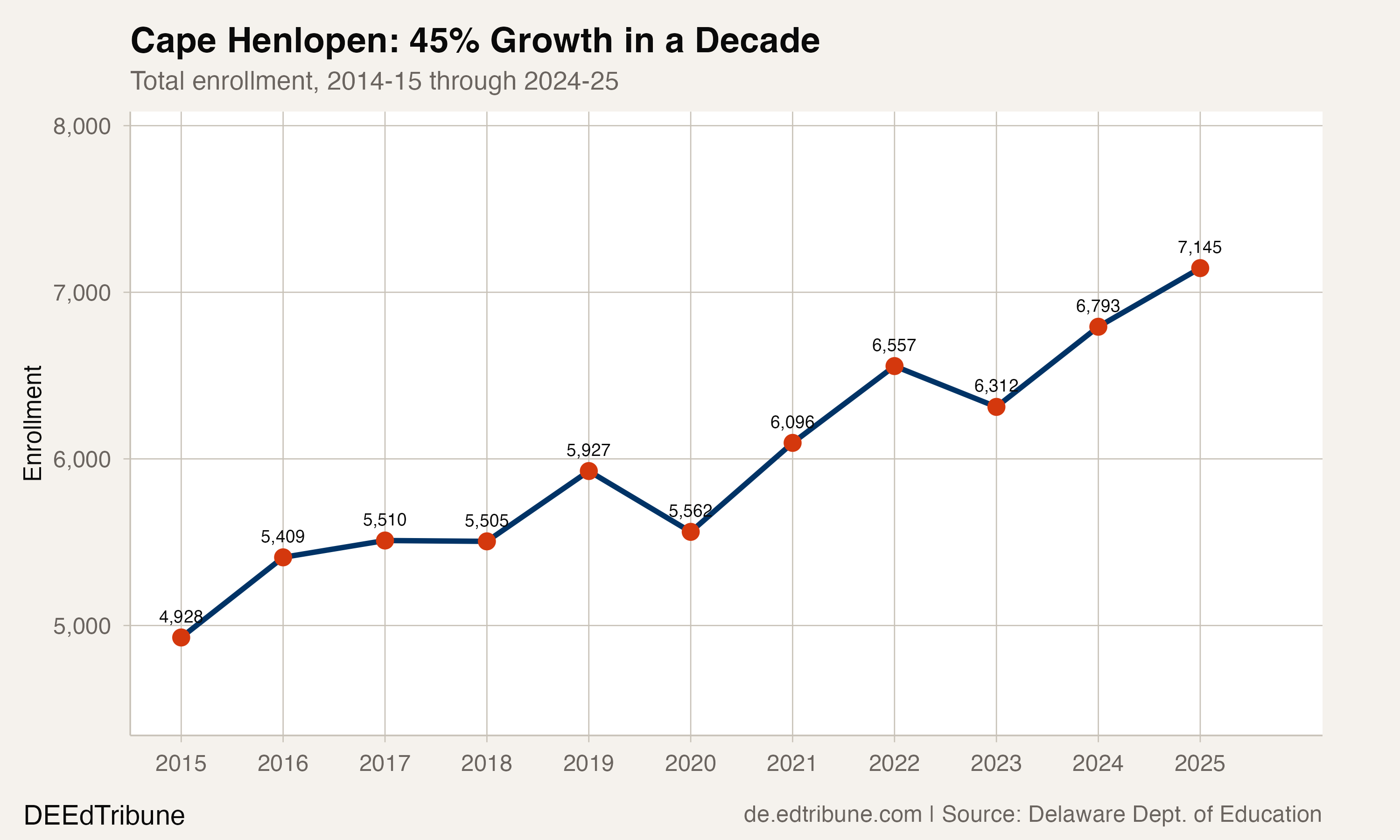
A District Built on a Building Boom
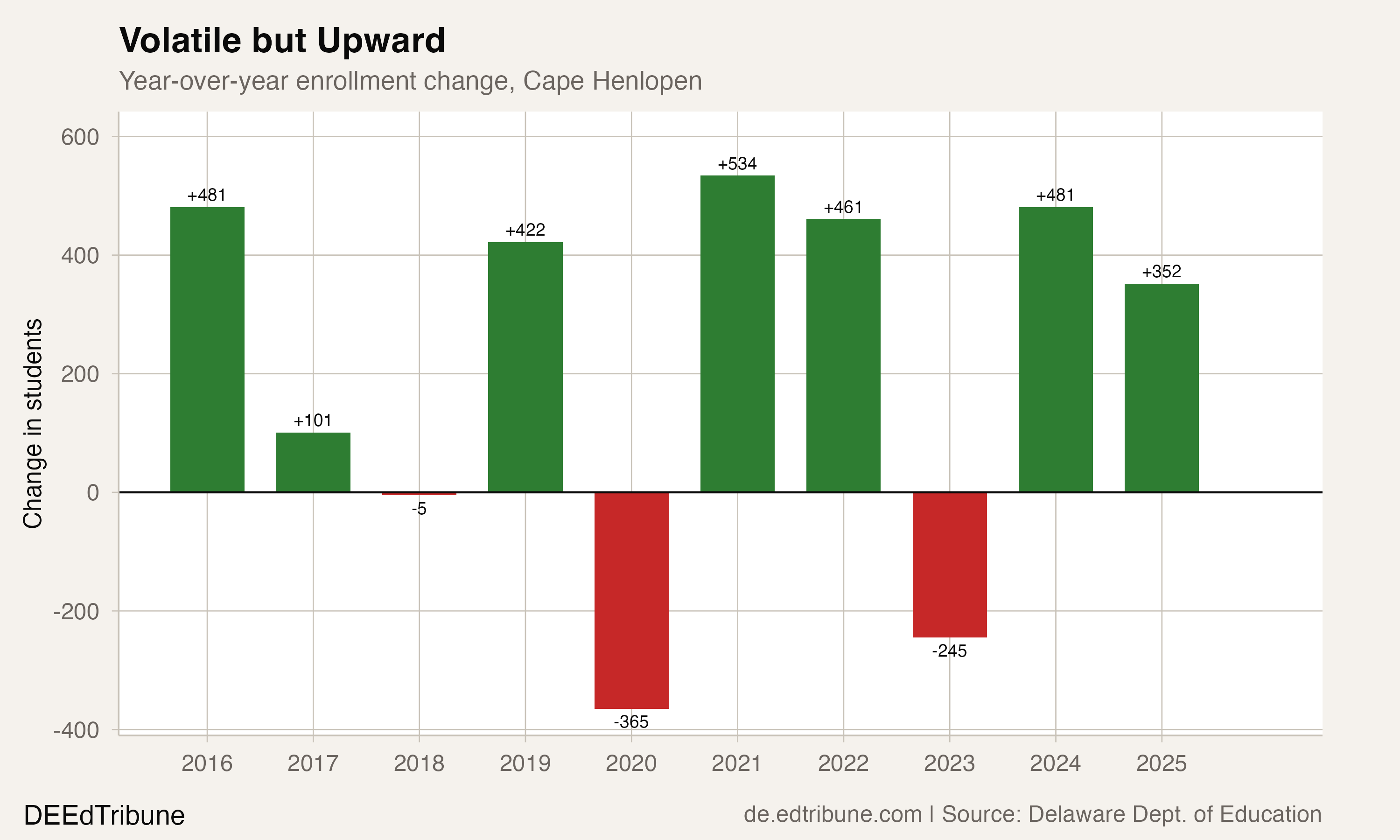
The growth is not subtle, but it is uneven. Cape Henlopen's year-over-year enrollment swings between gain and loss with little warning: +481 in 2016, flat in 2018, -365 in 2020, +534 in 2021. Seven of the past 10 years produced gains, and the gains consistently outweigh the dips. But the volatility makes capacity planning difficult. A district that adds 534 students one year and loses 245 two years later cannot size a building for the average.
The driver is residential construction. Sussex County's population surged 29.3% between 2010 and 2022, more than double the state's growth rate and four times the national average. More than 13,000 homes were built in five years, and 32,000 new residents arrived, 20,000 of them during the COVID-era remote work migration of 2021-2022. The county's median age of 51.4 years, far above New Castle County's 39.2, reflects the retiree-heavy character of the beach corridor. But retirees bring adult children, and adult children bring students.
Delaware's top state planner, David Edgell, told Sussex County leaders in 2025 that the pattern was unsustainable:
"Sussex County is a large geographic area and there are insufficient funds to cover you if we are going to have development everywhere."
The district is already feeling the squeeze. Cape Henlopen High School and Mariner Middle School were at 105% and 104% of capacity respectively for 2024-25, with the district overall at 92%. Seven teachers at the high school work from carts because there are no permanent classrooms to assign them. Some classes reach 35 students.
Not Just Cape Henlopen
Cape Henlopen's growth is the most pronounced, but the demographic transformation extends across Sussex County. Every major district in the county saw its Hispanic enrollment share rise substantially over the past decade.
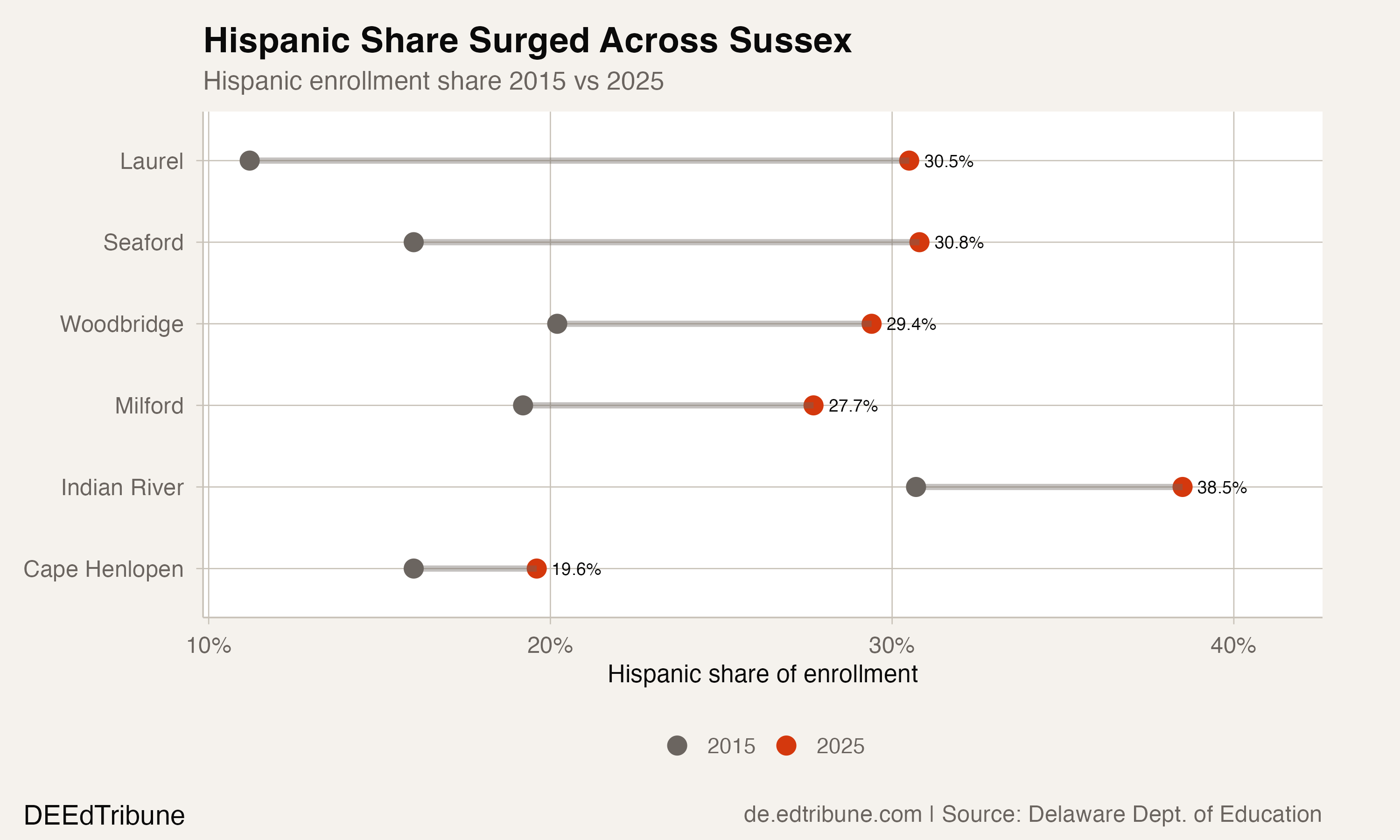
Indian River↗ET, the county's largest district, saw its Hispanic share climb from 29.6% to 37.8%. Laurel↗ET saw its Hispanic share jump from 10.6% to 29.8%, a 19.2 percentage-point swing. Seaford↗ET went from 15.3% to 30.1%. Cape Henlopen's own shift, from 15.1% to 19.4%, is comparatively modest in percentage-point terms, though it represents 644 additional Hispanic students, an 86.6% increase in absolute count.
The growth in multilingual learners tracks this demographic shift. Cape Henlopen's English learner enrollment more than doubled, from 323 to 737 students, a 128.2% increase that ran nearly twice the statewide rate of 69.5%. Sussex County as a whole saw 84% growth in multilingual learner students from 2016 to 2022, according to the Rodel Foundation.
A Composition Paradox
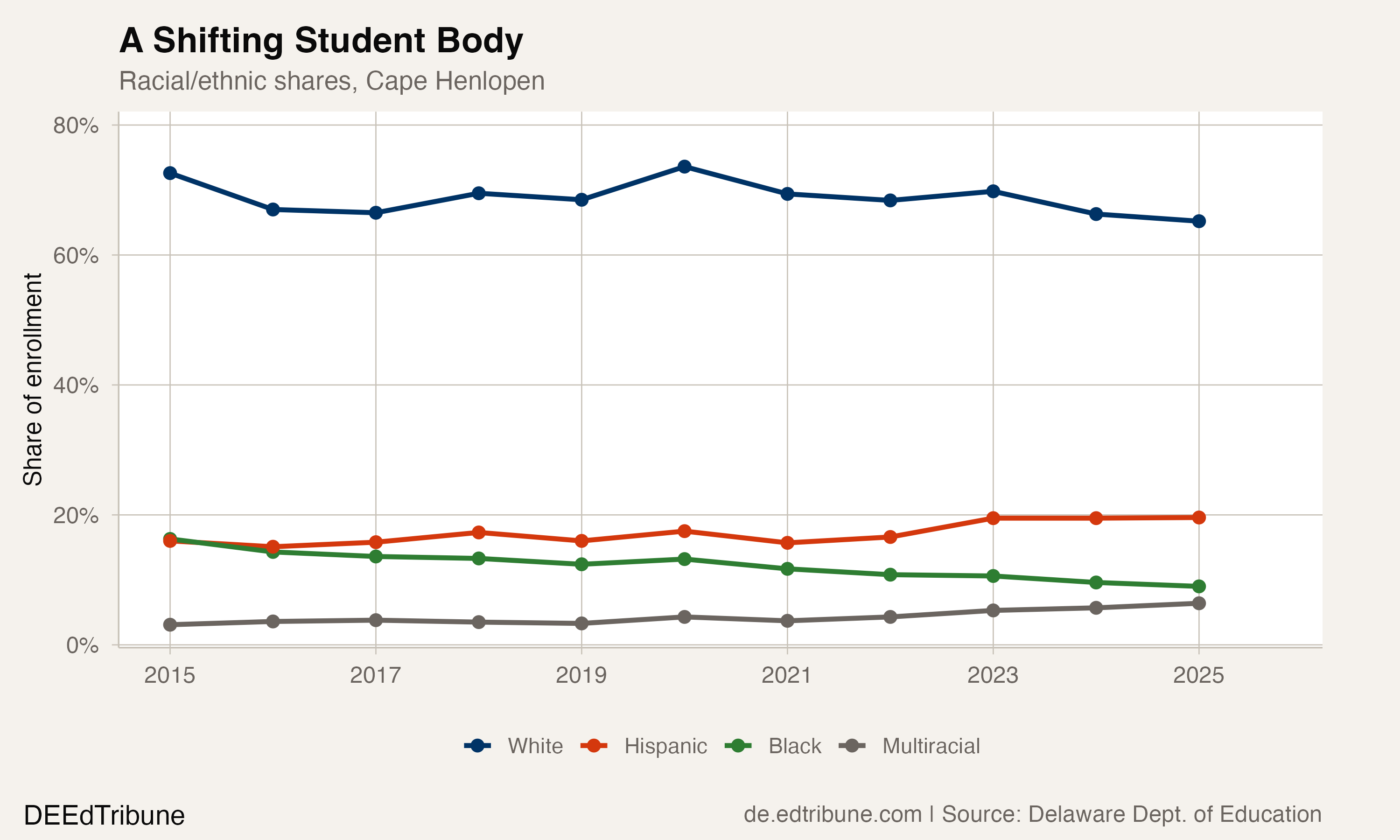
Cape Henlopen's racial composition tells a counterintuitive story. White enrollment actually grew in absolute terms, adding 1,175 students to reach 4,639. But because the district grew so fast overall, the white share still fell 5.4 percentage points, from 70.3% to 64.9%. Black enrollment declined both in absolute count (760 to 539) and share (15.4% to 7.5%). Multiracial enrollment grew nearly fourfold, from 91 to 345 students.
The district's economically disadvantaged share dropped sharply, from 42.4% to 21.1%, a 21.3 percentage-point decline. Part of this reflects the composition of new arrivals: families moving to the beach corridor for remote work or from higher-cost metro areas tend to have higher household incomes. But changes in economic disadvantage classification methodology also affect this figure, and the drop is too steep to attribute entirely to income demographics without accounting for possible reporting shifts.
Separately, Cape Henlopen's special education enrollment grew from 987 to 1,654 students, a 67.6% increase. The share rose from 20.0% to 23.1%, meaning nearly one in four Cape Henlopen students now receives special education services.
How the District Is Adapting
Cape Henlopen has been building as fast as it can. All five elementary schools have been built or renovated within the past eight years, with Lewes Elementary opening in 2022 and Frederick D. Thomas Middle School opening in 2024. The district sought voter approval in 2024 for additional capital spending, including relocating the district office from Cape Henlopen High School to free up space for classroom expansion. The first referendum failed in March 2024; a trimmed version also failed in May, with 53% of voters rejecting the request.
The cultural shift has prompted institutional adaptation, too. Cape Henlopen High School launched Spanish-language morning announcements in 2023, and the school's Latin American Student Organization grew from roughly 25 members after the pandemic to 197 in 2024.
"We just want to make everyone feel included." Alexandria Espinoza, Cape Henlopen broadcast anchor and LASO secretary. Source: Spotlight Delaware, April 2024
The Growth Question That Won't Resolve
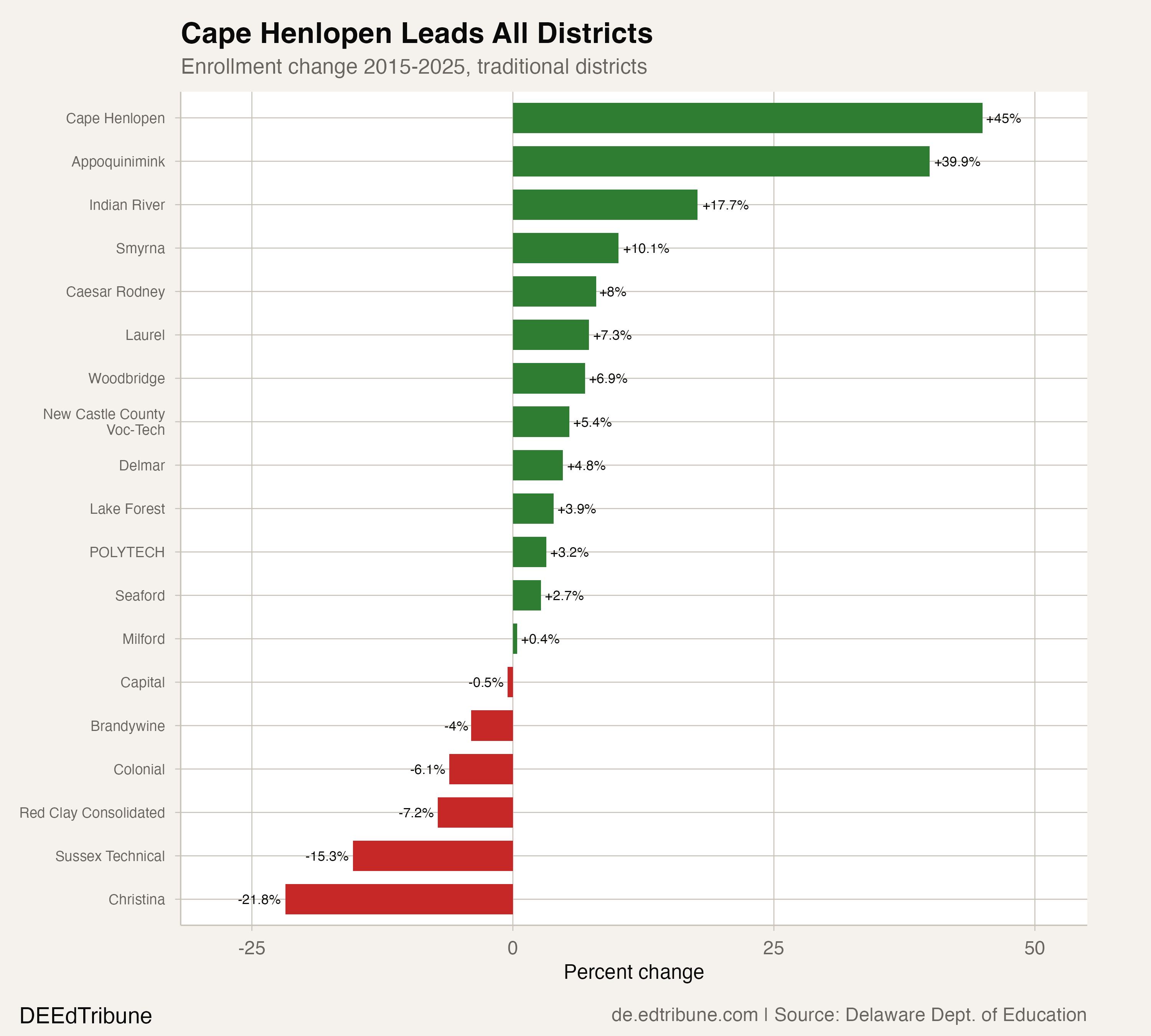
Cape Henlopen sits in a peculiar position among Delaware's 19 traditional districts. The northern districts anchored by Wilmington, Christina↗ET, Red Clay↗ET, Colonial↗ET, and Brandywine↗ET, collectively lost more than 6,400 students over the decade. The southern districts, led by Cape Henlopen and Indian River (+17.7%), absorbed growth. The Middletown corridor district of Appoquinimink grew almost as fast in percentage terms and added even more students in absolute count: 3,867 versus Cape Henlopen's 2,217.
Population studies cited by the district predict enrollment will continue rising significantly over the next decade. Governor Matt Meyer signed an executive order in January 2026 launching a seven-month coordinated planning process between the state and Sussex County, an acknowledgment that the county's growth has outrun its infrastructure. Three Sussex County council members lost their seats in a recent election cycle driven by concerns about developer-friendly policies.
The question for Cape Henlopen is whether 45% growth in a decade is the new normal or the beginning of a plateau. The district's high school is already over capacity. Its newest schools are already filling. If Sussex County's housing pipeline delivers the 14,000 additional homes in planning, the enrollment pressure will intensify before any slowdown takes hold.
Detailed code that reproduces the analysis and figures in this article is available exclusively to EdTribune subscribers.
Discussion
Sign in to join the discussion.
Loading comments...