The four districts that share responsibility for educating Wilmington's children lost 6,476 students over the past decade, an 11.0% decline that left them serving 52,641 in 2024-25, down from 59,117. During that same span, the rest of Delaware boomed: Appoquinimink↗ET gained 3,867, Cape Henlopen↗ET gained 2,217, and the charter sector nearly doubled. The state as a whole hit an all-time enrollment high.
The Redding Consortium for Educational Equity voted 19-2 in December 2025 to study merging those four districts into one. The question the enrollment data raises is whether a merger would fix a structural problem or merely consolidate four shrinking systems into a single larger one.
The gap between two Delawares
The divergence is not subtle. Indexed to 2014-15, the rest of Delaware's districts grew to 120.3% of their starting enrollment by 2024-25. The Wilmington four fell to 89.0%. That 31-point gap represents more than just headcount: it represents a shift in where Delaware's students are, and where its per-pupil funding flows.
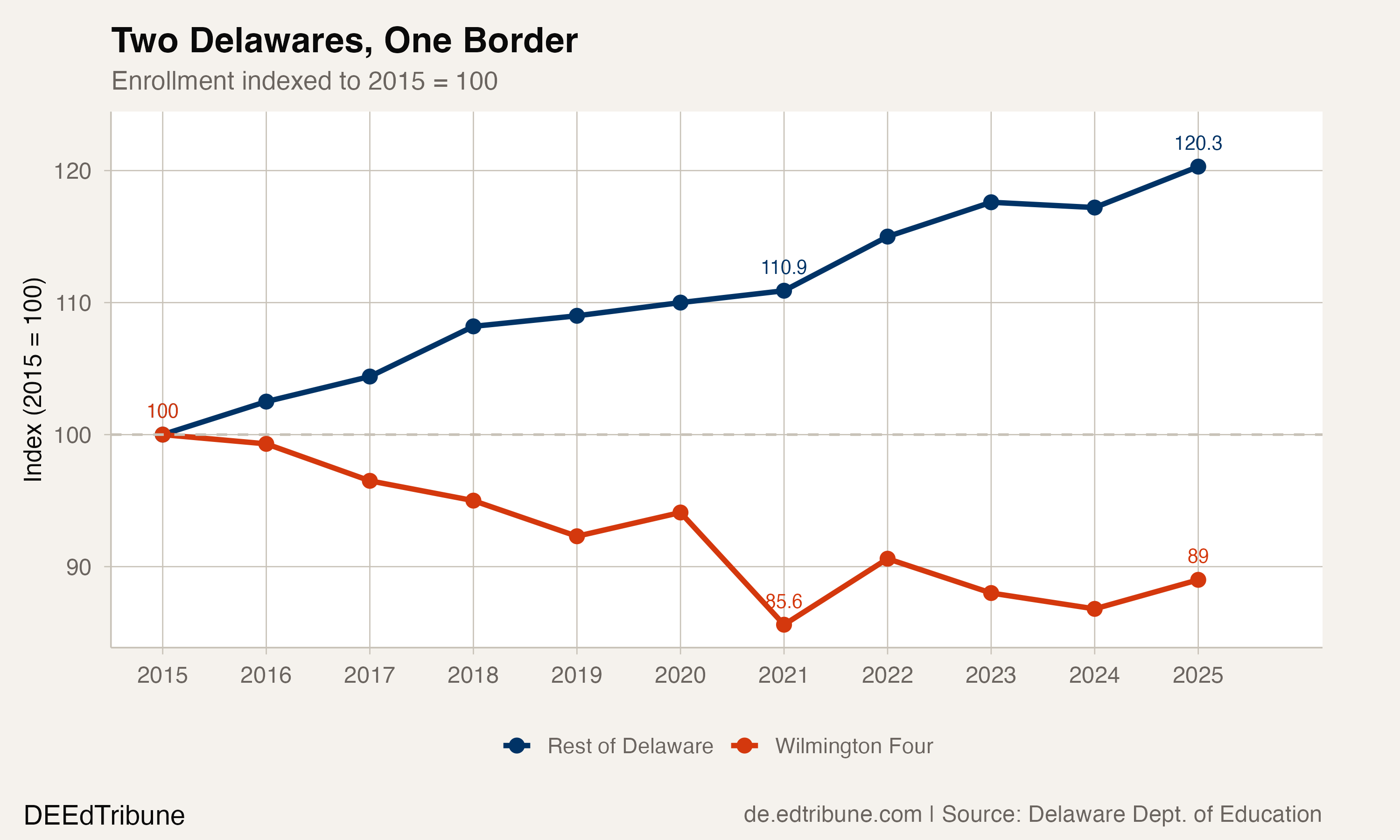
The four districts' share of statewide enrollment dropped from 42.5% to 35.0% over the decade. In a state with a unit-based funding formula that dates to the 1940s, fewer students means fewer units, fewer teachers, and a structural mismatch between fixed facility costs and declining revenue.
Christina's outsized losses
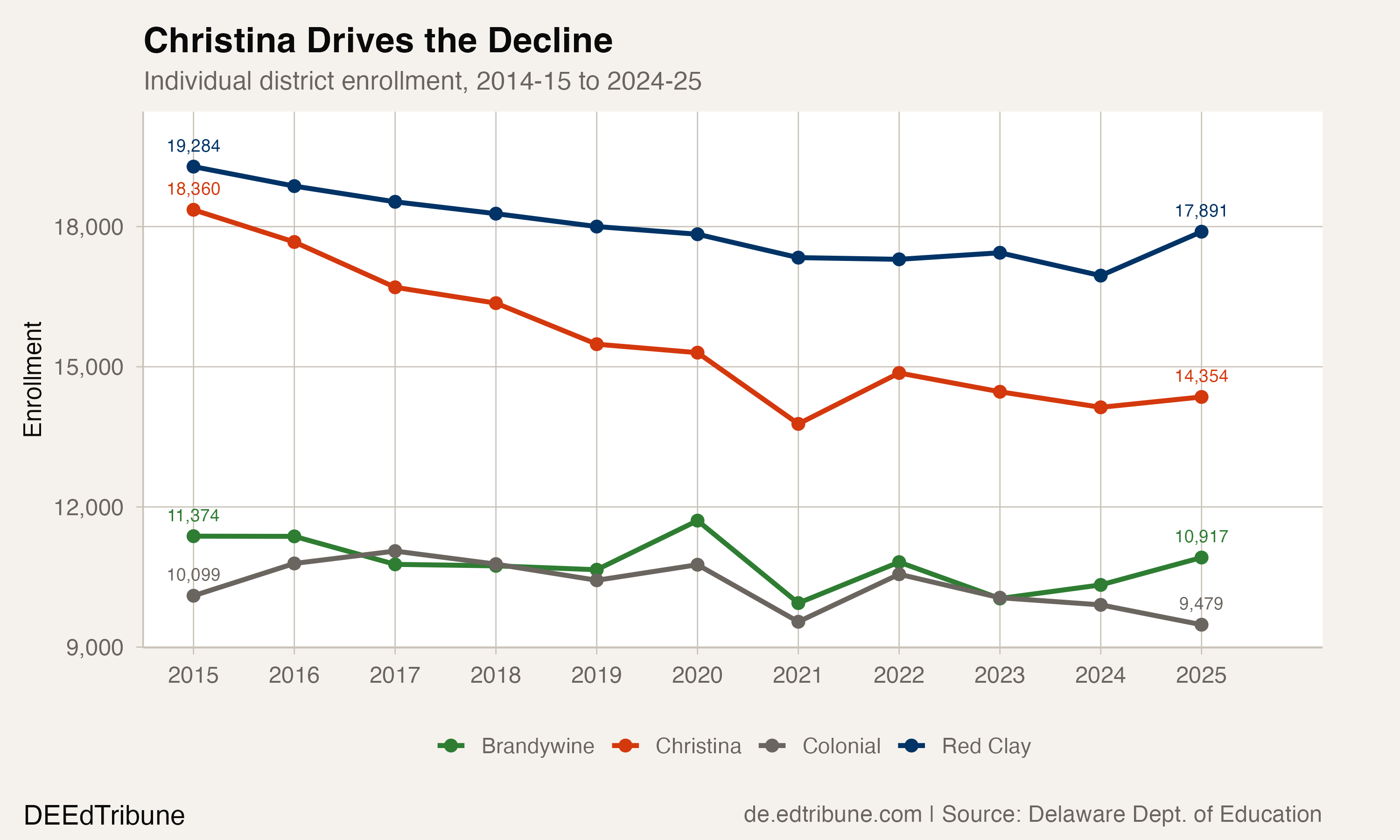
Not all four districts declined equally. Christina↗ET alone accounts for 4,006 of the 6,476 lost students, a 21.8% decline that dwarfs the losses at Red Clay↗ET (-1,393, or 7.2%), Colonial↗ET (-620, 6.1%), and Brandywine↗ET (-457, 4.0%).
Christina is Delaware's only non-contiguous district. Its boundaries stretch from the Newark suburbs to an island of downtown Wilmington neighborhoods, a legacy of 1980s court-ordered desegregation. That geography creates 15-mile commutes for some families. Board member Shannon Troncoso told Spotlight Delaware that the arrangement "makes it really prohibitive for parents to even be involved."
The non-contiguous structure also exposes Christina to a particular form of school choice pressure. Newark Charter School↗ET grew from 1,952 to 3,115 students over the decade, a 59.6% increase. Its five-mile enrollment radius captures many of Christina's suburban families in the Newark area while excluding Wilmington families who live in Christina's non-contiguous section. Odyssey Charter School↗ET, which draws from Red Clay's territory west of Wilmington, grew from 948 to 2,375, a 150.5% gain.
Who left, and who stayed
White enrollment across the four districts fell from 21,994 to 16,620, a loss of 5,374 students, or 24.4%. That single subgroup accounts for most of the combined net decline. Black enrollment held essentially flat, declining by just 43 students (0.2%), while Hispanic enrollment grew by 1,611 (14.9%).
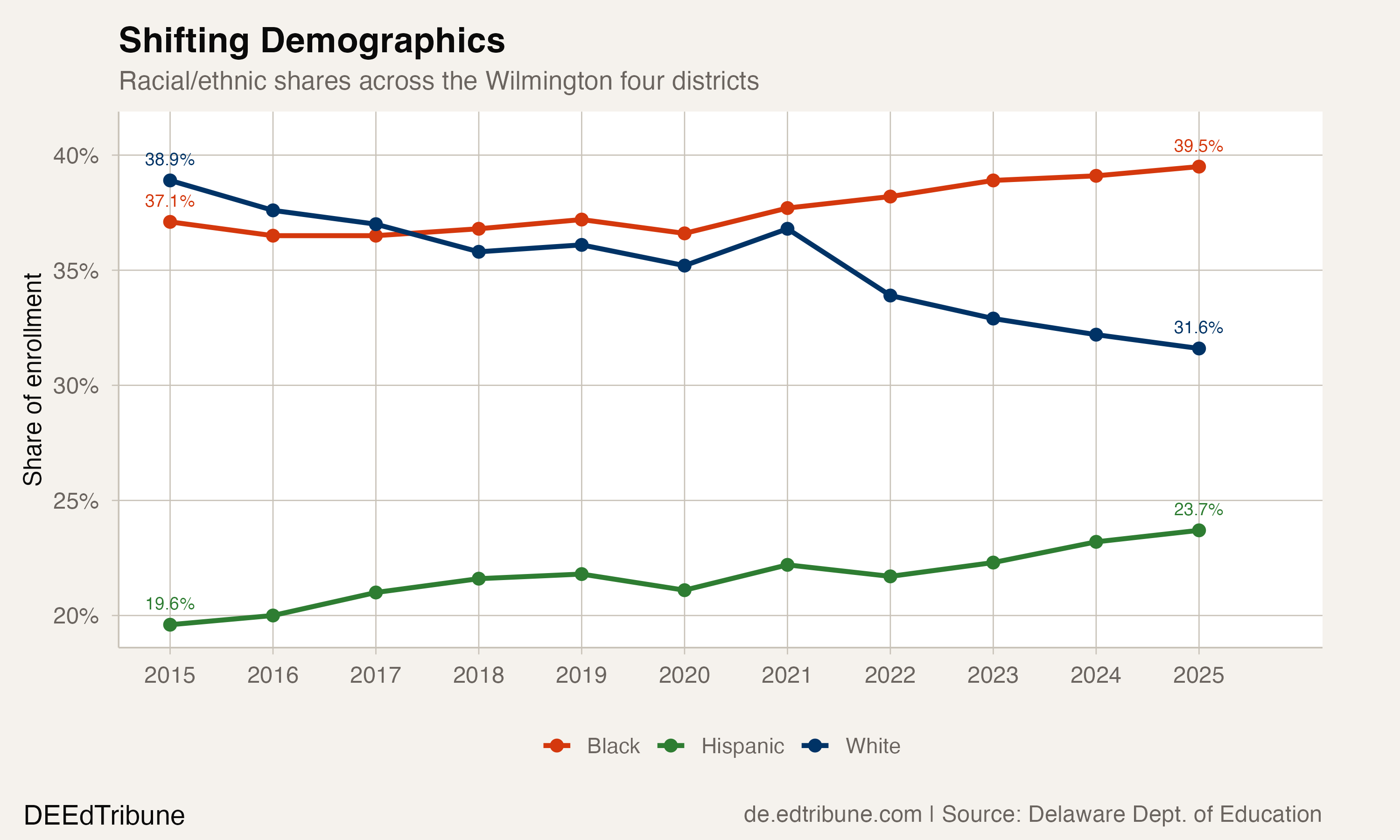
The shift is most pronounced in Christina, where white enrollment dropped 40.5%, from 5,264 to 3,133. White students now make up 21.8% of Christina's enrollment, down from 28.7%. Black students represent 47.7%, up from 40.9%.
Separately, the instructional profile of the four districts changed substantially. English learner enrollment grew from 6,582 to 7,642, pushing the EL share from 11.1% to 14.5%.
The special education surge
The most striking compositional shift is in special education. Across the Wilmington four, the share of students receiving special education services rose from 15.9% in 2014-15 to 26.3% in 2024-25. In absolute terms, that is 4,457 additional students classified for special education, even as total enrollment fell by 6,476.
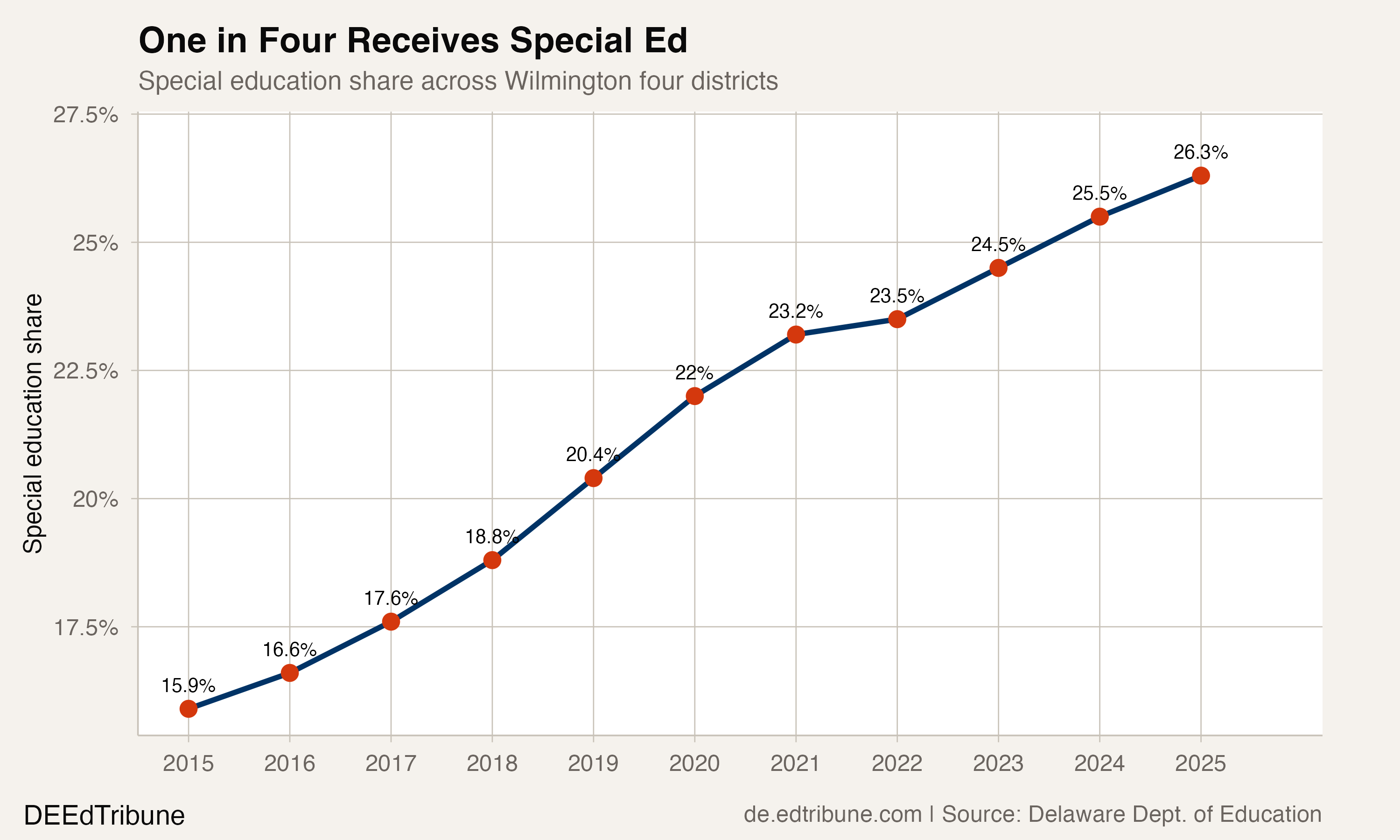
Christina and Colonial now each serve special education populations exceeding 29% of enrollment. The instructional programs these students receive carry higher per-pupil costs: specialized staffing, smaller class sizes, mandated services under federal law. A district losing total enrollment while gaining special education students faces a structural mismatch between its shrinking revenue base and its growing service obligations.
Whether the rise reflects improved identification, families choosing these districts specifically for their special education programs, or students with fewer resources being less likely to exercise school choice is unclear from enrollment data alone. All three mechanisms likely contribute.
Where the students went
The Wilmington districts' losses did not disappear from the state. Delaware gained 11,546 students statewide, and the growth concentrated in two corridors.
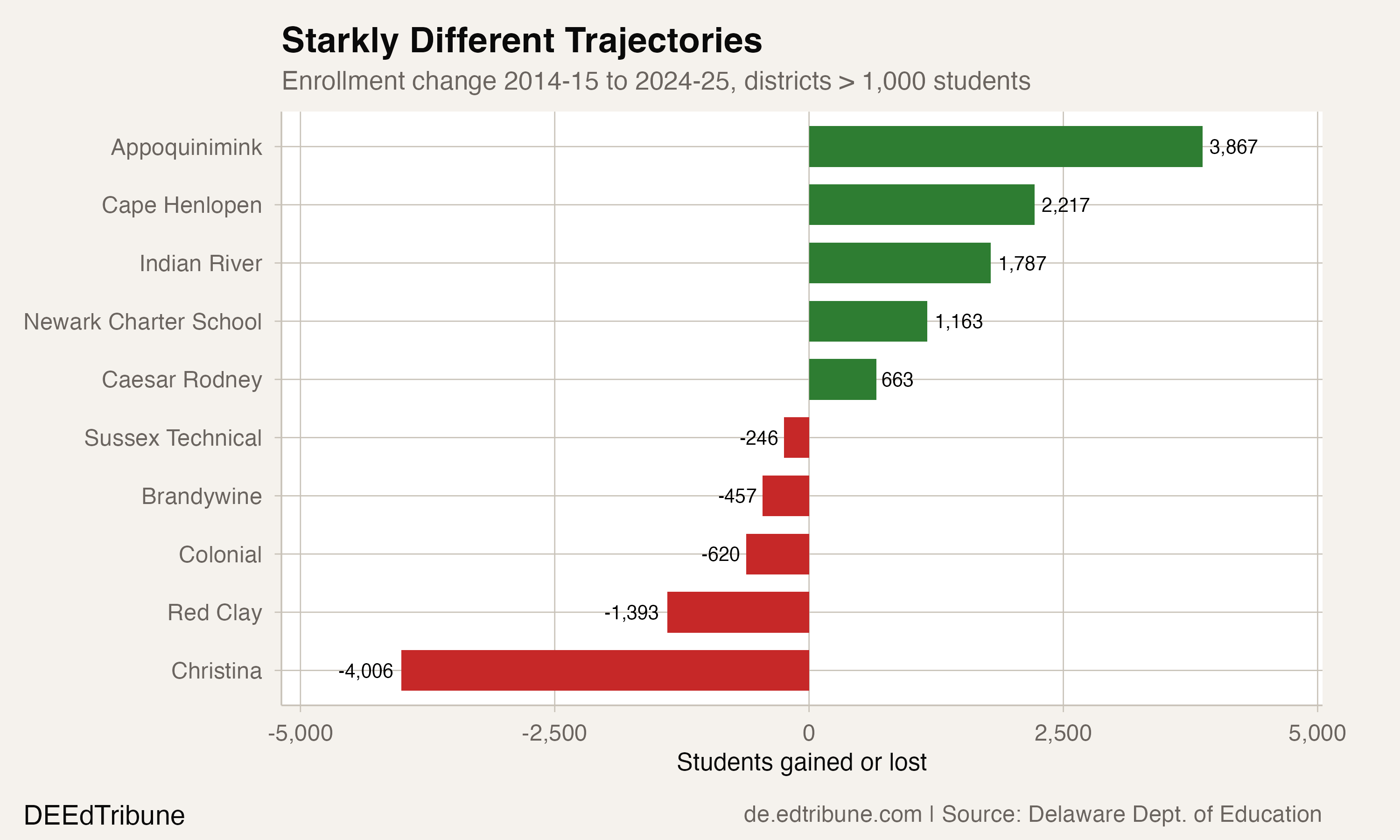
The Middletown corridor added the most: Appoquinimink gained 3,867 students (39.9%), driven by housing development that has expanded the town from one square mile to roughly 13. Caesar Rodney↗ET, south of Dover, added 663 (8.0%). Smyrna↗ET gained 563 (10.1%).
Sussex County's beach corridor was the other growth engine. Cape Henlopen added 2,217 students (45.0%), Indian River↗ET gained 1,787 (17.7%), and Laurel↗ET added 169 (7.3%). Sussex County's population grew 29.3% between 2010 and 2022, drawing retirees, remote workers, and families from Philadelphia and Washington.
The charter sector crossed 10.0% of statewide enrollment in 2024-25, up from 6.3% a decade earlier. Charters added 6,336 students across 19 entities. Newark Charter and Odyssey Charter alone account for 2,590 of those gains.
The merger question
The Redding Consortium's 19-2 vote in December 2025 directed the American Institutes for Research to develop a consolidation plan for the four districts. Red Clay teacher Mike Mathews told WHYY the rationale plainly:
"Nothing is going to change if we aren't willing to change. I know that we need to go big."
Not everyone agreed. Christina teacher Michelle Suchyj raised a concern that resonates with the enrollment data:
"I don't want my kids in the city of Wilmington to get lost in an even bigger pool than they're already lost in."
The plan has already slipped. In March 2026, the consortium pushed its deadline from summer 2026 to the end of the calendar year. State Sen. Tizzy Lockman, the consortium's co-chair, acknowledged the tension: "We feel that urgency, but also the call to not be over hasty and yield a sloppy proposal."
What a merger would inherit
A merged Northern New Castle County district would enroll roughly 52,641 students with a combined demographic profile unlike any current Delaware district: 31.6% white, 39.5% Black, 23.7% Hispanic, and 26.3% receiving special education services. It would inherit Christina's non-contiguous geography, Colonial's high-poverty schools, Red Clay's charter competition, and Brandywine's relative stability.
The underlying enrollment trend would not change. The families who left for Appoquinimink, Newark Charter, and Sussex County beaches did not leave because of where district boundaries fell. They left for newer schools, higher-rated systems, growing communities, and programs that matched their preferences. A single district with the same schools in the same neighborhoods would still face those competitive pressures.
A 2023 AIR study found Delaware underfunds high-need students by $600 million to $1 billion. The state's Opportunity Funding program provides roughly $66 million annually to support low-income and multilingual learners, but advocates argue that figure remains insufficient relative to the scale of the gap. Whether consolidation or a new funding formula would reach Wilmington's classrooms faster is the political question that enrollment data alone cannot answer.
Detailed code that reproduces the analysis and figures in this article is available exclusively to EdTribune subscribers.
Discussion
Sign in to join the discussion.
Loading comments...