In this series: Delaware Chronic Absenteeism 2024-25.
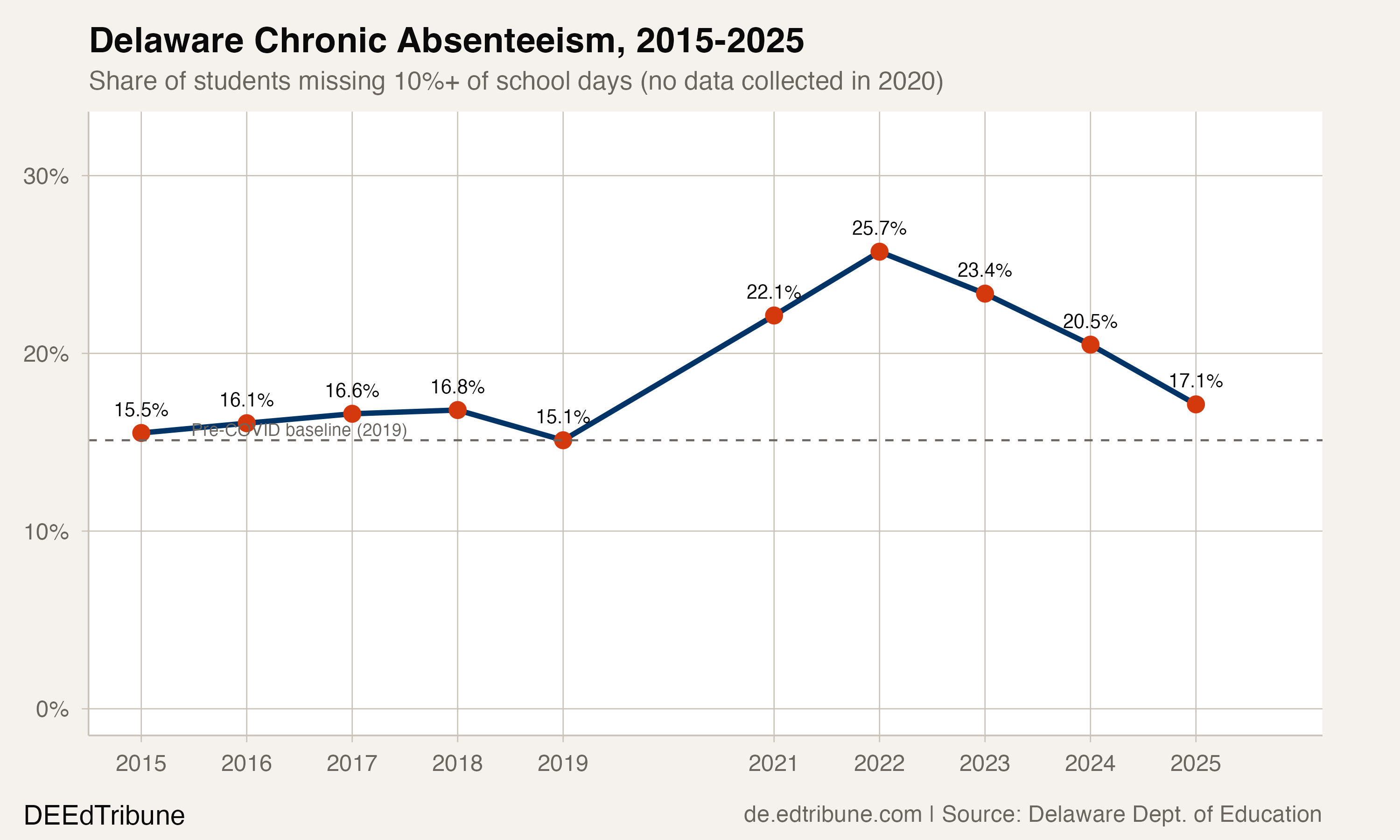
Three years ago, more than one in four Delaware students was chronically absent. In 2022, 37,520 students missed 10% or more of the school year, a rate of 25.7%, more than 10 percentage points above the state's pre-pandemic baseline. At Seaford↗ET School District in Sussex County, the number approached one in three.
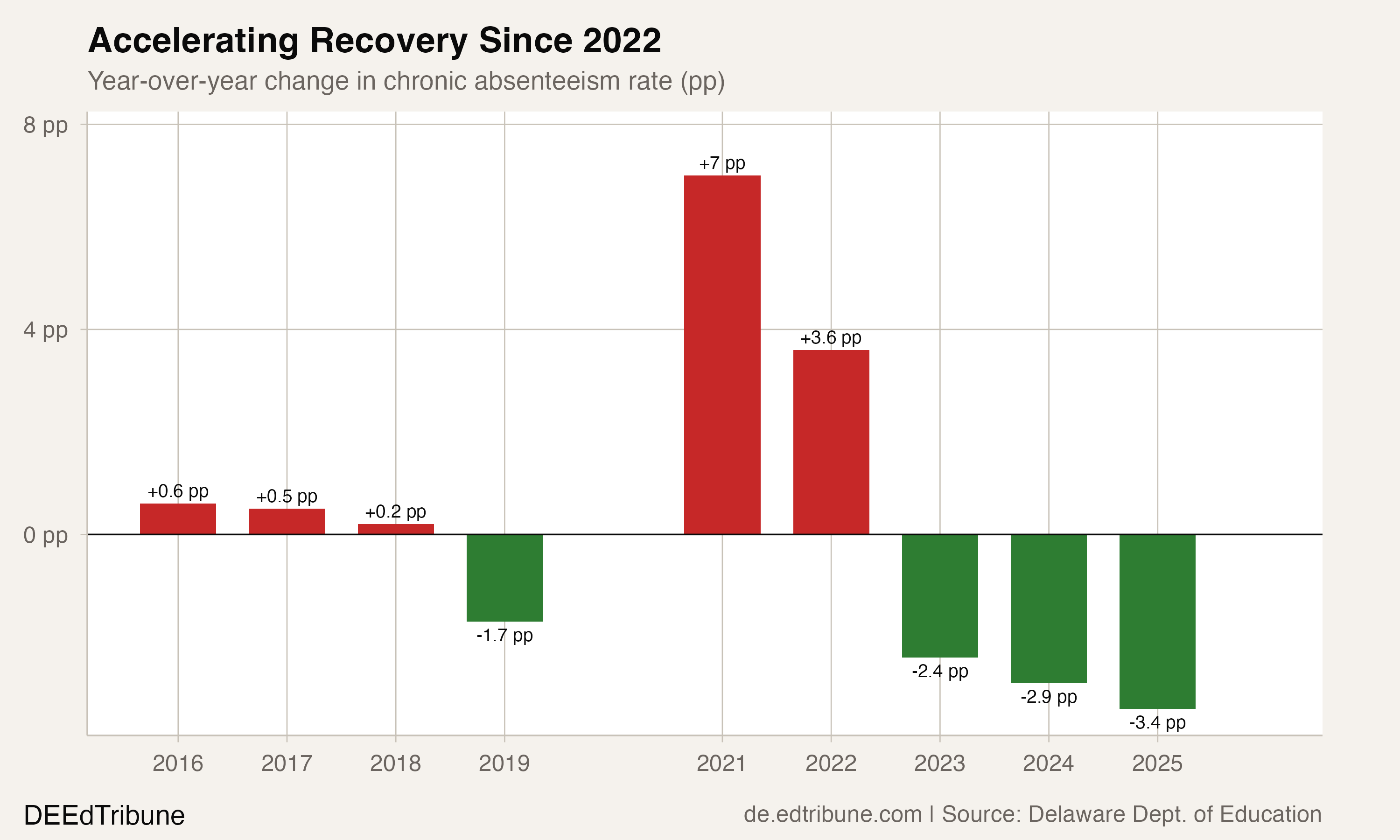
By 2025, the chronically absent count had fallen by 12,285. Delaware's chronic absenteeism rate dropped to 17.1%, recovering 81% of the ground lost during COVID. The improvement is accelerating: the state cut 2.4 percentage points in 2023, 2.9 in 2024, and 3.4 in 2025. At that pace, Delaware could cross below its pre-COVID rate of 15.1% within a year.
An outlier recovery in a stalled national picture
That trajectory makes Delaware a national outlier. Nationwide, chronic absenteeism peaked at roughly 28% in 2022 and fell to approximately 23.5% by 2024, a combined five-percentage-point improvement over two years. Delaware cut 8.6 percentage points in three years, and the pace is getting faster, not slower. Most states are decelerating. Delaware is doing the opposite.
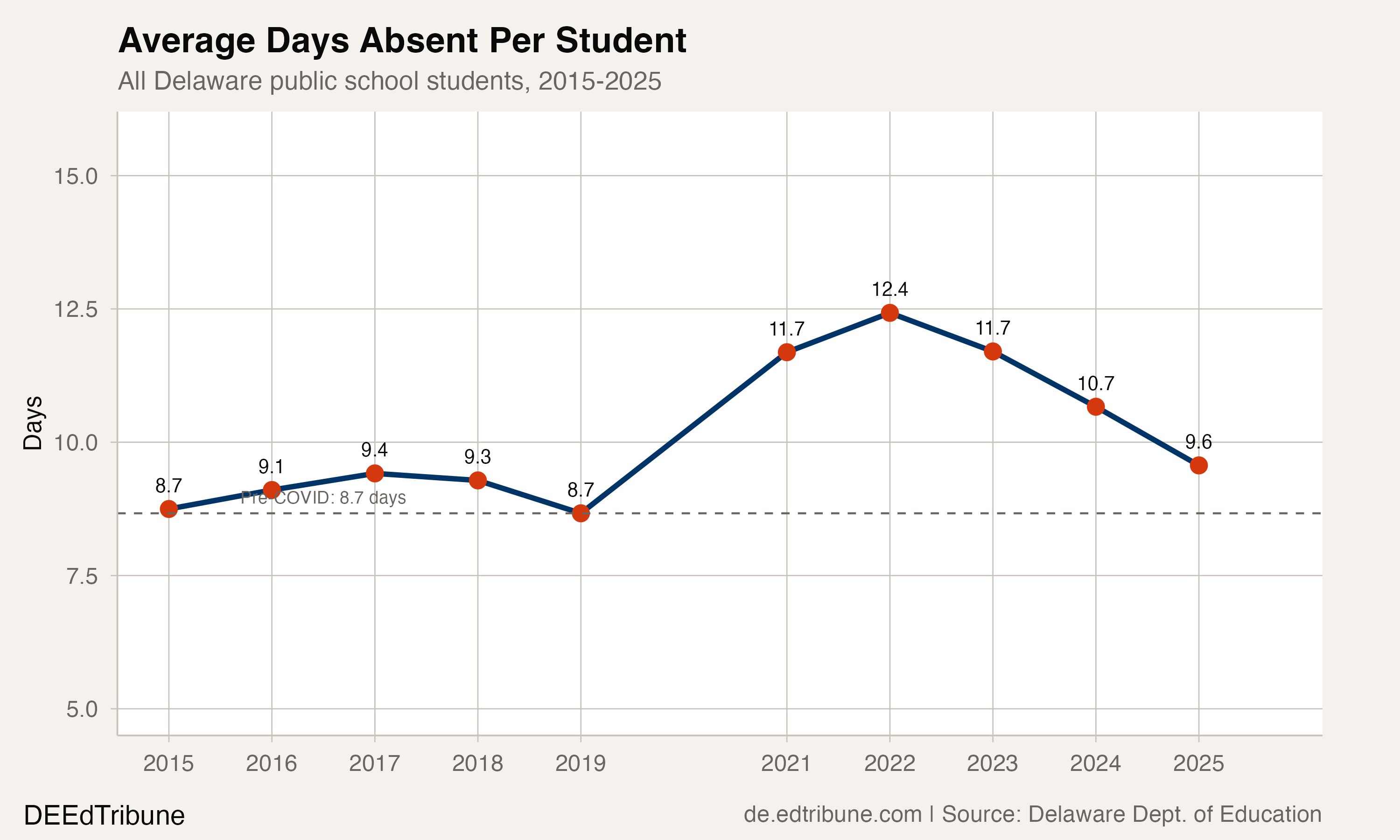
The average Delaware student missed 9.6 days in 2025, down from 12.4 days in 2022. That is closing in on the pre-COVID average of 8.7 days, a gap of less than one school day per student per year.
What 12,285 students look like in a small state
Delaware enrolls 147,296 students. In a state that size, 12,285 fewer chronically absent students amounts to one out of every 12 students in the system who crossed from chronically absent to regularly attending. That is not a statistical abstraction. It means fewer empty desks in Sussex County elementary schools, fewer ninth-graders at Colonial↗ET falling behind on credits, fewer families getting truancy letters from the state.
The charter sector's recovery has been even more striking. Charter schools dropped from 23.3% chronic absenteeism in 2022 to 11.2% in 2025, a 12.1 percentage-point improvement that brought the sector within 0.3 points of its pre-COVID charter rate of 10.9%. Traditional districts fell from 25.2% to 17.2%, a decline of 8.0 percentage points, still 2.1 points above their 2019 level.
Not every district recovered equally
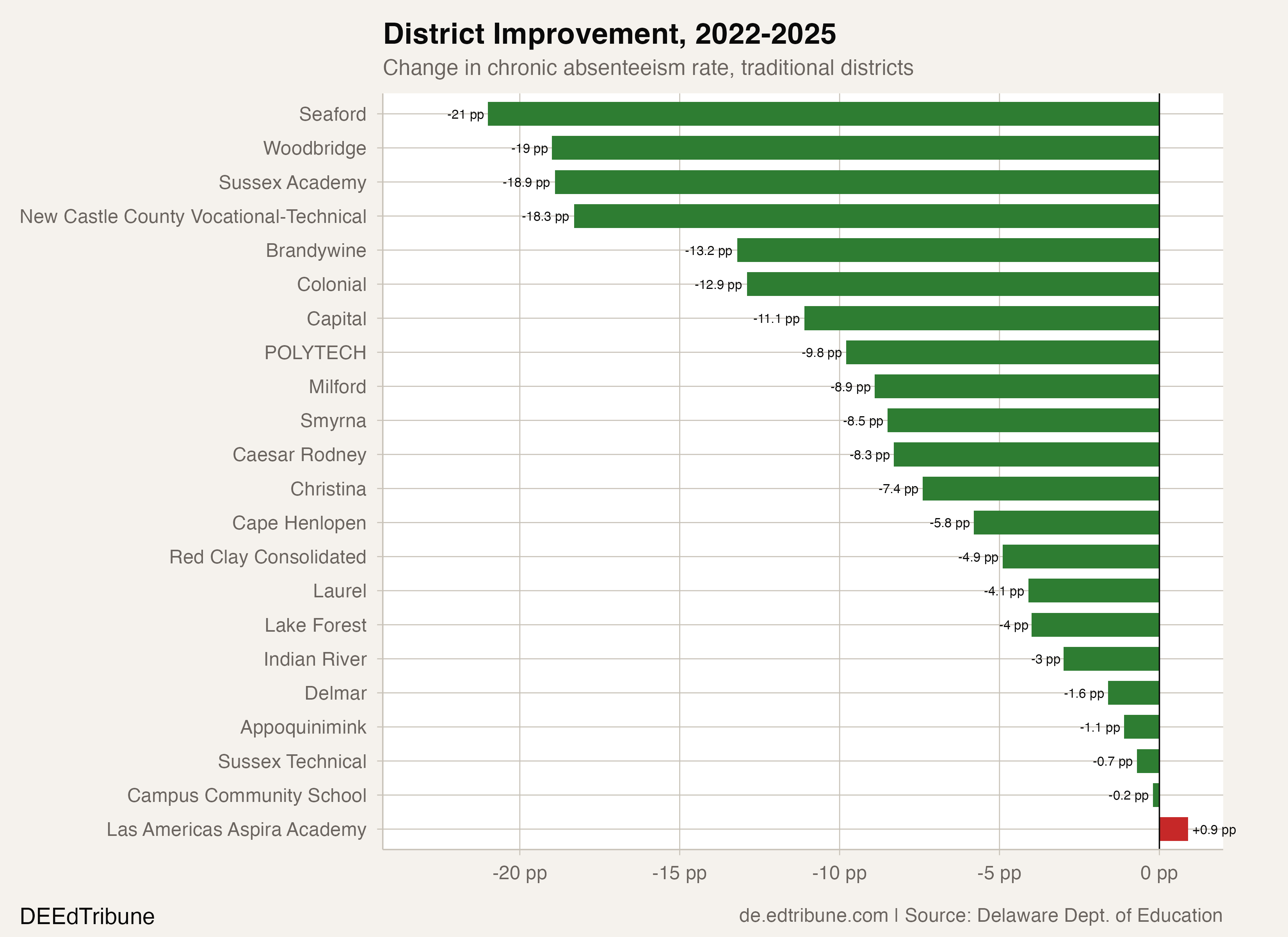
Nearly every Delaware district reduced chronic absenteeism between 2022 and 2025. But the magnitude varies enormously.
Seaford↗ET cut its rate from 29.7% to 8.7%, a 21 percentage-point drop. Woodbridge↗ET fell from 24.2% to 5.2%, a 19-point improvement. New Castle County Vocational-Technical dropped 18.3 points. These are not gradual improvements. They are transformations.
Seaford's turnaround coincided with a documented intervention. The district adopted PowerSchool's Attendance Intervention system, and a quasi-experimental evaluation by Johns Hopkins University's Center for Research and Reform in Education found that elementary students in treatment schools attended roughly two more days than their peers. The district's rate fell from nearly 30% to below 9% in three years.
At the other end, Capital↗ET School District still posts a 26.1% rate, down from 37.3% but still meaning more than one in four students is chronically absent. Indian River, the largest district in Sussex County, improved just 3 percentage points, from 23.2% to 20.2%. Las Americas Aspira Academy was the only entity to move in the wrong direction, ticking up from 13.5% to 14.4%.
A health system built around attendance
One of the more unusual elements of Delaware's recovery involves linking medical data to school attendance. In 2021, Colonial↗ET School District, Nemours Children's Health, the Delaware Health Information Network, and The Data Service Center launched the D.A.S.H. collaborative, one of just two such programs in the country at the time. With parental consent, the system alerts a student's primary care provider when they miss three consecutive days or 10 total days in a year.
"By having the primary care provider reach out, in addition to the school, we are hopeful that the families feel more supported." Jon Cooper, Colonial School District Director of Health and Wellness. Source
Colonial's rate dropped from 37.8% to 24.9%, a 12.9 percentage-point improvement. That is substantial but still leaves the district with one of the highest rates in the state. Whether D.A.S.H. is a contributing factor is difficult to isolate from the broader statewide recovery. Colonial began from a much higher peak than most.
Separately, the Wilmington Learning Collaborative joined Digital Promise's national chronic absenteeism cohort in June 2024, a six-month initiative spanning 19 districts and 210,000 students. The program aimed to develop community-centered solutions through co-design with families and students.
The equity gap shrank but did not close
Every student group improved. But the gaps that existed before COVID remain structurally intact.
Black students had a chronic absenteeism rate of 20.3% in 2025, down from a peak of 31.3% in 2022. That represents an 84.8% recovery toward the pre-COVID rate of 18.3%. White students recovered 86.2%, from 21.4% back to 14.0%. Hispanic students recovered 78.6%, landing at 18.4%.
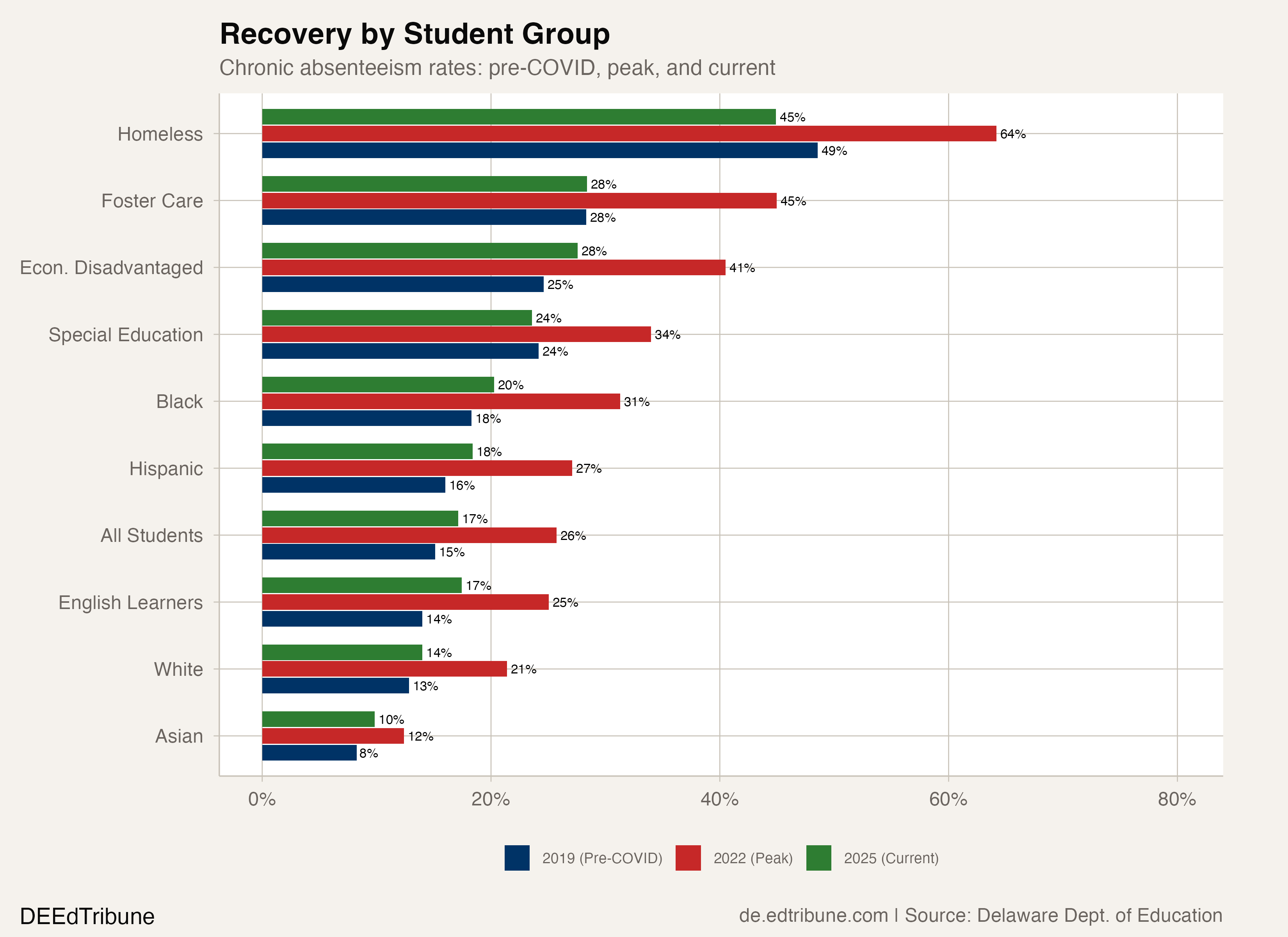
The starkest numbers belong to students without stable housing. Nearly half of Delaware's students who are currently homeless, 44.9%, were chronically absent in 2025. That is actually below the pre-COVID rate of 48.6%, one of only two subgroups (along with students with disabilities) to surpass full recovery. But 44.9% still means nearly every other student who is currently homeless is missing more than a month of school. With 4,416 students identified as experiencing homelessness in 2022-23, nearly 1,000 more than the prior year, the scale of the challenge is immense.
Students in foster care sit at 28.4%, essentially identical to their 2019 rate of 28.3%. Economically disadvantaged students remain at 27.6%, 3.0 percentage points above their pre-COVID baseline. English learners at 17.4% are 3.4 points above where they were in 2019, with a 69% recovery rate. Among service populations, that is the slowest return to normal.
How students are spending their time
The average days absent data tells a parallel story. In 2019, the typical Delaware student missed 8.7 days. By 2022, that climbed to 12.4 days, nearly 2.5 school weeks. In 2025, it dropped to 9.6 days, less than one day above the pre-COVID norm.
That last day matters. Delaware uses a September 30 unit count for state funding rather than average daily attendance, so chronic absenteeism does not directly reduce state aid the way it does in states that fund schools based on daily attendance. The consequences are academic rather than fiscal: students who miss more than 10% of school days are, according to years of research, substantially less likely to read at grade level, graduate on time, or avoid involvement with the justice system.
What 2026 will answer
Delaware's pre-COVID rate of 15.1% was not a golden age. The state ran above 15% every year from 2015 to 2019, peaking at 16.8% in 2018 before a sharp correction brought it down to 15.1% in 2019. One in seven students was chronically absent before anyone had heard of COVID-19.
The accelerating recovery (each of the past three years better than the last) will eventually hit a floor as the easy gains are exhausted. The national pattern suggests it does. A February 2026 analysis in Education Week and the American Enterprise Institute found that national recovery progress is stalling, with the easiest-to-recover students already back. The students still chronically absent tend to have deeper barriers: housing instability, health conditions, transportation, and disengagement that a robocall cannot fix.
Delaware's 2.0 remaining percentage points look small on paper. But those 2.0 points represent about 2,900 students, disproportionately poor, disproportionately Black, disproportionately unstably housed. They are the hardest to reach. The acceleration has held for three years running. The 2025-26 data will show if it holds for a fourth, or if the last 2,900 students prove to be the ones no trend line can reach.
Detailed code that reproduces the analysis and figures in this article is available exclusively to EdTribune subscribers.
Discussion
Sign in to join the discussion.
Loading comments...