At Red Clay Consolidated↗ET, Delaware's largest school district, 27.0% of Black students were chronically absent in 2024-25. The rate for white students in the same district: 9.9%. That is a 17.1 percentage-point gap, nearly three times the statewide disparity, in a district where Black and white students attend many of the same schools.
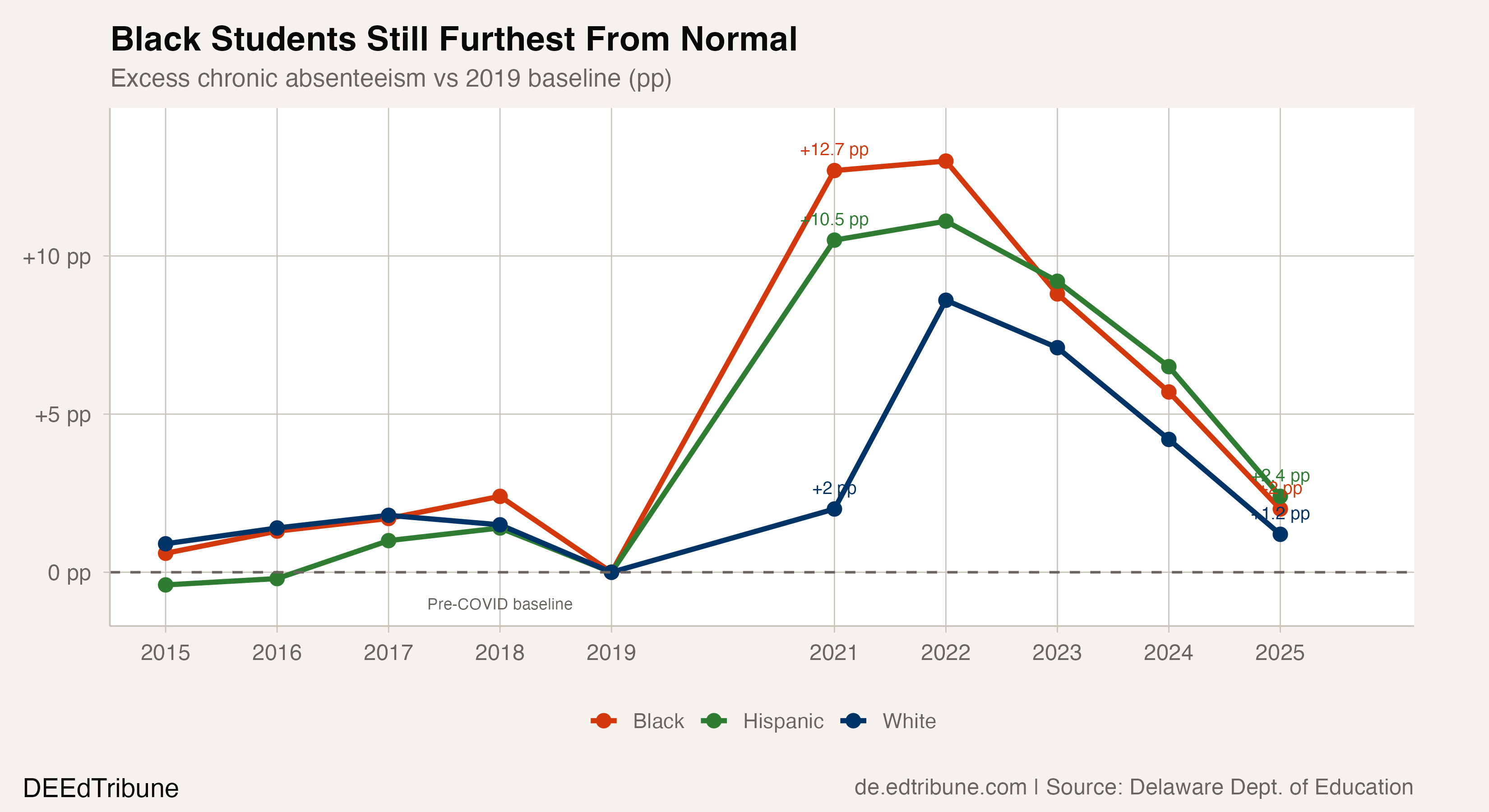
Red Clay is not an outlier in kind. It is an outlier in degree. Across Delaware, every racial group's chronic absenteeism rate has dropped since the pandemic peak. The overall state rate fell from 25.7% in 2022 to 17.1% in 2025, an 81% recovery. But the improvement has not been distributed equally. The Black-white gap in chronic absenteeism stands at 6.3 percentage points in 2025, 0.8 points wider than it was before the pandemic. The Hispanic-white gap widened by 1.2 points. The multiracial-white gap widened by 1.6 points. COVID did not create Delaware's attendance equity problem. It deepened it, and the deepening has stuck.
A gap that was already growing
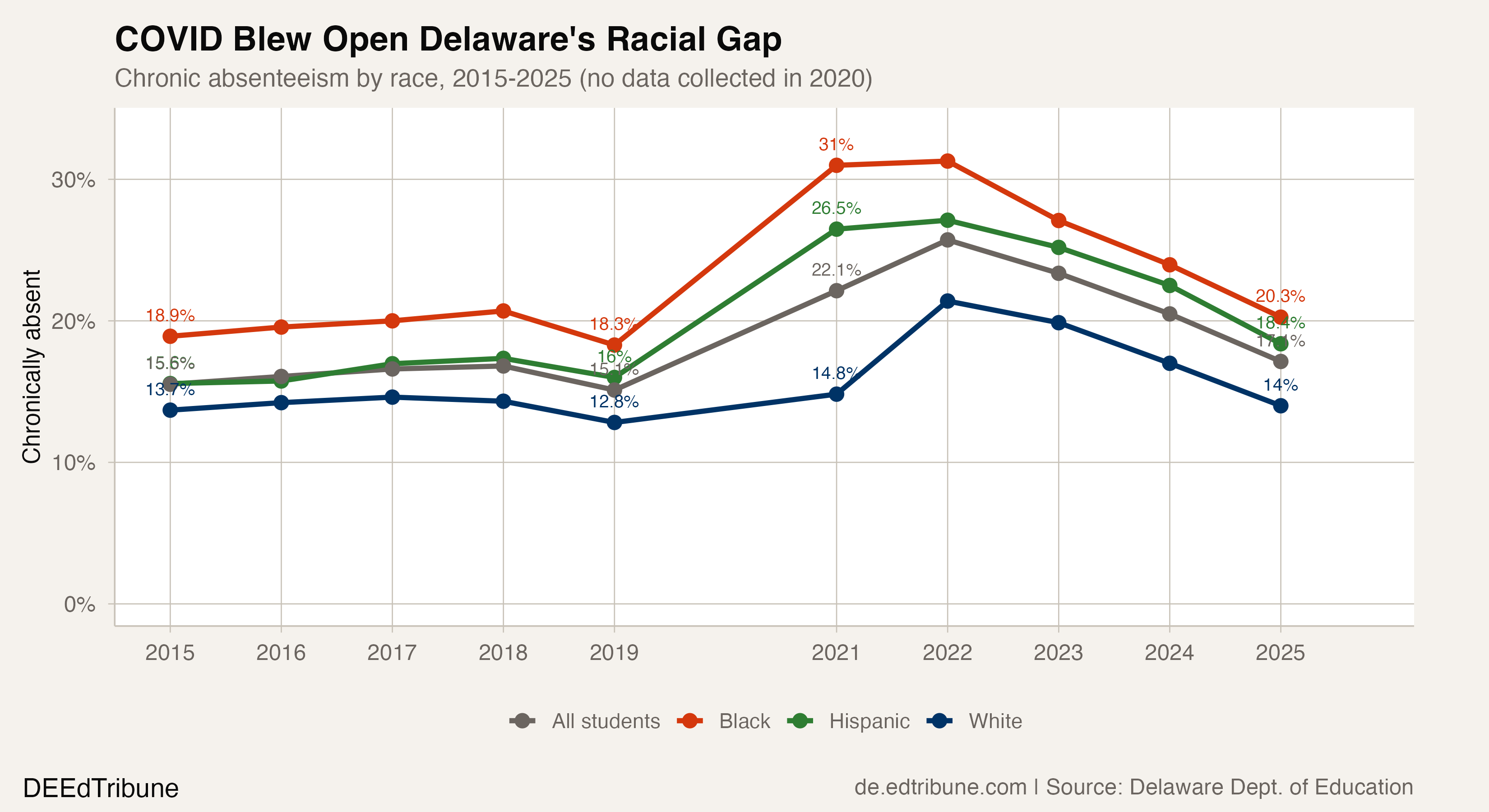
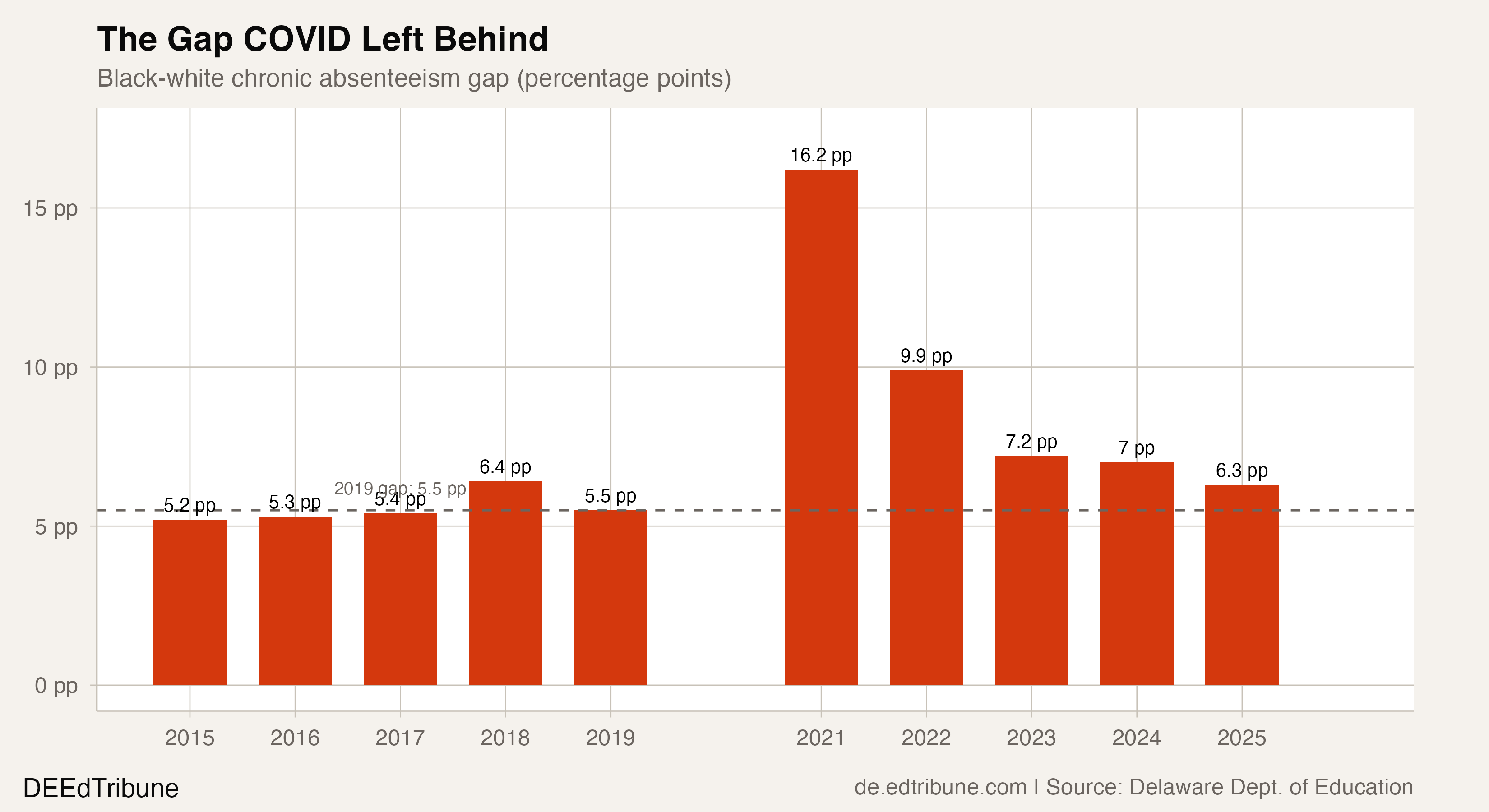
The Black-white gap was not stable before COVID. In 2014-15, Black students were chronically absent at 18.9% compared to 13.7% for white students, a gap of 5.2 percentage points. By 2017-18, the gap had widened to 6.4 points as Black chronic absenteeism climbed to 20.7% while white rates barely moved. A dip in 2018-19 brought the gap back to 5.5 points, but the pre-pandemic trend was upward.
Then came 2020-21, the first full school year after COVID closures. Black chronic absenteeism surged to 31.0%, up 12.7 percentage points. White chronic absenteeism rose to 14.8%, a smaller increase. The gap nearly tripled to 16.2 percentage points in a single year.
By 2025, Black chronic absenteeism has fallen to 20.3%, a significant recovery from the 31.3% peak in 2021-22. White chronic absenteeism dropped to 14.0%. Both groups improved, but the gap closed only to 6.3 points. Four years after the pandemic shock, the Black-white attendance gap remains wider than any pre-COVID year except 2017-18.
In raw numbers, 9,460 Black students were chronically absent in 2024-25, down from 14,299 at the peak. That is 4,839 fewer Black students missing 10% or more of the school year. The progress is real. But 9,460 chronically absent Black students, out of 46,689 total, means one in five Black students in Delaware is still missing enough school to put academic progress at risk.
Every gap wider, not just one
The Black-white gap gets the attention because of its size, but the pattern extends across every racial group.
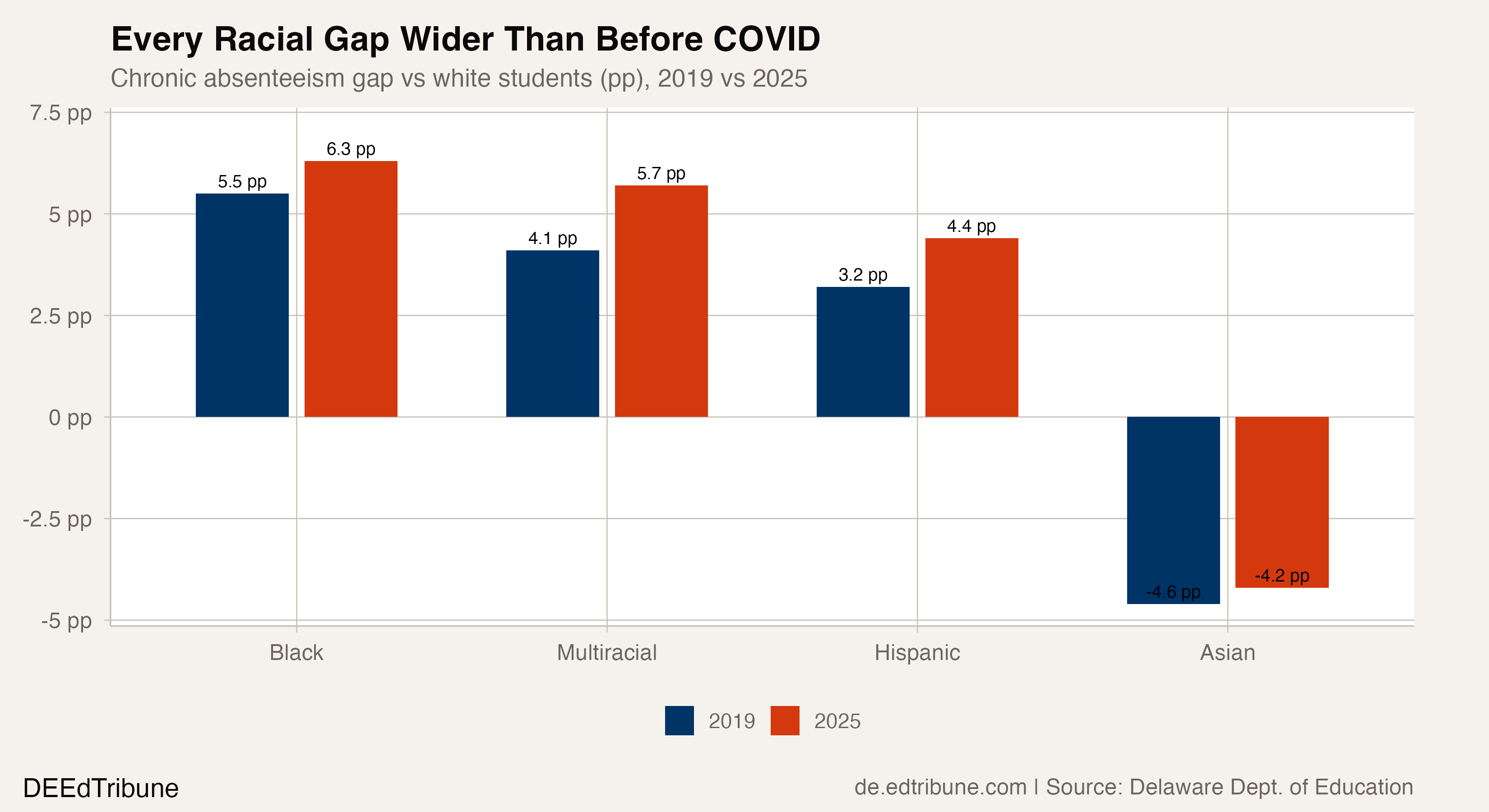
Hispanic students were chronically absent at 16.0% in 2019, 3.2 points above white students. By 2025, the Hispanic rate had fallen to 18.4% from a 27.1% peak, but the gap with white students widened to 4.4 points. Multiracial students went from a 4.1-point gap to 5.7 points, a widening of 1.6 percentage points. Even Asian students, who have the lowest chronic absenteeism rate in the state at 9.8%, saw their advantage over white students shrink from 4.6 points below to 4.2 points below.
The consistency of the pattern suggests this is not a story about one group's struggles. White students recovered faster than every other racial group. White chronic absenteeism has recovered 86.2% of the way back to its 2019 level. Black students have recovered 84.8%. Hispanic students, 78.6%. The recovery gap is not enormous in percentage terms, but it compounds: each year that the gap persists, the cumulative effect on the students furthest behind grows.
Where the gap concentrates
The statewide numbers obscure how much the gap varies by district.
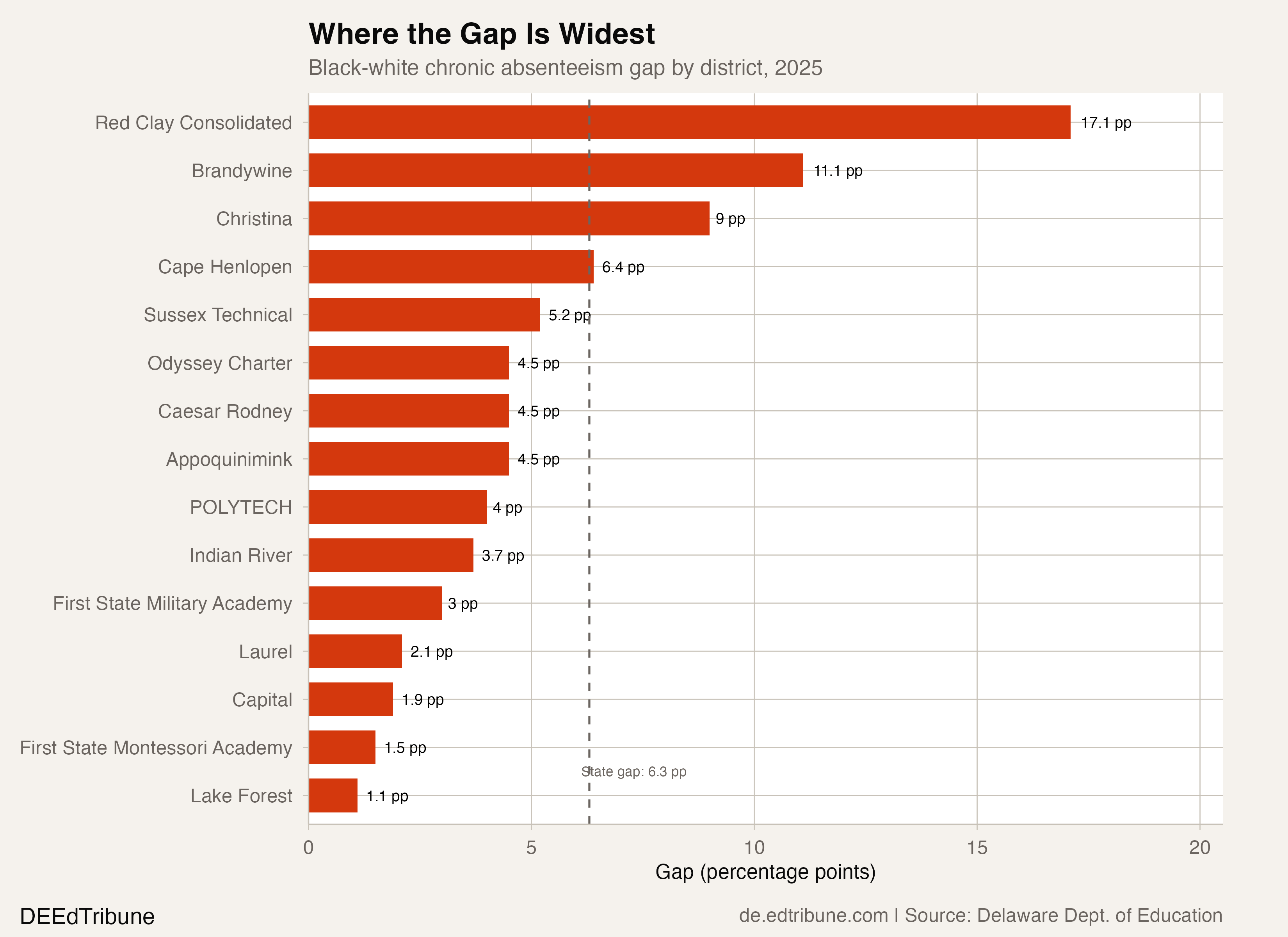
Red Clay Consolidated leads with a 17.1-point Black-white gap. Brandywine↗ET follows at 11.1 points, and Christina↗ET at 9.0 points. All three are northern New Castle County districts that serve Wilmington students under district boundaries drawn after the 1978 desegregation order. Those boundaries, now nearly half a century old, are the subject of active redistricting debate. The Redding Consortium for Educational Equity, a legislative task force named for civil rights lawyer Louis L. Redding, voted in December 2025 to pursue a single northern New Castle County consolidated district that would remove Christina from serving Wilmington students.
The Consortium's research found that Wilmington students face compounding obstacles: housing instability, community violence that deters students from public spaces and transportation routes, and unequal resource distribution across neighborhoods. These are attendance barriers that operate along racial lines. Wilmington's population is approximately 52% Black, and the Wilmington neighborhoods with the least proximity to services, Southbridge, West City, Hilltop, and East Side, are predominantly Black.
Not every district follows the pattern. At Colonial↗ET, where chronic absenteeism is among the highest in the state at 24.7% for white students, the gap actually inverts: Black students are chronically absent at 24.2%, 0.5 points below white students. At Capital↗ET in Dover, both groups exceed 25%, and the gap is just 1.9 points. In high-poverty districts, white students face many of the same attendance barriers as Black students. The gap is widest in districts where white students have comparatively low chronic absenteeism, leaving Black students visibly further behind.
Discipline, poverty, and the mechanisms underneath
Chronic absenteeism data shows who is missing school. It does not explain why. But several structural factors operate disproportionately on Black students in Delaware.
Discipline is one. ACLU Delaware reports that Black students in Delaware are two to three times more likely to receive a suspension than white peers, and 69% of all out-of-school suspensions are for low-level offenses. Suspensions remove students from the building, and suspended students who fall behind on coursework are less likely to return consistently. Delaware has been shifting toward restorative practices, but the discipline gap persists.
Poverty is another. Students who are economically disadvantaged in Delaware were chronically absent at 27.6% in 2025, compared to 12.9% for students who are not economically disadvantaged, a gap of 14.7 percentage points. Black students are overrepresented in the economically disadvantaged category. But poverty does not fully explain the racial gap: a FutureEd analysis of 27 states found that even after accounting for income, Black students experienced larger pandemic-era increases in chronic absenteeism than white students nationally. The gap widened by roughly six percentage points more for Black students than white students between 2018-19 and 2021-22.
"Students who experienced the largest pandemic-era increases, Black and Hispanic children and those from low-income families, are generally the furthest from their pre-pandemic attendance levels." Source: The 74, Jan. 2025
A national AEI analysis found that Black chronic absenteeism rose from 19% to 39% nationally between 2020 and 2022, a 20-point jump, while white chronic absenteeism rose from 11% to 24%, a 12.5-point increase. Delaware's pattern mirrors the national one: a pandemic shock that hit Black students harder and a recovery that has not fully closed the differential.
What the data cannot settle
Whether the 0.8-point widening represents a permanent shift or a lag that will continue closing is an open question. The gap narrowed every year from 2021 to 2025, from 16.2 points to 6.3 points. If the rate of narrowing continues, the gap could return to pre-COVID levels within two to three years. But that trajectory requires Black students to continue recovering faster than white students, and the annual improvement for Black students has been uneven: 4.2 percentage points in 2023, 3.1 in 2024, 3.7 in 2025. Meanwhile, white chronic absenteeism is within 1.2 points of its pre-COVID rate, leaving less room for continued improvement. The gap may be approaching a floor.
Red Clay, Brandywine, and Christina face a redistricting debate that may not touch the attendance gap at all. Moving Wilmington students into different district configurations does not move their homes, change the bus routes that pass through neighborhoods where community violence deters students from public spaces, or alter the housing instability that drives absences. The Redding Consortium's timeline for a detailed plan has slipped to late 2026, with 2027 the earliest approval window. New district lines are governance reform. The attendance gap is about what happens inside the lines.
Detailed code that reproduces the analysis and figures in this article is available exclusively to EdTribune subscribers.
Discussion
Sign in to join the discussion.
Loading comments...