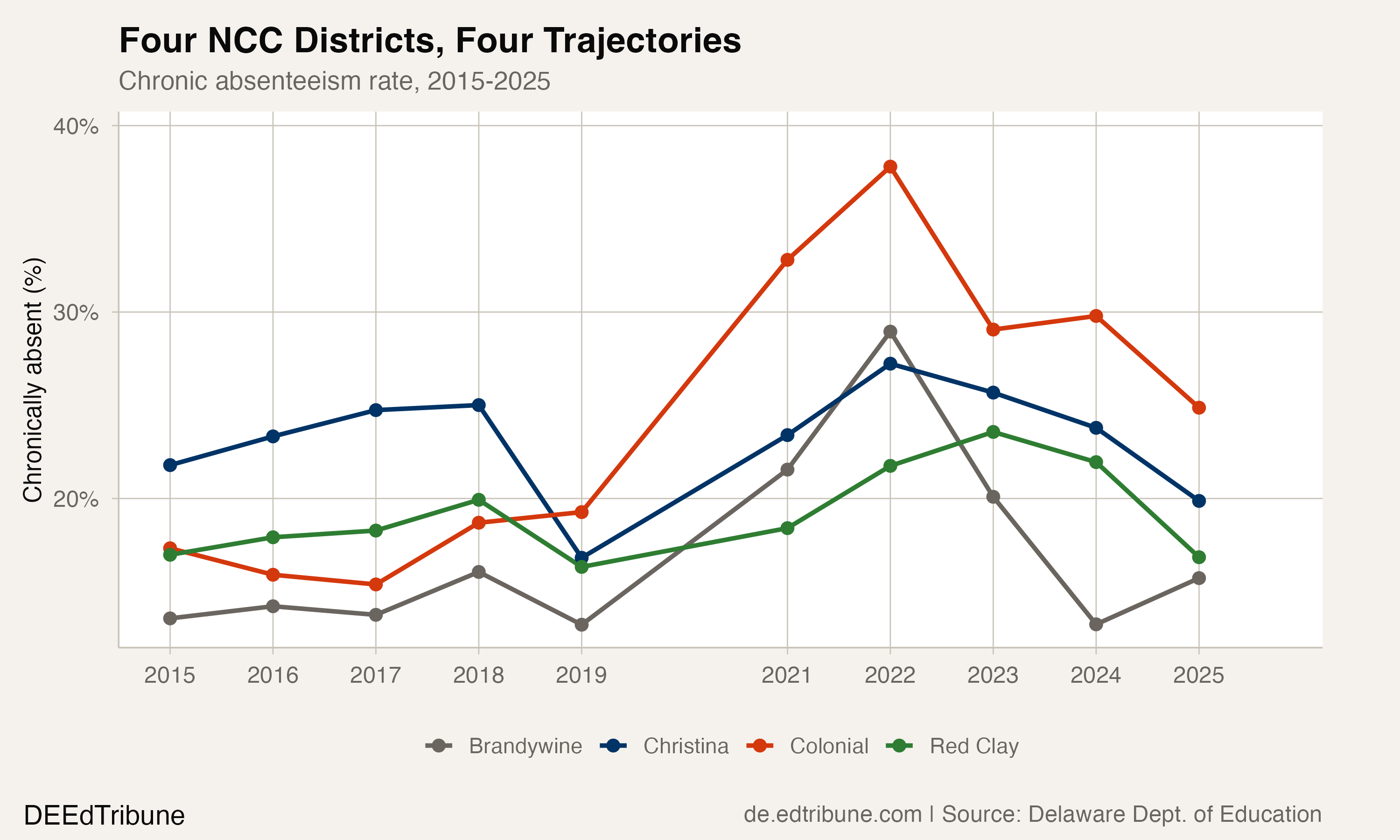
At Colonial School District↗ET, the average student in the state's attendance records missed 13.2 days of school in 2024-25, compared with Delaware's average of 9.6 days. Colonial's chronic absenteeism rate dropped 12.9 percentage points from its observed 2022 peak of 37.8%. At 24.9% in 2024-25, roughly one in four students in the reported attendance population was chronically absent.
The figures describe 2024-25, not current attendance. Every rate here uses the reported chronic absence count and its own published attendance population. That population differs from a fall enrollment count.
The northern New Castle County comparison
Among the four named northern New Castle County districts, Colonial had the highest 2024-25 chronic absence rate. Brandywine↗ET reported 15.7%, Red Clay↗ET 16.8% and Christina↗ET 19.9%, compared with the statewide rate of 17.1%.
Colonial's rate was 5.0 percentage points above the next-highest named peer and 7.7 points above the state rate. Differences are computed from the underlying counts before rounding.
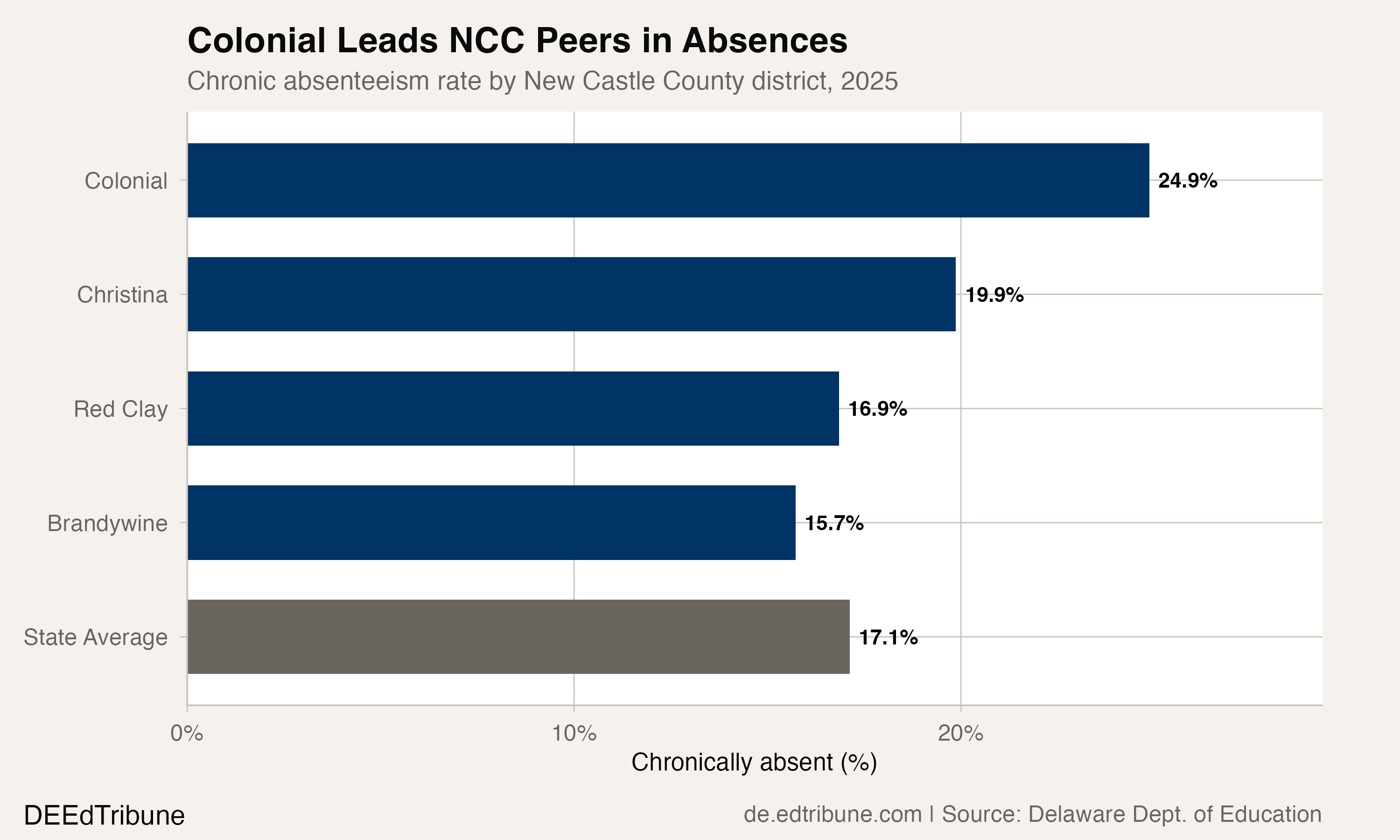
Capital School District↗ET, at 26.1%, had a higher rate. Colonial ranked second among noncharter district reporting entities with attendance populations above 1,000 students.
Of the 9,875 students in Colonial's published attendance population, 2,456 were chronically absent in 2024-25.
An uneven decline from the peak
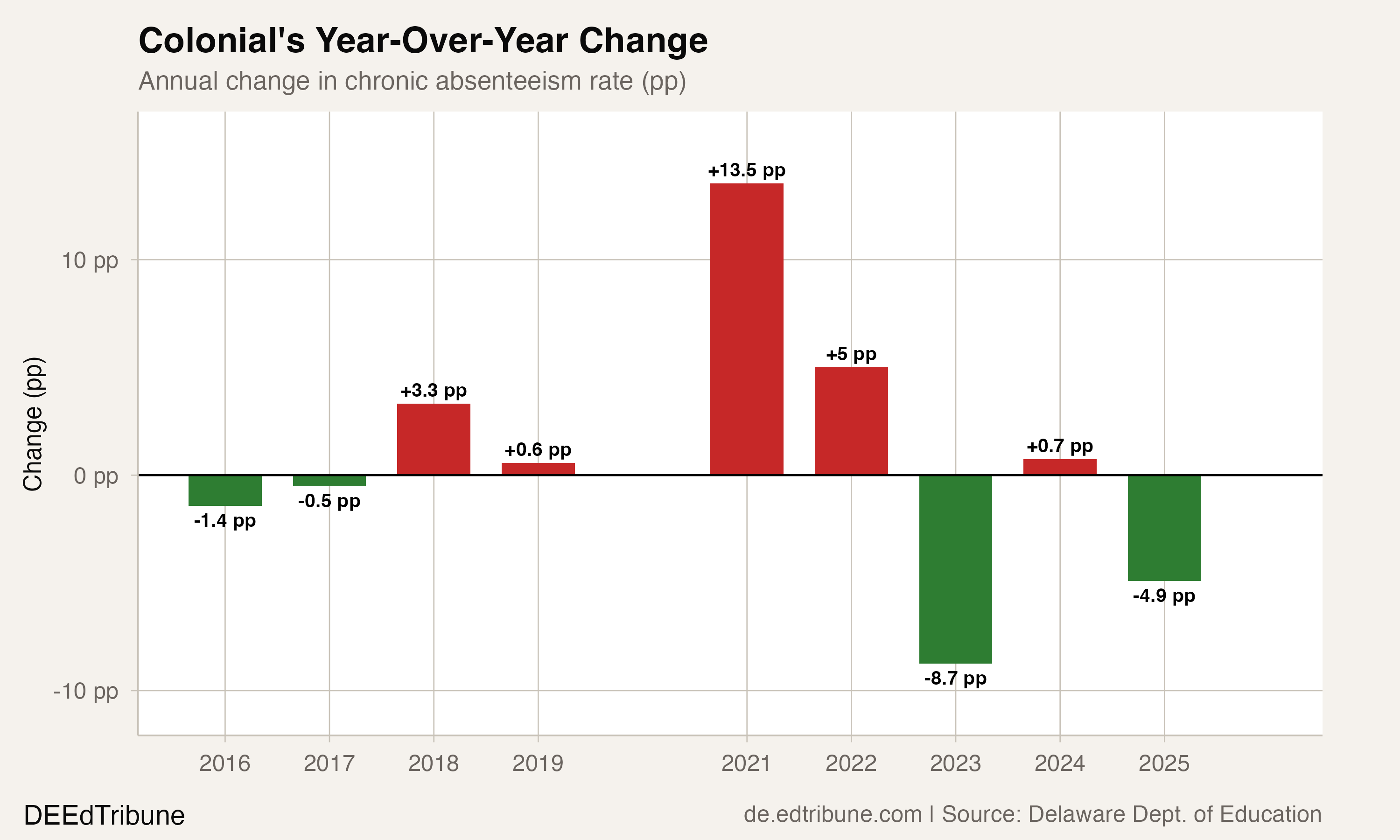
From its observed 2022 peak of 37.8%, Colonial posted an 8.7-point drop in 2023. The rate then rose 0.7 points in 2024, to 29.8%, while the other three named peers improved. In 2025, Colonial's rate fell 4.9 points.
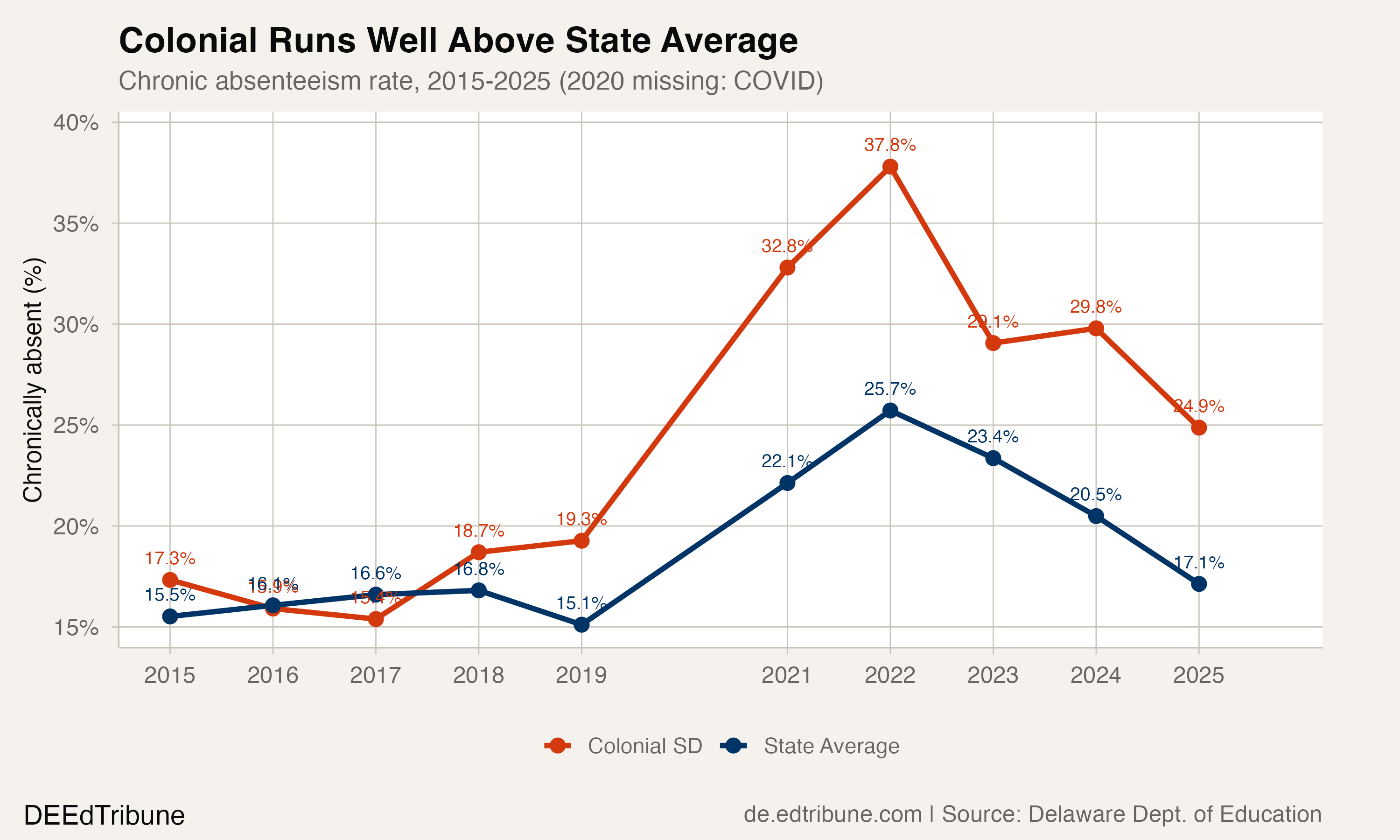
The state rate fell in each of those adjacent annual comparisons: 2.4 points in 2023, 2.9 in 2024 and 3.4 in 2025. Measured against the gap between 2019 and the observed 2022 peak, the state had closed 81% of that gap by 2025; Colonial had closed 70%.
Colonial's rate was 19.3% in 2019, 4.2 points above the state rate of 15.1%. Its 2025 rate remained 5.6 points above that baseline. The records used here have no 2020 observation; the figures do not identify what caused the subsequent changes.
Higher rates in the secondary grades
In 2024-25, Colonial's elementary grades, kindergarten through fifth grade, had chronic absence rates between 11.3% and 17.5%. Sixth grade's rate was 28.6%, seventh grade's was 35.9% and eighth grade's was 35.0%. Ninth grade had the highest rate among the district's measured grades, at 38.7%. Grades 10 through 12 ranged from 33.1% to 38.6%.
These are comparisons of grade populations in the same school year. They do not track the same students moving between grades or show why the rates differ.
Subgroup comparisons
Colonial's White student rate was 24.7%, compared with 14.0% statewide, a 10.7-point gap. That was the widest district-state gap among the measured racial groups with at least 100 Colonial students. Its Black student rate was 24.2%, 3.9 points above the statewide Black rate of 20.3%. Its Hispanic student rate was 27.0%, 8.6 points above the corresponding state rate.
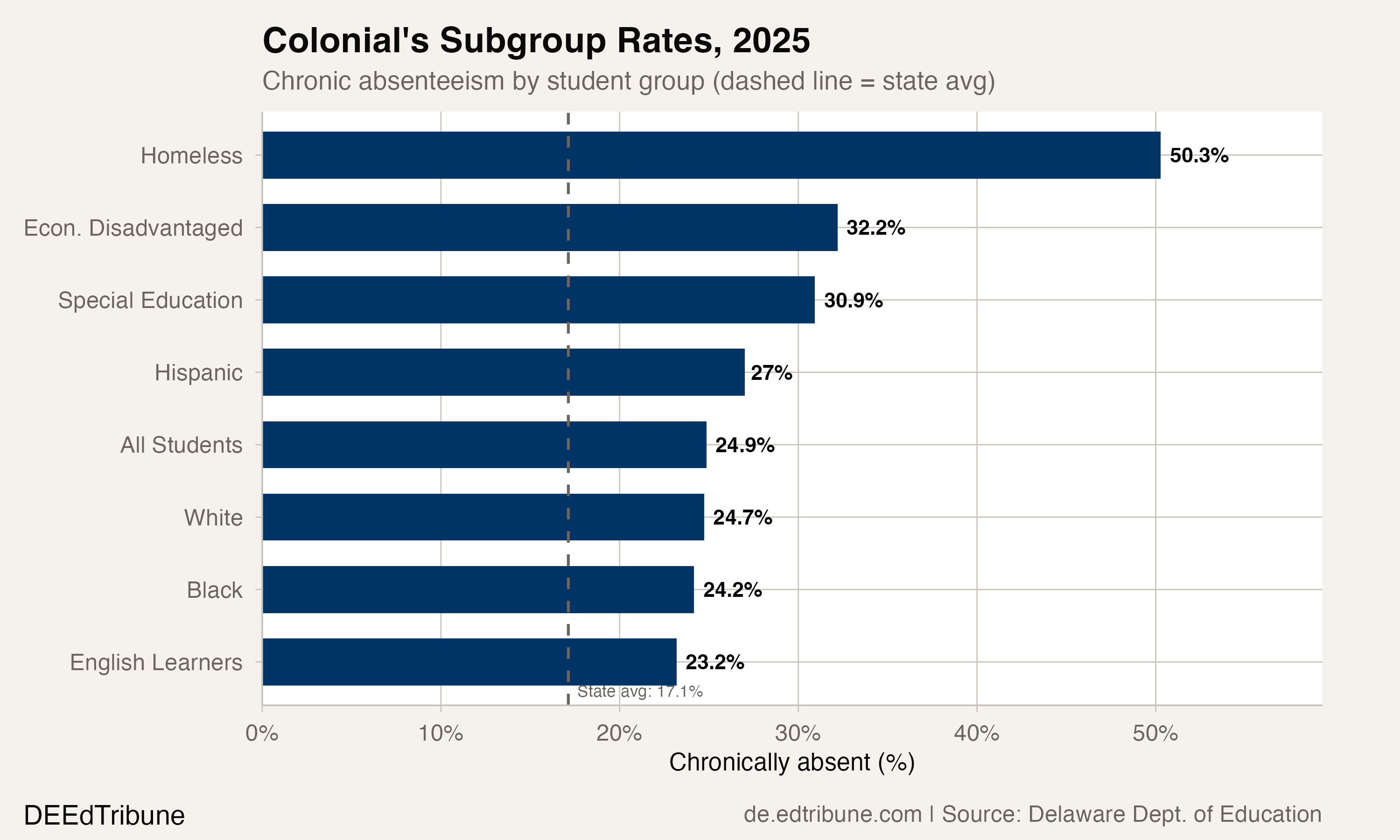
The state's economic-disadvantage reporting category had a 32.2% chronic absence rate at Colonial. The complementary reporting category had a rate of 20.7%, an 11.5-point difference. The latter was also above the statewide rate for all students. These comparisons do not establish an income effect or explain absences.
Among the 360 students reported as experiencing homelessness in 2024-25, 50.3% were chronically absent. This is a reported subgroup count for that year, not a current count.
Health context and limits
Nemours' original D.A.S.H. announcement describes a collaboration with Colonial, the Delaware Health Information Network and the Data Service Center. With parental consent, attendance and education-plan information can be shared with providers, and absence alerts are intended to prompt contact with families. That programme description does not establish that the collaboration caused Colonial's rate decline.
The records show a recent district-wide decline alongside substantially higher rates in secondary grades. They do not identify a programme effect, demonstrate a grade-transition mechanism or establish how quickly Colonial might return to its earlier baseline.
Detailed code that reproduces the analysis and figures in this article is available exclusively to EdTribune subscribers.
Discussion
Sign in to join the discussion.
Loading comments...