In the middle school grades at Capital↗ET School District in Dover, more than three in 10 students are chronically absent. In 9th grade, the number is closer to four in 10. Across the district, where math proficiency runs at 17%, roughly half the statewide average, the attendance problem sits on top of every other challenge.
Capital has the highest chronic absenteeism rate of any traditional school district in Delaware: 26.1% in 2025. That is 9.0 percentage points above the state average of 17.1%. In a district of 7,635 students, it means 1,995 students missed 10% or more of the school year. The number is improving. It is not improving fast enough.
A gap that was always there, then tripled
Capital's attendance problems predate the pandemic. In 2019, the district's chronic rate was 18.5%, already 3.4 points above the statewide 15.1%. It was the third-highest among traditional districts that year, behind Lake Forest (19.6%) and Colonial↗ET (19.3%).
COVID transformed that modest gap into a chasm. Capital's rate spiked to 39.3% in 2021, the highest among traditional districts. The state hit 22.1% that same year. The distance between Capital and Delaware widened from 3.4 points pre-COVID to 17.2 points at the peak.
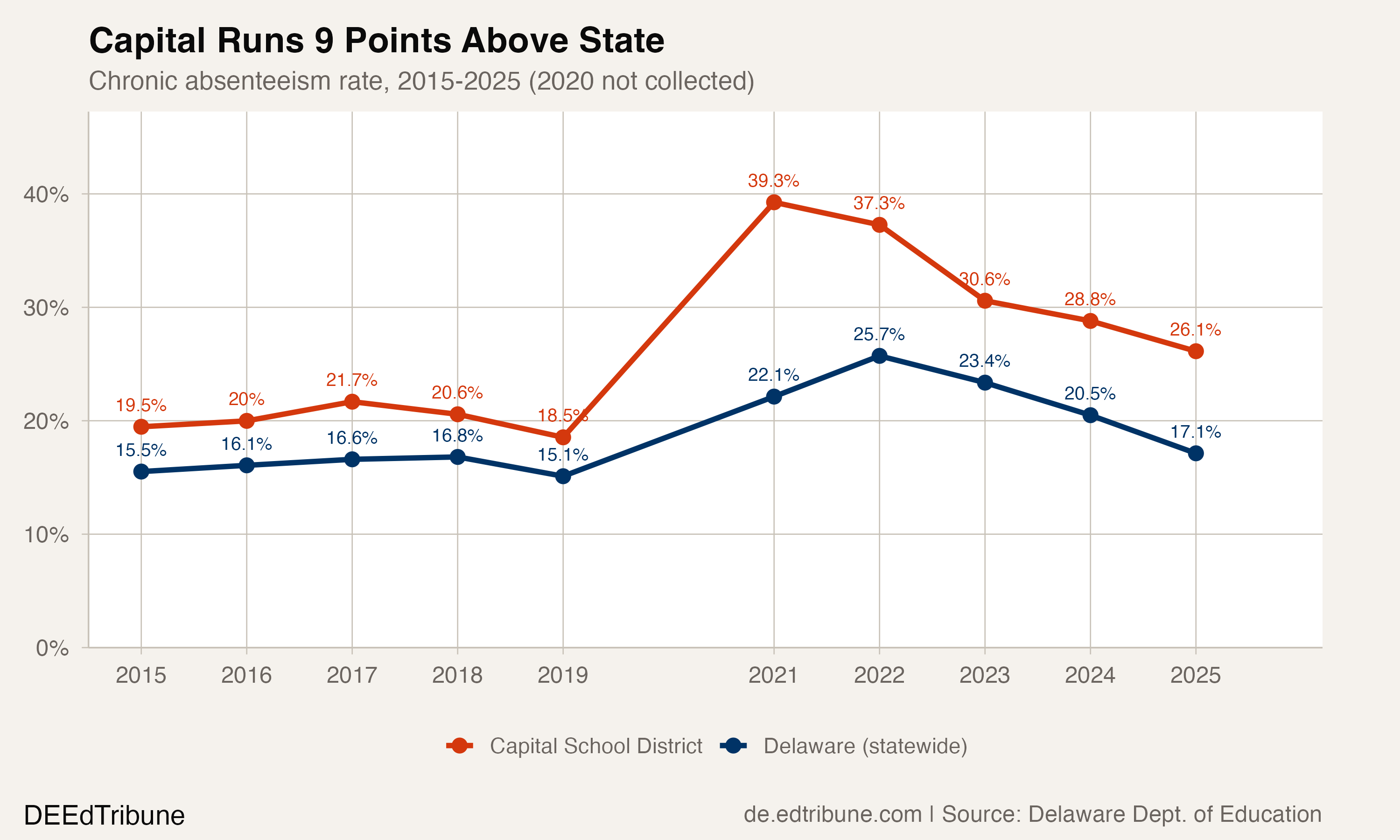
Three years of recovery have cut Capital's rate by 13.1 percentage points from that peak. But the state recovered faster. Delaware as a whole has clawed back 81% of its COVID attendance loss. Capital has recovered just 63%. The district entered the pandemic with a small attendance deficit and exits with a large one: 7.6 points above its own pre-COVID rate compared to 2.0 points for the state.
Where the absences concentrate
The district's 9th-grade chronic absenteeism rate is 36.6%, the highest of any grade. More than one in three freshmen miss at least 18 school days per year. The rate drops to 19.7% by 12th grade, a pattern that likely reflects students who were chronically absent in 9th grade leaving school before senior year rather than improving attendance.
The grade-level profile shows two pressure points. Elementary grades cluster between 21% and 26%, worse than the state at every grade but without a single standout. Then 7th grade begins a steep climb: 31.3% in 7th, 32.4% in 8th, and the 36.6% peak in 9th.
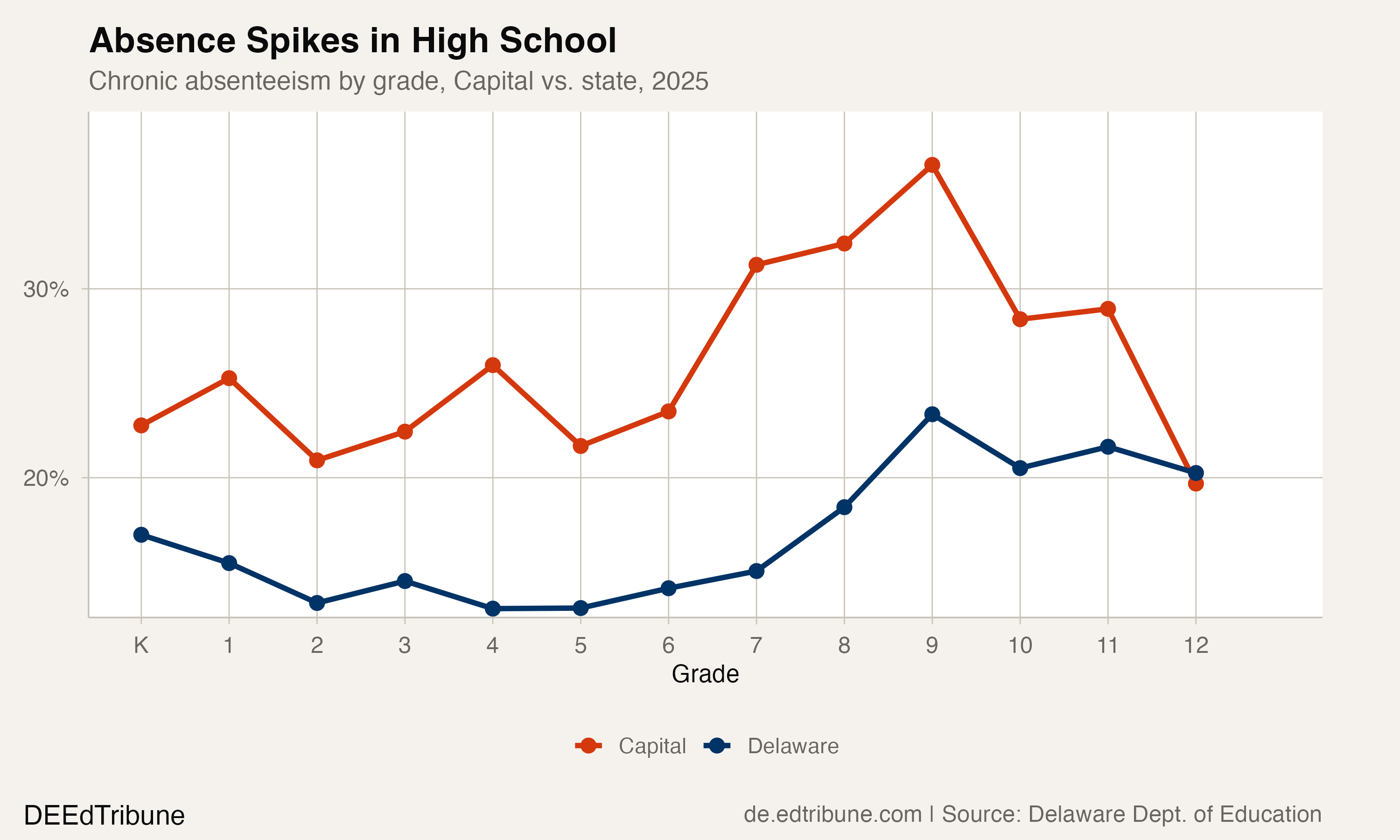
The gap between Capital and Delaware widens as students get older. In kindergarten, Capital runs about 6 points above the state. By 9th grade, the gap is 13 points. Whatever is driving Capital's attendance problem gets worse at the transition to high school.
Poverty as both explanation and insufficient answer
Capital's economically disadvantaged students have a chronic absenteeism rate of 35.0%, with 3,398 students, roughly 45% of the district's enrollment, falling into that category. The poverty gap within the district is stark: economically disadvantaged students are chronically absent at nearly double the rate of their peers (35.0% vs. 19.0%, a 16.1 percentage-point gap).
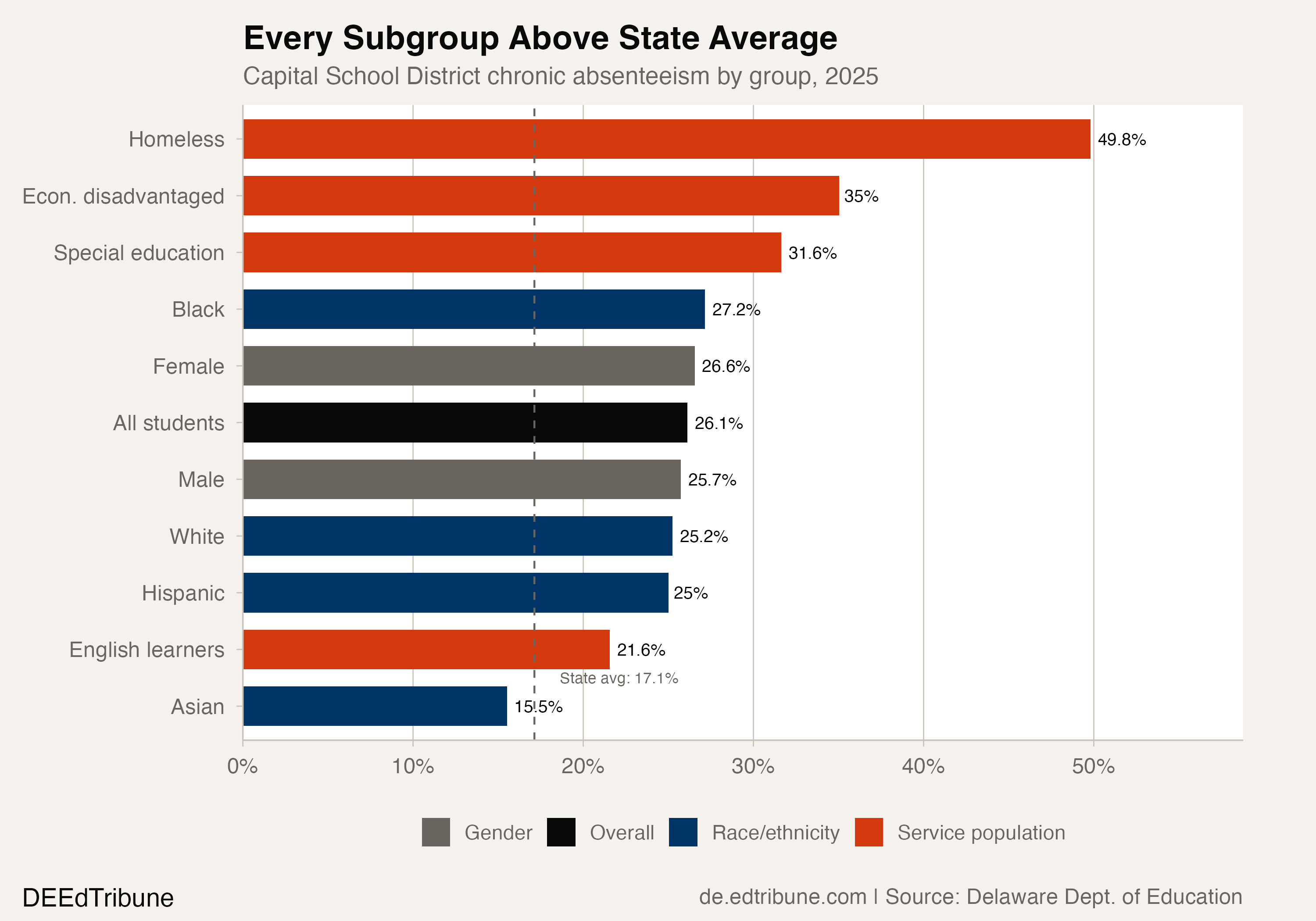
But poverty does not explain the full picture. Capital's non-economically-disadvantaged students also post a 19.0% chronic rate, higher than the overall state average of 17.1%. Even the district's most advantaged students are more absent than the typical Delaware student. The attendance problem permeates the district regardless of income.
Students who are homeless face the steepest challenge. Nearly half, 49.8%, are chronically absent. Capital enrolls 522 students identified as homeless, a population where transportation barriers, food insecurity, and housing instability compound to make regular attendance structurally difficult.
How Capital compares to its neighbors
Capital sits in Kent County, the state capital's county, flanked by Caesar Rodney↗ET School District to the south and Smyrna↗ET to the north. The contrast is sharp. Caesar Rodney, which serves 9,230 students in the same county, posts an 18.0% chronic rate. Smyrna, with 6,008 students, comes in at 12.1%, less than half of Capital's rate.
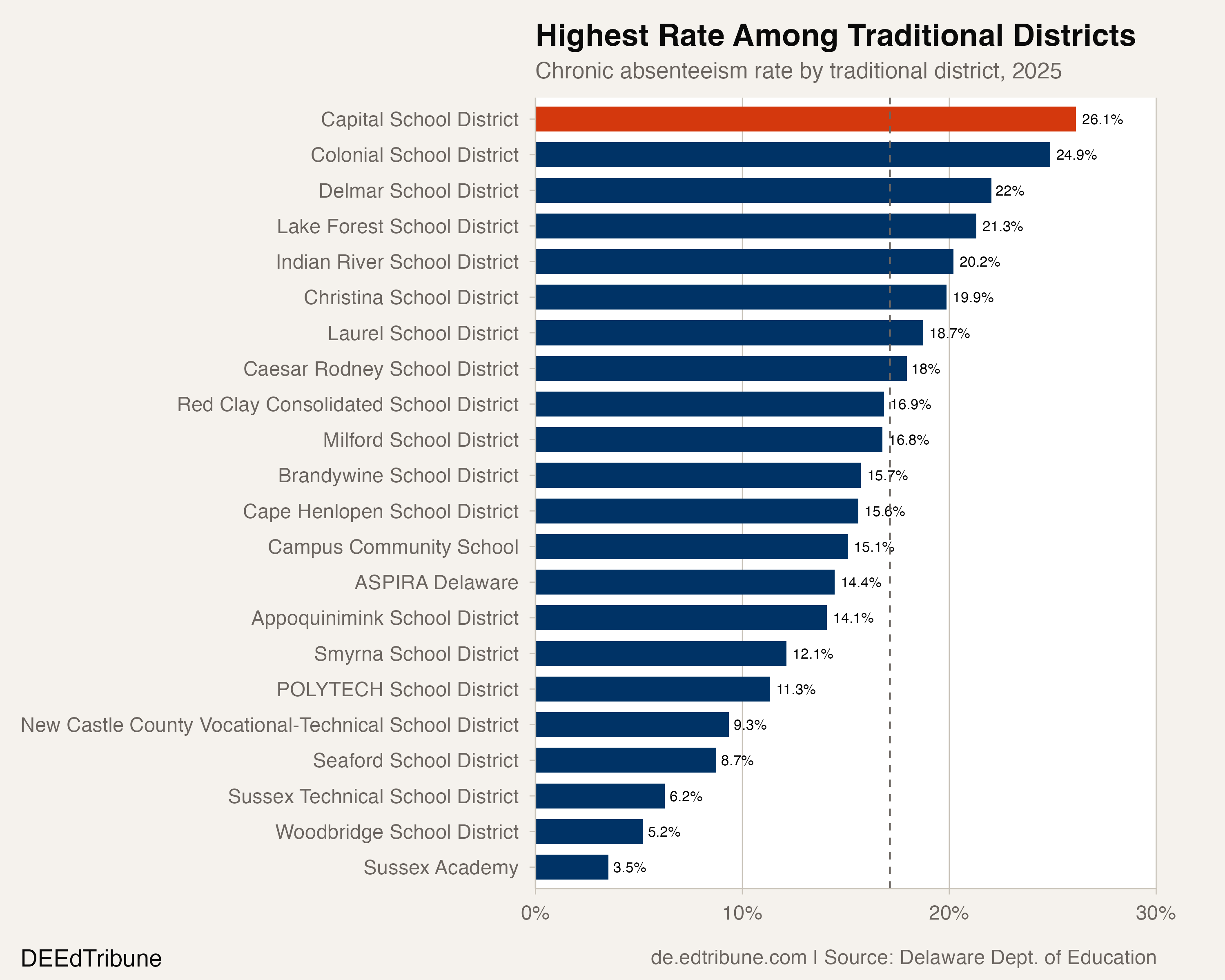
The only traditional district that comes close is Colonial at 24.9%, and Colonial is in New Castle County, 70 miles north. Capital is Kent County's attendance outlier.
The district's economically disadvantaged chronic rate of 35.0% ranks sixth statewide, behind several charter schools with smaller enrollments. Among traditional districts, only Colonial's economically disadvantaged rate (32.2%) is in the same range. Caesar Rodney's economically disadvantaged students are chronically absent at 29.7%, and Smyrna's at 21.1%, suggesting that poverty alone does not determine the outcome. District-level factors, from attendance tracking systems to intervention protocols to school culture, shape how poverty translates into missed days.
The recovery's uneven pace
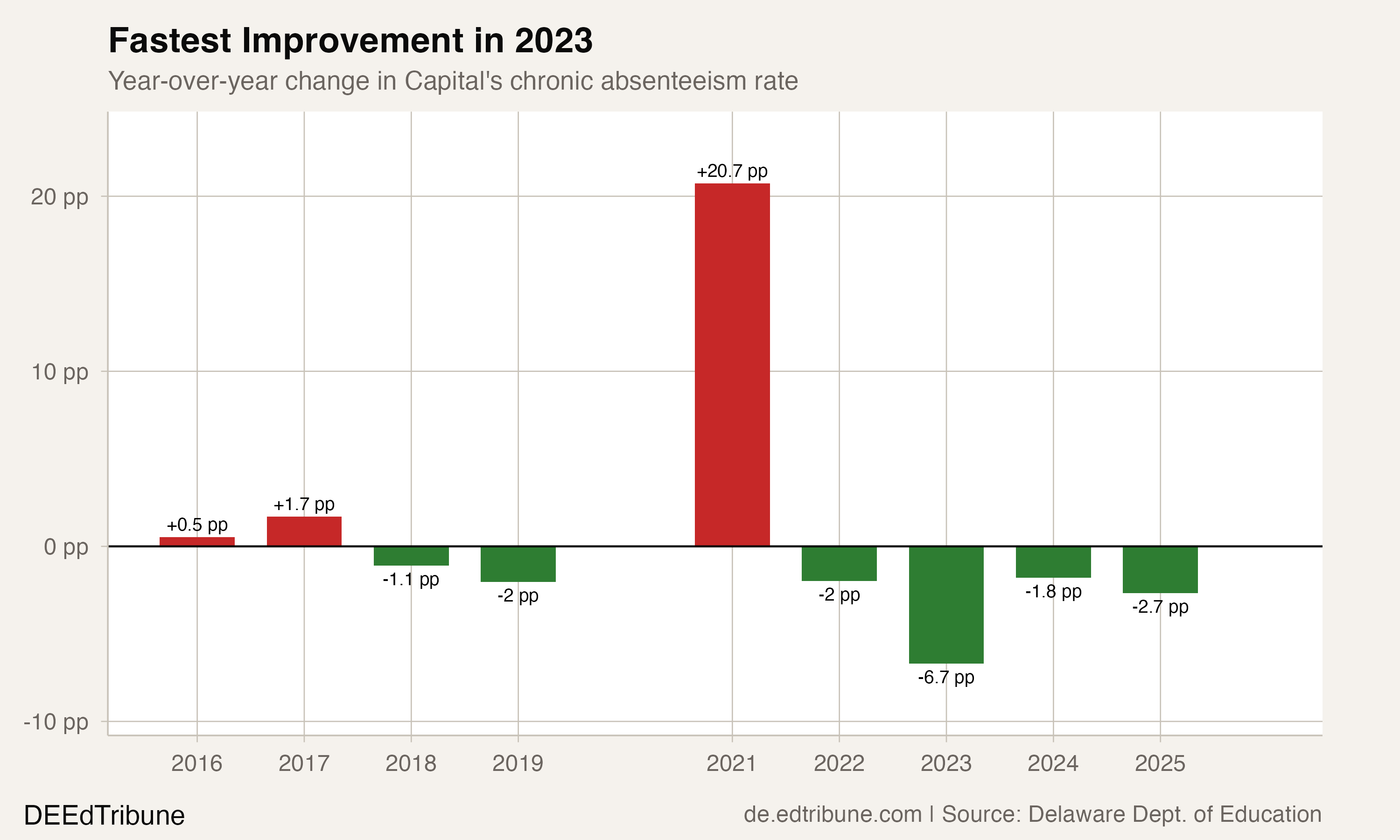
Capital's biggest single-year improvement came in 2023, when the chronic rate dropped 6.7 percentage points in one year. That coincided with the statewide post-COVID improvement wave, as the shock of pandemic-era rates spurred schools across Delaware to invest in attendance interventions.
The pace has since slowed. Capital cut 1.8 points in 2024 and 2.7 points in 2025. The deceleration mirrors a pattern seen across Delaware's highest-rate districts: the easiest attendance gains came first, pulling back students whose absence was most situational. The remaining chronically absent population skews toward students with deeper barriers.
One piece of good news embedded in the data: Capital's enrollment is rebounding. The district dropped from 7,433 students in 2019 to 6,850 in 2021, a loss of 583 students during COVID. By 2025, enrollment had climbed back to 7,635, the highest in the dataset. Families are returning. Whether the district can attend to them, literally, is the open question.
What the data cannot show
This analysis identifies that Capital's attendance problem is structurally embedded, not a COVID artifact. The district was an outlier before the pandemic and remains one after. The chronic rate improved significantly from its 2021 peak but has not returned to its pre-COVID baseline, while the state is within two points of doing so.
What the data does not reveal is why Capital's recovery has been slower than the state's, or why its non-poor students also post above-average chronic rates. Potential explanations include differences in school climate, transportation barriers specific to Dover's geography, or the compounding effect of concentrated poverty on institutional capacity. Janice Barlow, Delaware's KIDS COUNT director, has noted that chronic absenteeism often traces to factors well beyond a family's control:
"Some kids are chronically absent because they have trouble getting to school, safe routes and things like that." -- Delaware Public Media, June 2024
Capital's average student missed 12.0 days in 2025, compared to 9.3 days before the pandemic. That gap of 2.7 extra days per student, compounded across 7,635 students, amounts to roughly 20,600 additional student-days lost each year compared to pre-COVID norms.
The district's ninth-grade crisis is the most immediate operational concern. A 36.6% chronic rate among freshmen, in a district where the graduation rate has climbed to 91%, means the pipeline of students falling behind on credits in their first year of high school runs directly counter to the district's gains in on-time graduation. Those two numbers cannot coexist indefinitely.
Detailed code that reproduces the analysis and figures in this article is available exclusively to EdTribune subscribers.
Discussion
Sign in to join the discussion.
Loading comments...