In 2021-22, more than half the students at Seaford Senior High School were chronically absent. The 52.6% rate meant that in a building of 981 teenagers, 516 were missing at least 18 school days per year. Across the district, nearly one in three students qualified as chronically absent, a rate 4 percentage points above the state average and among the worst in Delaware.
Three years later, the high school's rate is 16.3%. The district-wide rate is 8.7%, less than half the state average. Seaford↗ET did not simply recover from COVID. It overcame a chronic attendance problem that predated the pandemic by at least a decade.
A district that was never average
Before COVID, Seaford's chronic absenteeism rate hovered around 20-21% from 2015 through 2018, consistently 5 to 6 percentage points above the state average. Even the district's best pre-pandemic year, 2018-19, clocked in at 18.1%, three points above the statewide 15.1%.
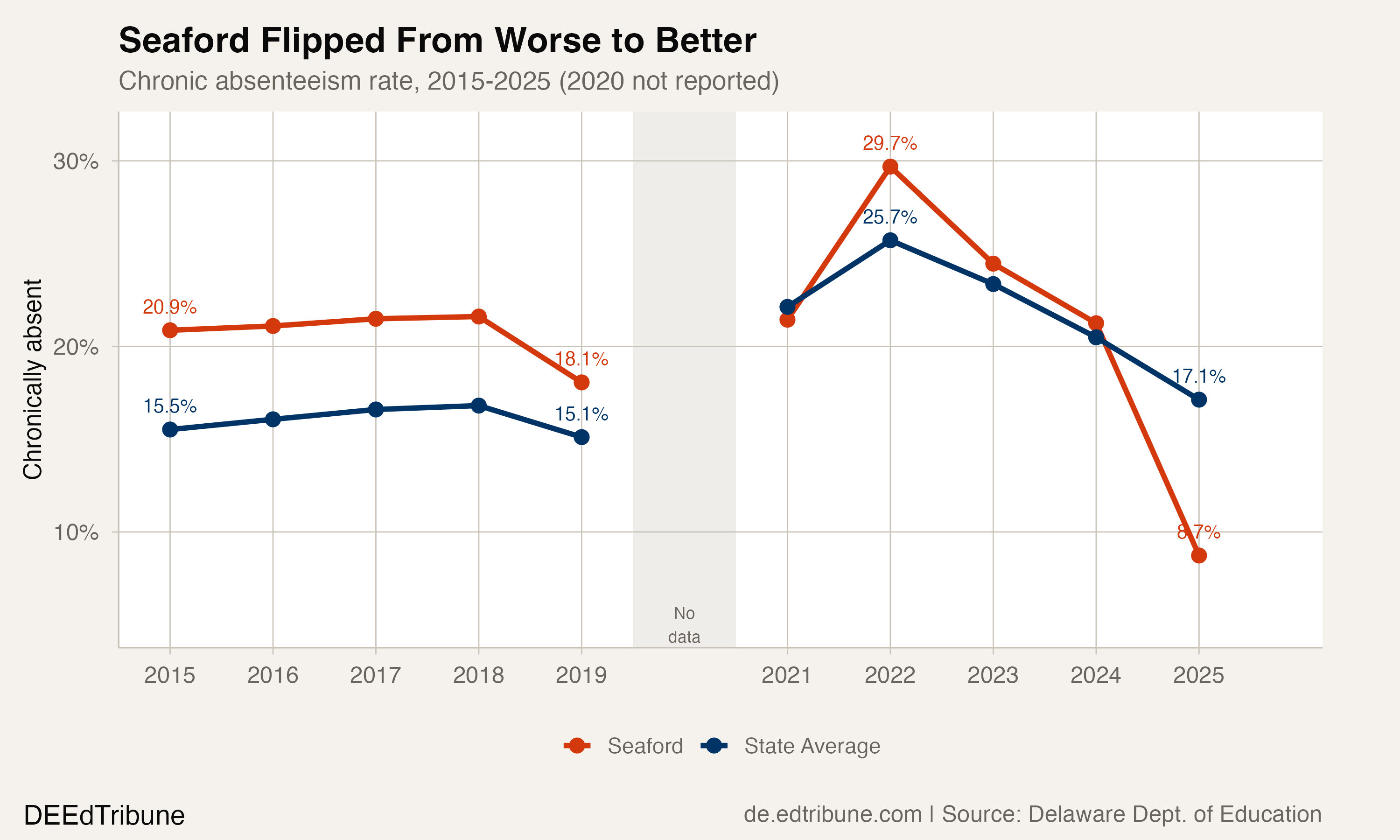
The pandemic made things worse, but the baseline was already bad. Seaford ranked 32nd out of 43 districts in 2019. It was not a district with a brief COVID disruption to fix. It was a district with a structural attendance problem, serving roughly 3,900 students in a rural Sussex County community where more than 40% of students are economically disadvantaged.
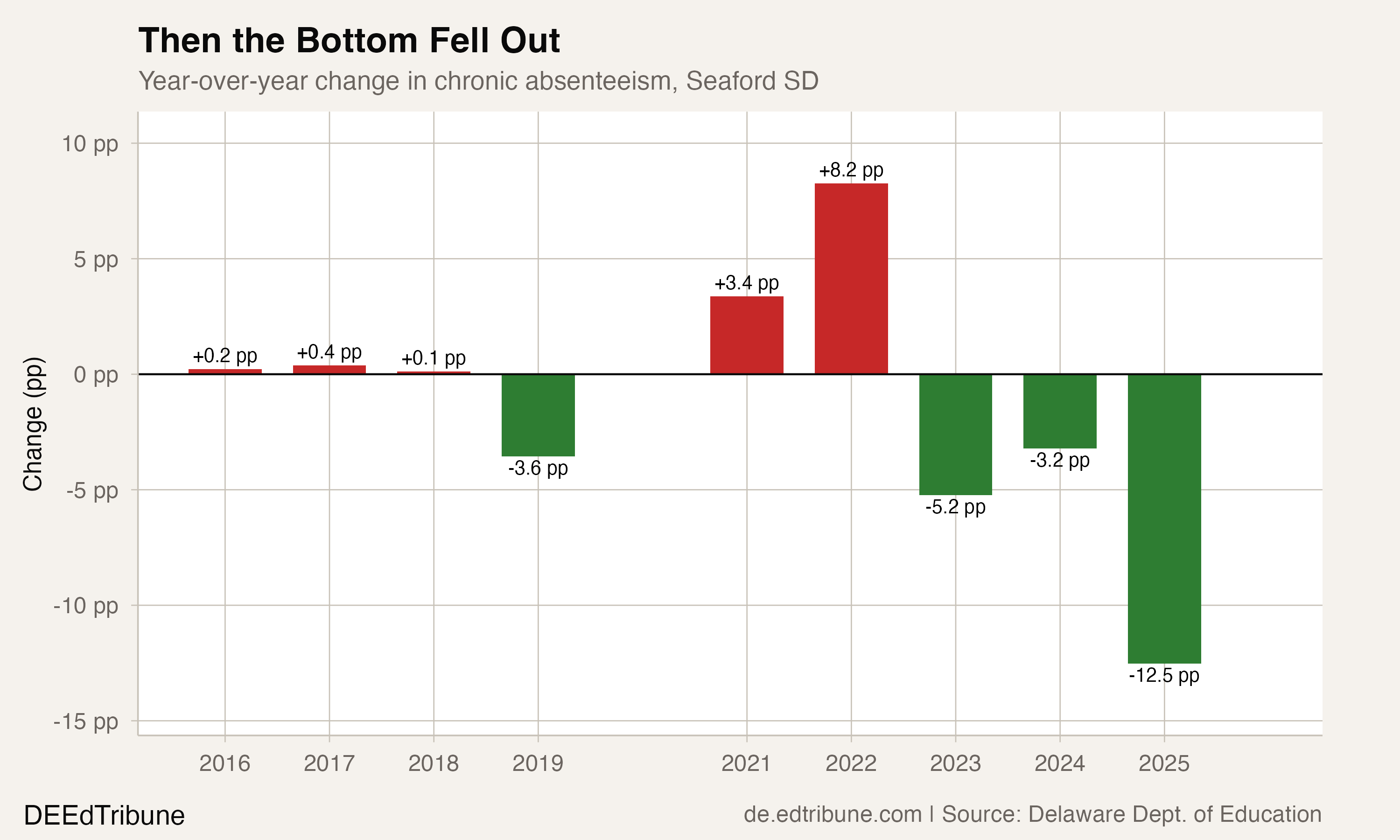
The turnaround came in stages. In 2022-23, the rate fell 5.2 points. In 2023-24, another 3.2 points. Then in 2024-25, the rate plunged 12.5 points in a single year, the largest year-over-year improvement of any traditional school district in Delaware.
Inside the schools
The improvement reached every building, though the scale varied.
Seaford Senior High School produced the single most striking turnaround: from 52.6% chronically absent in 2022 to 16.3% in 2025, a 36.3 percentage-point drop. That translates to 339 fewer students missing significant school time. The high school had been Seaford's worst performer for a decade, consistently above 40% before COVID.
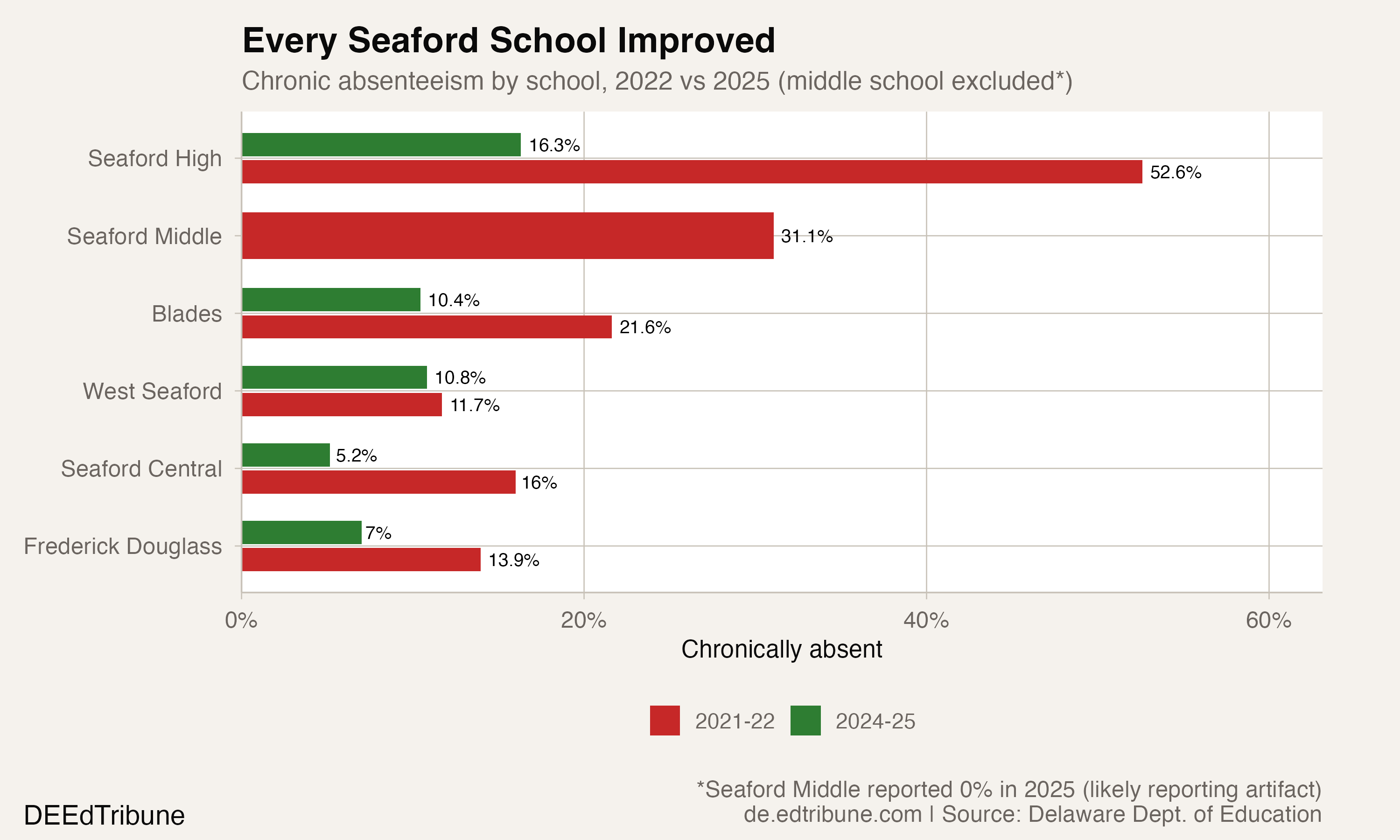
Frederick Douglass Elementary, a 2020 National Blue Ribbon School recognized for closing achievement gaps, dropped from 14.0% to 7.0%. Seaford Central Elementary fell from 16.0% to 5.2%.
One significant caveat: Seaford Middle School reported a 0% chronic absenteeism rate in 2024-25, down from 26.4% the year before. Zero chronically absent students out of 874 would be unprecedented for any school of that size in Delaware. This figure likely reflects a data reporting change rather than an actual elimination of chronic absence. The middle school's numbers are excluded from the school-level chart above. Even without the middle school, the district's improvement is substantial.
Two superintendents, one trajectory
The turnaround spans two administrations. Corey Miklus, who arrived at Seaford as Director of Instruction in 2015 and became superintendent in 2020, inherited a district that ranked last in English Language Arts and Math among Delaware schools. He oversaw the adoption of the Bookworms literacy curriculum developed at the University of Delaware. Frederick Douglass Elementary earned a National Blue Ribbon award in 2020, and West Seaford Elementary was named a 2023 National ESEA Distinguished School.
"One thing that makes me proud about Seaford is that we fight for every single student and family." -- UD Magazine, January 2021
Miklus left for the Caesar Rodney School District superintendency in 2023. Dr. Sharon DiGirolamo, who had served as Seaford's Director of Special Education since 2015 and Assistant Superintendent since 2020, succeeded him. The largest single-year improvement, the 12.5-point drop in 2024-25, occurred during DiGirolamo's tenure.
The continuity matters. DiGirolamo did not arrive from outside. She helped build the systems Miklus put in place and then accelerated them.
What the district did differently
Seaford adopted PowerSchool's Attendance Intervention platform, which automates parent notifications and flags students showing early warning signs of chronic absence. A Johns Hopkins University evaluation of the tool's deployment in Seaford found that elementary students in treatment schools attended approximately two more days per year than comparison students, with chronic absenteeism rates declining measurably.
At West Seaford Elementary, principal Laura Schneider implemented a system that Education Week profiled in 2023. Her approach involved five core elements: early September data analysis to identify at-risk students, a seven-member attendance team meeting twice monthly, daily teacher contact with families for every absence, check-in mentors for highest-risk students, and direct provision of barriers like transportation and clothing.
"The bottom line is that it doesn't matter which curriculum you choose if your classroom seats are empty." -- Laura Schneider, West Seaford Elementary principal, Education Week
In 2021-22, the school's chronic absenteeism among Black students, who make up roughly 40% of enrollment, fell from 30% to 7% in a single year. West Seaford's overall rate has held steady in the 10-11% range in the years since.
The poverty gap shrank too
Among Seaford's economically disadvantaged students, chronic absenteeism fell from 38.0% in 2022 to 11.8% in 2025, a 26.2 percentage-point improvement. That group's pre-COVID rate was 23.0%, meaning low-income students are now 11.2 points below where they were before the pandemic.
The gap between economically disadvantaged and total students in Seaford narrowed from 8.3 percentage points in 2022 to 3.1 points in 2025. In a district where the highest-need students historically had the worst attendance, the improvement reached them first and furthest.
Sussex County context
Seaford's results are not an isolated phenomenon in southern Delaware. Woodbridge↗ET, a neighboring Sussex County district of 2,700 students, dropped from 24.2% to 5.2% over the same period. Together, Seaford and Woodbridge are two of only four traditional districts in the state now below their pre-COVID chronic absenteeism rates.
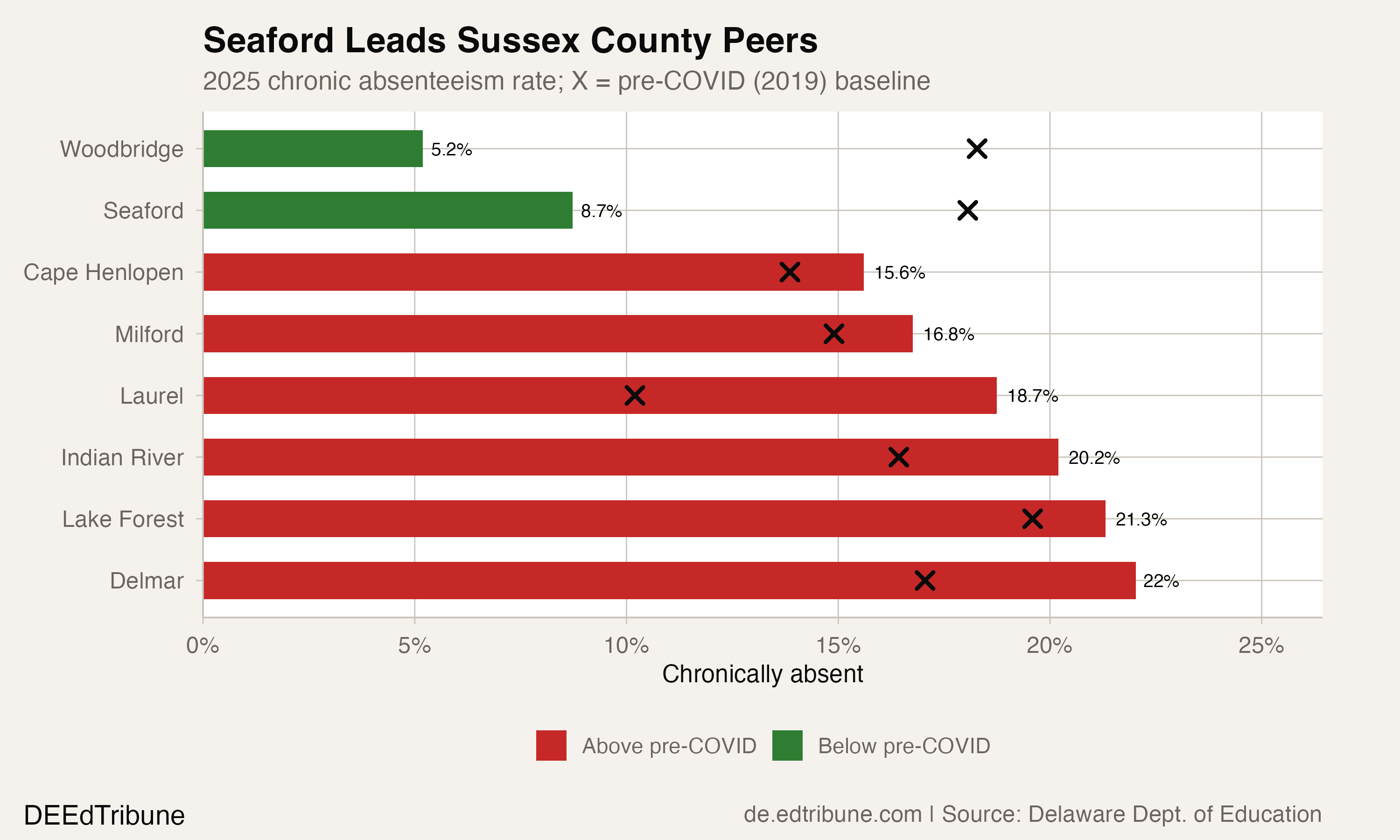
But most of their peers have not followed. Indian River↗ET, Sussex County's largest district, remains at 20.2%. Lake Forest↗ET is at 21.3%. Delmar↗ET is at 22.0%. Among the eight Sussex and Kent County traditional districts in Seaford's peer group, six still exceed their pre-COVID rates.
Seaford and Woodbridge may have discovered something transferable, or their results may reflect district-specific conditions that do not generalize. The 12.5-point single-year drop at Seaford is so large that it warrants scrutiny. The middle school's implausible 0% figure suggests the district may have changed how it counts or reports absences, which could inflate the improvement.
What to watch next
Seaford's 8.7% rate is low enough that sustaining it will be harder than achieving it. The district now sits 12th out of 41 districts statewide, surrounded by charter schools and vo-tech programs that draw self-selected, motivated student bodies. For a traditional district serving all comers in rural Sussex County, that positioning is unusual.
The test comes in 2025-26. If the middle school's data returns to normal reporting and the district-wide rate holds near single digits, the turnaround is real and durable. If the rate rebounds, the 2024-25 figure may have been partly an artifact. Either way, the trajectory from 2022 through 2024, a steady descent from 29.7% to 21.2%, was genuine and documented. The 753 fewer students chronically absent compared to 2022 represent real children in real classrooms in a community that could not afford to lose them.
Detailed code that reproduces the analysis and figures in this article is available exclusively to EdTribune subscribers.
Discussion
Sign in to join the discussion.
Loading comments...