At the Hope Center in New Castle County, Delaware's largest family shelter, more than half of the 300-plus residents are children. They sleep in converted hotel rooms, ride buses to schools across the county, and try to keep up with classmates who go home to the same house every night.
The attendance data shows how often that effort falls short. In 2024-25, 44.9% of Delaware's students who are currently homeless were chronically absent, missing 10% or more of the school year. That is 2.6 times the statewide rate of 17.1%. Of the 3,946 students the state identified as homeless, 1,772 missed enough school to be classified as chronically absent.
The rate is down from its pandemic peak. In 2021-22, 64.2% of students who are currently homeless were chronically absent, a number so high it meant the typical student who is currently homeless missed more school than not. But here is the counterintuitive finding: the current 44.9% rate is actually lower than the pre-COVID rate of 48.6% in 2018-19. Delaware's students who are currently homeless, as a group, attend school more consistently now than they did before the pandemic upended everything.
The gap that narrowed both ways
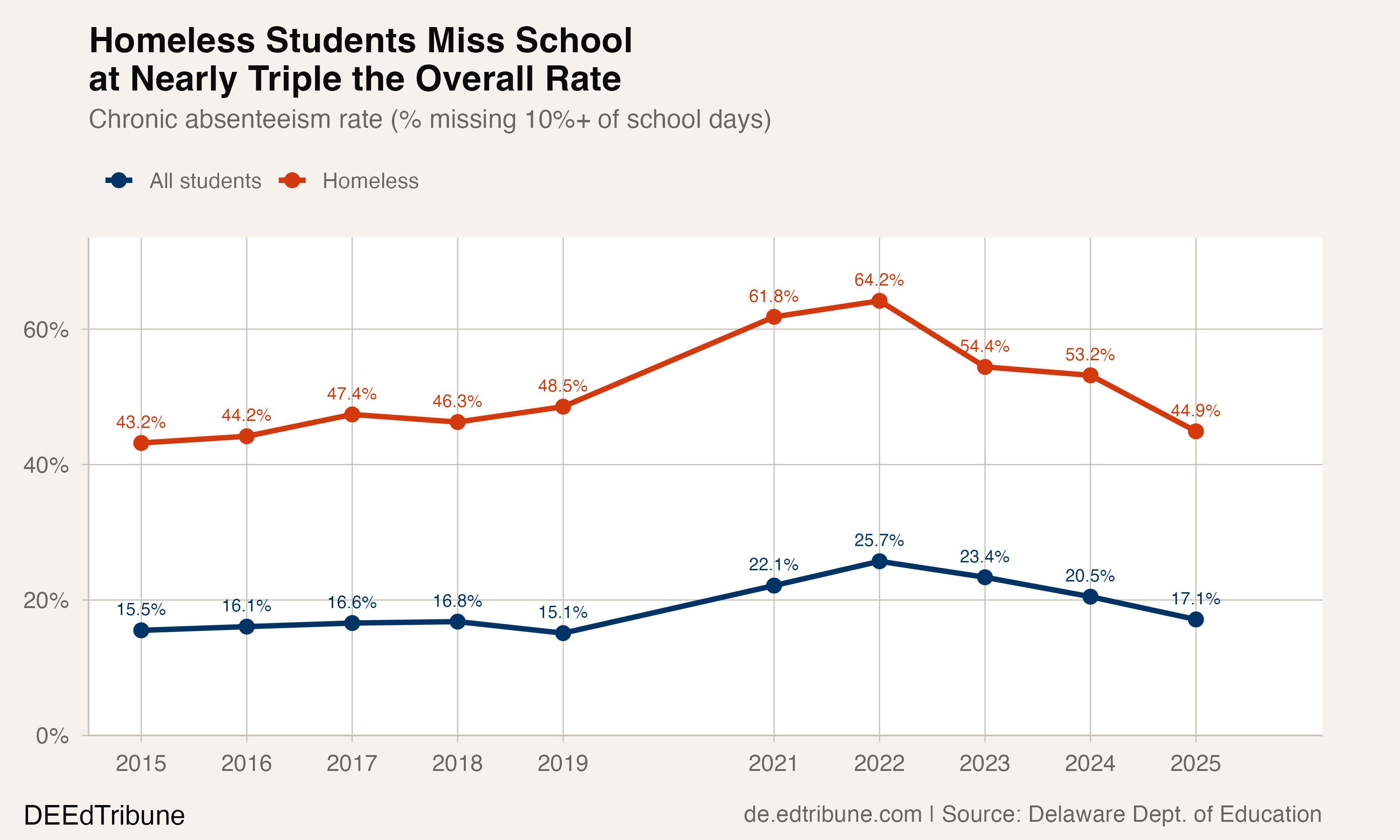
The story is not simply that students who are currently homeless miss more school. It is that both the homeless rate and the overall rate rose during COVID, and the homeless rate has come down faster.
Before the pandemic, the gap between homeless and overall chronic absenteeism was widening: 27.7 percentage points in 2014-15, climbing to 33.4 pp by 2018-19. COVID blew the gap out to 39.7 pp in 2020-21. But by 2024-25, it had closed to 27.8 pp, matching the level last seen in 2014-15 (27.7 pp), the first year in the dataset.
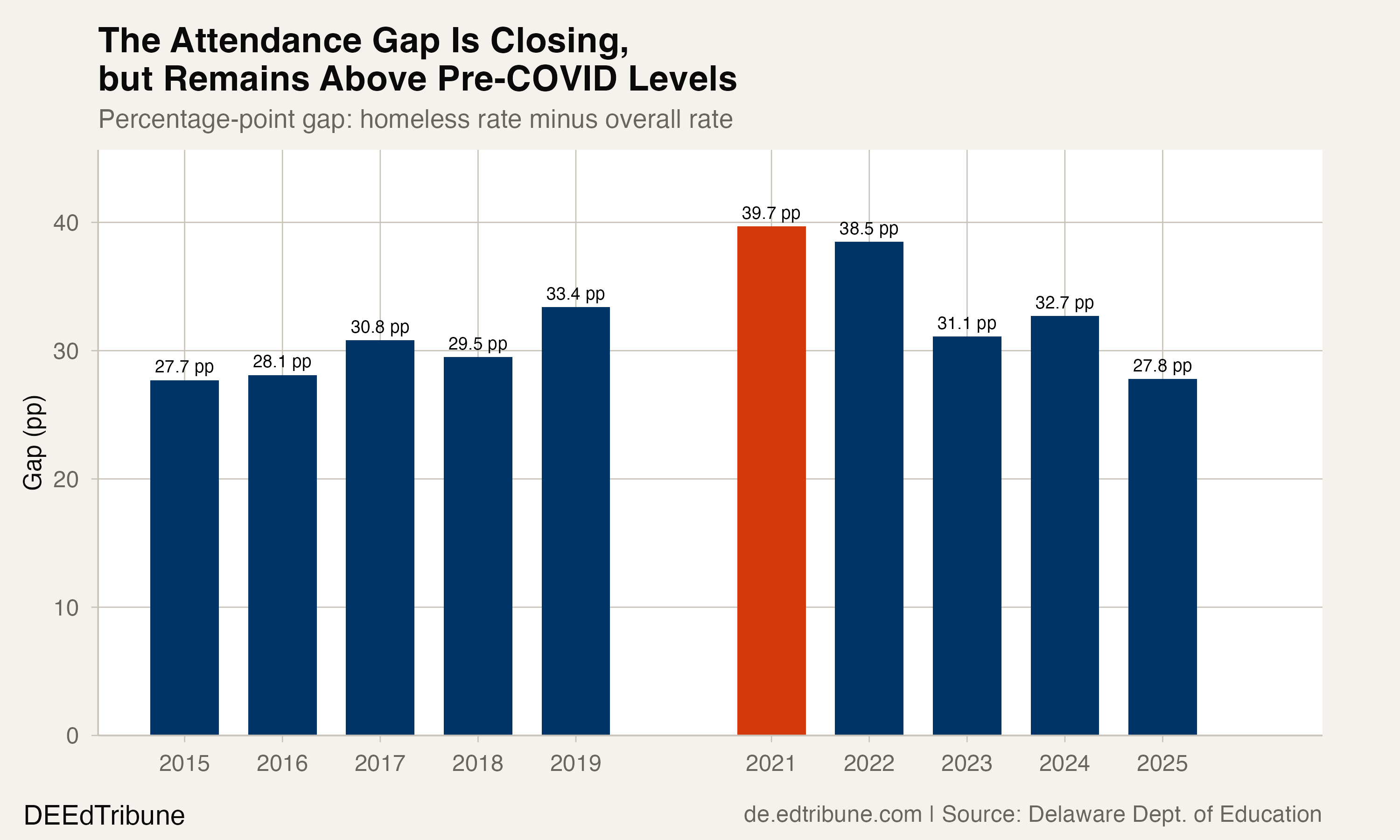
That 27.8 pp gap is 5.6 points narrower than the pre-COVID gap and 11.9 points narrower than the pandemic peak. The gap closed because students who are currently homeless recovered faster: their chronic absenteeism rate fell 19.3 points from peak, compared to 8.6 points for all students. The overall statewide rate has recovered 81% of the way back to pre-pandemic levels. The homeless rate has overrecovered, dropping below its pre-COVID baseline.
1,772 students, 16.7 days
The rate is one measure. The human count is another. In 2024-25, 1,772 students who are currently homeless were chronically absent. That is down from a peak of 2,374 in 2022-23, when the count of students who are currently homeless itself surged to 4,362, nearly 1,000 more than the prior year. The 2022-23 spike in identification aligns with national trends: public schools identified 1,374,537 students who are currently homeless that year, a 14% increase.
Students who are currently homeless in Delaware missed an average of 16.7 school days in 2024-25, compared to 9.6 days for all students, a difference of more than seven instructional days. For a student enrolled an average of 144 days (compared to 159 for the typical student), those 16.7 absences represent 11.6% of their enrolled time.
The identification count matters for funding. Delaware received McKinney-Vento grants to support 14 districts and charter schools in facilitating enrollment, attendance, and school success for students who are currently homeless. With 3,946 students identified statewide, the per-student allocation from federal grants alone is thin. The McKinney-Vento Act defines eligibility broadly: students living doubled-up with other families, in shelters, in motels, or unsheltered all qualify.
Where the crisis concentrates
Not all districts face the same challenge. Among districts with at least 20 students who are currently homeless, chronic absenteeism rates ranged from 0% at Edison Charter to 73.1% at Delmar↗ET.
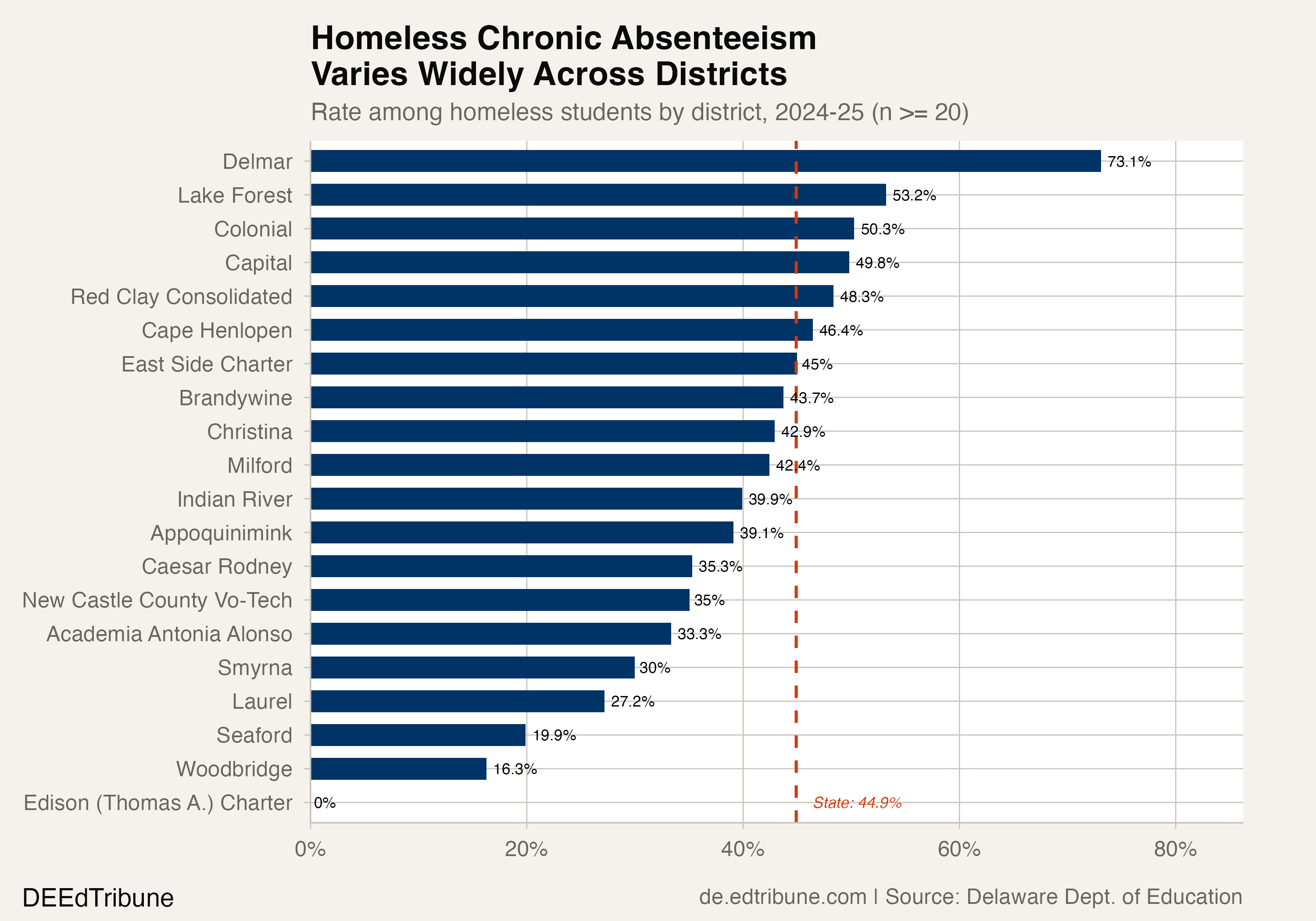
Capital School District↗ET in Dover had 522 students who are currently homeless, the second-largest count in the state, and 49.8% were chronically absent. Colonial School District↗ET, which has piloted the D.A.S.H. (Data Access for Student Health) collaborative with Nemours Children's Health to link attendance data with primary care providers, still saw 50.3% of its 360 students who are currently homeless chronically absent. The pilot, launched in 2021, alerts a child's doctor when absences exceed a threshold, but the results for students who are currently homeless in particular suggest that health-data integration alone does not overcome housing instability.
Christina School District↗ET had the largest population of students who are currently homeless at 580, with 42.9% chronically absent. That is 249 students in a single district.
The standout on the other end is Seaford School District↗ET. Just 19.9% of its 206 students who are currently homeless were chronically absent, less than half the state homeless rate. Seaford has adopted PowerSchool Attendance Intervention, which a Johns Hopkins evaluation found reduced chronic absenteeism and increased elementary attendance by roughly two additional days per student. Woodbridge↗ET, Seaford's neighbor in Sussex County, posted an even lower 16.3% rate among its 86 students who are currently homeless.
The hierarchy of disadvantage
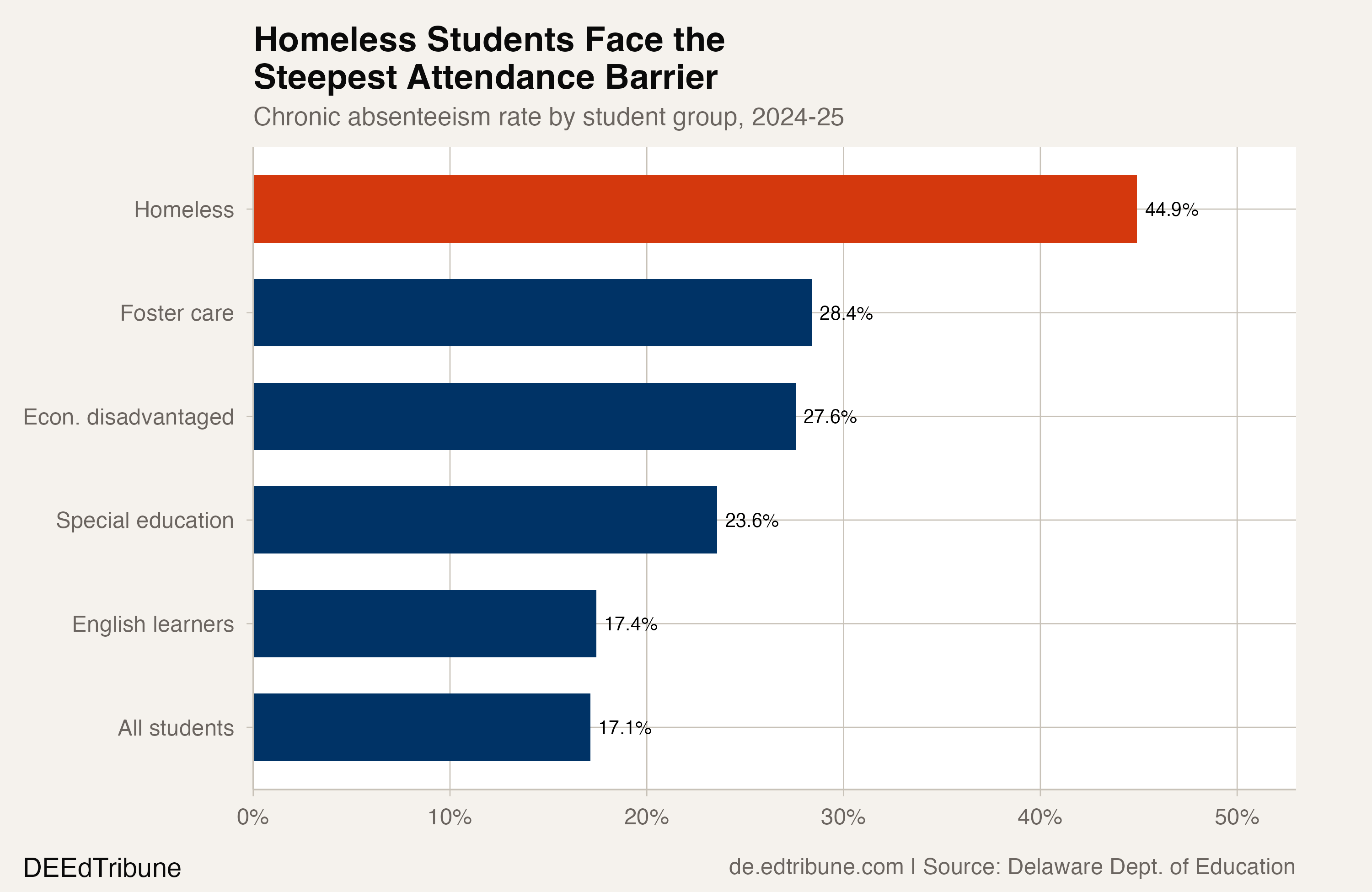
Homelessness sits at the top of Delaware's attendance hierarchy. At 44.9%, students who are currently homeless' chronic absenteeism rate is 16.5 percentage points higher than the next most affected group, students in foster care at 28.4%. Economically disadvantaged students are at 27.6%, special education students at 23.6%, English learners at 17.4%, and all students at 17.1%.
These categories overlap. A student who is currently homeless may also be economically disadvantaged and receiving special education services. But the stacking matters: homelessness compounds other risk factors in ways that make the attendance gap larger than any other single category produces.
Students in foster care, a smaller group of 458, show a pattern worth noting. Their 28.4% rate in 2024-25 has returned almost exactly to the pre-COVID rate of 28.3% in 2018-19. Unlike students who are currently homeless, who overrecovered, students in foster care are back where they started, suggesting the pandemic's disruption to their attendance was temporary rather than structural.
Ninth grade: where the crisis peaks
Among students who are currently homeless, chronic absenteeism is not uniform across grades. In 2024-25, 9th graders had the highest rate at 58.2%, meaning nearly three in five freshmen who are homeless were chronically absent. Tenth graders followed at 50.7%. The transition into high school, already a known attrition point for at-risk students, is where housing instability does the most damage to attendance.
Kindergartners were also heavily affected at 48.2%, suggesting that the youngest students who are currently homeless, who depend entirely on adult caregivers for transportation, face acute barriers to getting to school. Grades 4 and 5, at 39.7% and 38.5%, were the relative bright spots, though "bright spot" is generous when four in 10 students are still chronically absent.
What the system sees and what it does not
Delaware's approach to student homelessness operates through two main channels. The first is identification: schools designate McKinney-Vento liaisons who identify qualifying students and connect them to services including transportation, school supplies, and enrollment stability. The second is attendance intervention.
"Nemours Children's Health, Colonial School District, and the Delaware Health Information Network have announced the formation of the Data Access for Student Health (D.A.S.H.) collaborative, one of just two such projects in the country." -- Nemours Children's Health, August 2021
The D.A.S.H. model is designed to catch health-related absences. If a student misses three consecutive days or 10 total days, their primary care provider gets an alert. The premise is that many absences have underlying health causes, from unmanaged asthma to untreated mental health conditions, that a doctor could address if they knew the student was missing school.
For students who are currently homeless, though, the barriers are more basic. Delaware passed a mental health excused absence law in 2023 allowing students to miss school for mental or behavioral health reasons without a doctor's note. A student who is absent for a second mental health day must be referred to a school-based specialist. Whether students who are currently homeless, who change schools and addresses more frequently, consistently receive those referrals is not tracked in the public data.
What recovery means for these students
The overrecovery of homeless attendance rates, dropping below pre-COVID levels, raises a question that the data alone cannot answer. Did pandemic-era investments in identification and intervention produce lasting improvements? Or did the composition of the population of students who are currently homeless change in ways that made the group's average attendance look better without individual students attending more?
The count of students who are currently homeless rose from 3,275 in 2018-19 to 3,946 in 2024-25, a 20.5% increase. If newly identified students were more stably housed than previously identified students (doubled-up with family rather than living in shelters, for instance), the average rate could improve even if shelter-based students' attendance did not change.
The 2024 Point-in-Time survey identified 1,358 residents who are homeless in Delaware, the largest count in the survey's 18-year history outside of COVID-era years, a 9% increase from 1,245 in 2023. The Sunday Breakfast Mission in Wilmington reported that it is "not unusual to have 45 to 50 women and children overnight" compared to only 5-15 before the pandemic. The underlying housing crisis has not eased. What changed is how schools respond to it.
Delaware's overall chronic absenteeism rate is on pace to return to pre-COVID levels by 2026. For students who are currently homeless, getting below 45% is meaningful but still means that nearly half the population misses a month or more of instruction. Seaford and Woodbridge show that district-level rates in the teens are achievable. The 1,772 students who were chronically absent last year will move through the system regardless of whether those models spread.
Detailed code that reproduces the analysis and figures in this article is available exclusively to EdTribune subscribers.
Discussion
Sign in to join the discussion.
Loading comments...