In Seaford↗ET, a former DuPont company town in inland Sussex County, roughly one in three boys does not finish high school in four years. The male graduation rate there is 67.7%. In Christina↗ET, the sprawling district that straddles Newark and part of Wilmington, it is 67.3%.
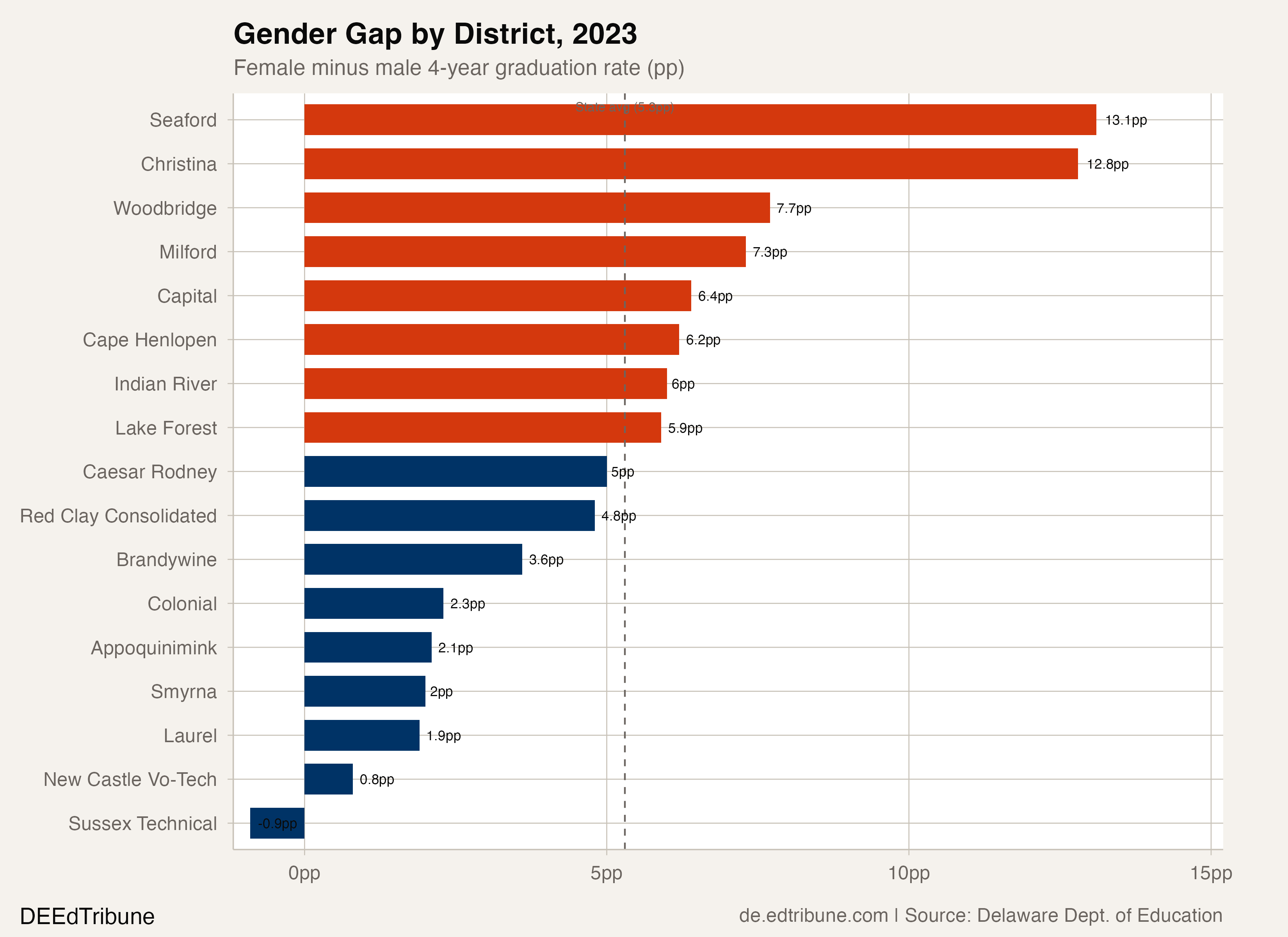
Those numbers belong in a different state. Delaware's statewide male graduation rate is 86.2%, and in several suburban and vo-tech districts, boys graduate at rates above 90%. But in Seaford and Christina, male students finish at rates that would rank among the lowest state averages in the country. The female graduation rate in both districts hovers near 80%, producing gender gaps of 13.1 and 12.8 percentage points, respectively. The national average gender gap is roughly 6.5 points.
These two districts, separated by 80 miles and serving different communities, share one distinction: they are where Delaware's largest graduation gaps concentrate, and those gaps fall overwhelmingly on male students.
A gap that runs deepest where poverty runs highest
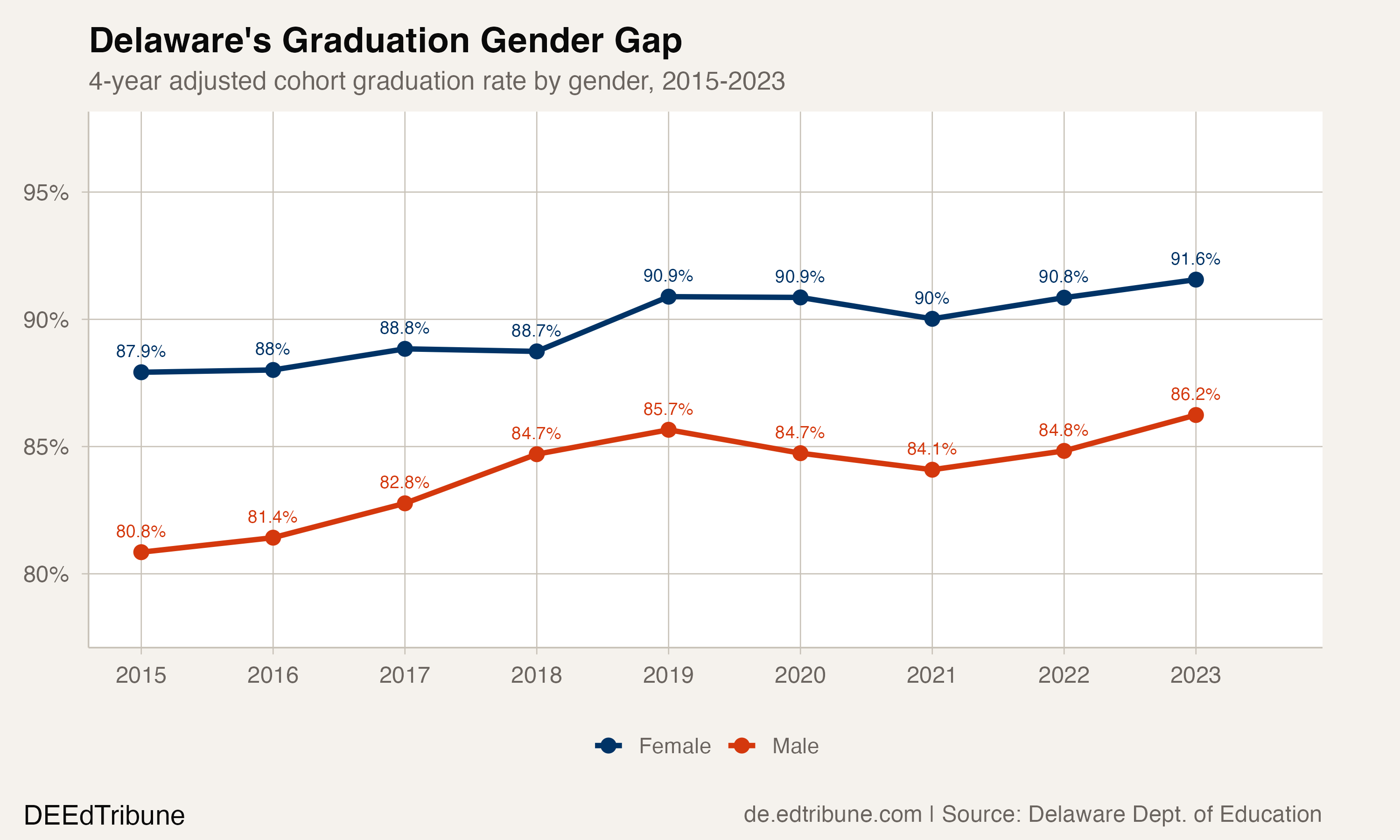
Statewide, the gender gap in Delaware's four-year adjusted cohort graduation rate is 5.3 percentage points: 91.6% of girls graduate on time versus 86.2% of boys. That is within range of the national average. But the state figure obscures massive variation.
Eight of Delaware's 17 districts with complete gender data have gaps exceeding the state average. The two outliers, Seaford and Christina, stand apart. The next-largest gap, Woodbridge at 7.7 points, is four full percentage points smaller than Seaford's.
The pattern is not random. Seaford carries the highest poverty rate of any district in Delaware, at 19.8%, a legacy of DuPont's plant closure that stripped the town of its economic anchor. Christina serves a student body that is 76% students of color and spans some of the lowest-income neighborhoods in New Castle County, including sections of Wilmington.
Research from the Brookings Institution's American Boys and Men Project has documented that the gender gap in education widens sharply with poverty. Girls raised in the poorest families are 57% more likely to earn a four-year college degree than boys from the same backgrounds, compared to just 8% among affluent families. The same dynamic appears to operate earlier in the pipeline: in lower-income communities, the gap between boys and girls is wider.
"The developmental gap between boys and girls starting kindergarten is much wider for children from homes with less educated mothers." Richard V. Reeves. Source: Of Boys and Men Substack
The racial dimension compounds the economic one. Nationally, the graduation gender gap is 9 percentage points among Black and Hispanic students, compared to roughly 5 points among white students. In Michigan, only 61% of Black boys graduated on time in 2021, compared to 87% of white girls in the same state. Delaware does not publish graduation rates disaggregated by both race and gender simultaneously, which makes it impossible to isolate how much of the Seaford and Christina gaps reflect racial disparities versus economic ones. That is a meaningful blind spot in the state's accountability data.
Seaford: from stable to volatile
The Seaford gender gap was not always this wide. In 2021, it measured just 2.0 percentage points, the narrowest in the nine-year dataset. Two years later, it tripled to 13.1.
The shift was driven almost entirely by the male side. Between 2021 and 2023, the male graduation rate in Seaford fell from 72.7% to 67.7%, while the female rate rose from 74.8% to 80.8%. The girls' rate recovered from a multi-year slide; the boys' rate continued its descent.
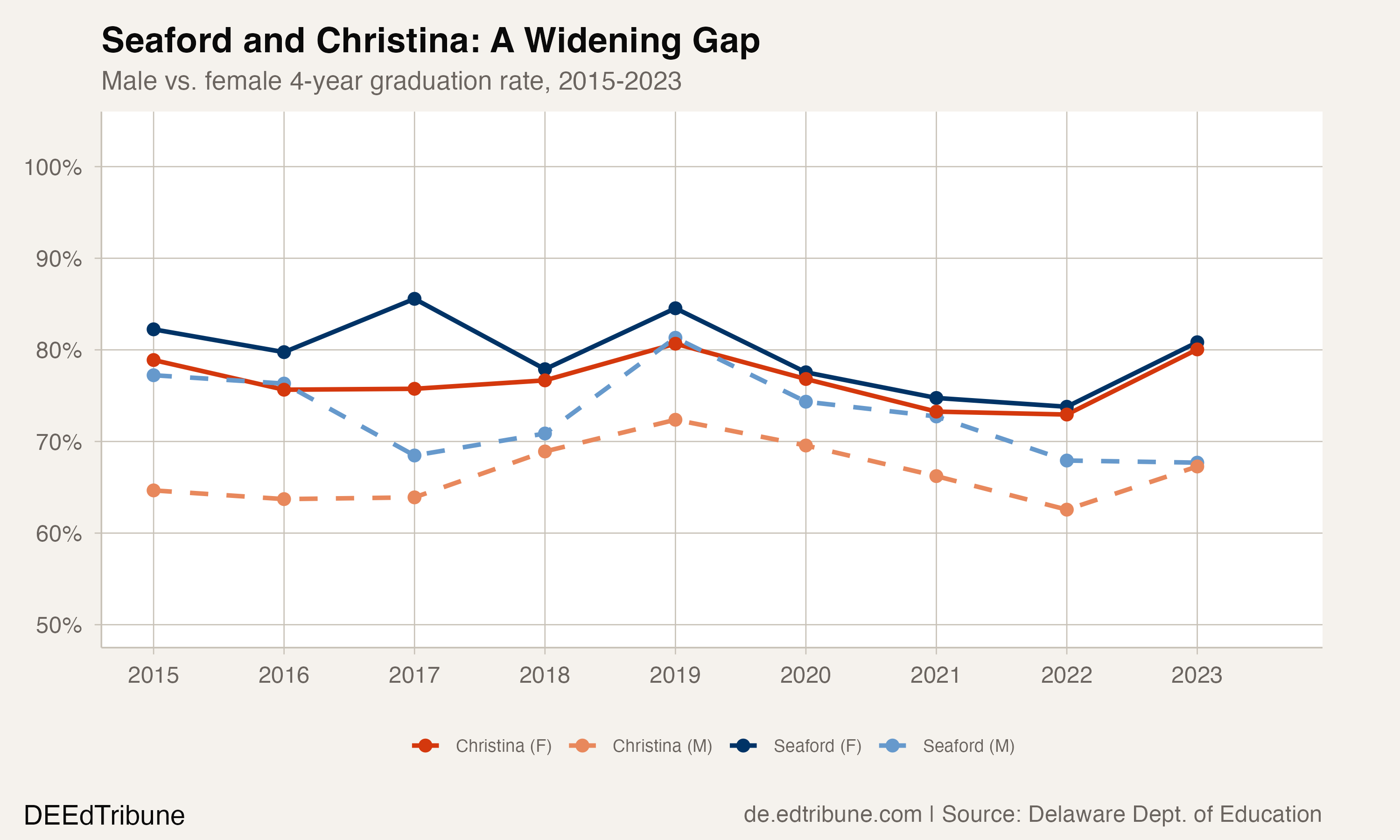
Small districts produce volatile statistics. Seaford's graduating cohort runs roughly 190 to 250 students, split across genders, so a handful of students not finishing on time can swing each rate by several points. The 17.1-point gap that appeared in 2017, then collapsed to 3.2 by 2019, illustrates this volatility.
But the direction since 2021 is not noise. The male rate has declined in back-to-back years while the female rate has climbed in back-to-back years. In a district that the Education Trust once profiled for narrowing elementary-level achievement gaps through a reading instruction overhaul, the high school pipeline tells a different story for boys.
Christina's chronic gap
Christina's gender gap is less volatile but more entrenched. In all nine years on record, the gap has been at least 7 percentage points. It peaked at 14.2 points in 2015, narrowed to 7.0 by 2021, then reopened to 12.8 in 2023.
The male graduation rate in Christina has not reached 73% in any year since 2015. It hit its low point of 62.6% in 2022, meaning that in a district serving more than 14,000 students, nearly four in 10 boys did not finish high school on time that year. Even the 2023 figure of 67.3%, which represents an improvement, leaves Christina's boys more than 18 points below the state male average.
Christina is no stranger to scrutiny. The district's overall graduation rate, which the Newark Post reported has climbed from 70% to about 74% over five years, remains the lowest in Delaware. The Redding Consortium's December 2025 vote on whether to reorganize the Wilmington portion of the district may reshape Christina's boundaries, but it will not on its own address why boys in the district's high schools are graduating at rates that trail their female classmates by double digits.
Where the gap vanishes
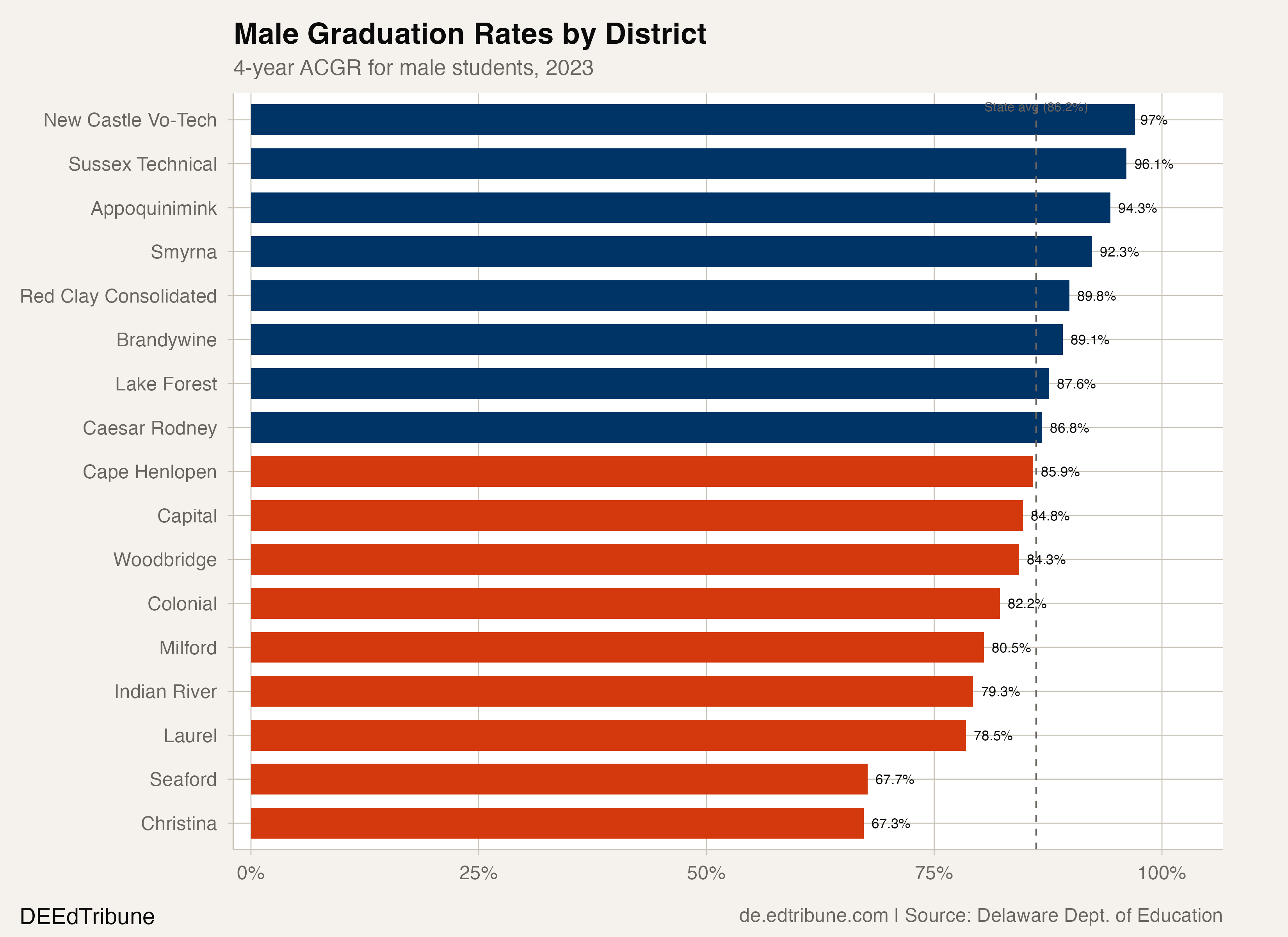
The starkest comparison in this data is not between Seaford and the state average. It is between traditional districts and vo-tech districts.
At New Castle County Vocational-Technical School District↗ET, 97.0% of boys graduated on time in 2023. The gender gap was 0.8 percentage points. At Sussex Technical↗ET, boys actually graduated at a higher rate than girls: 96.1% versus 95.2%.
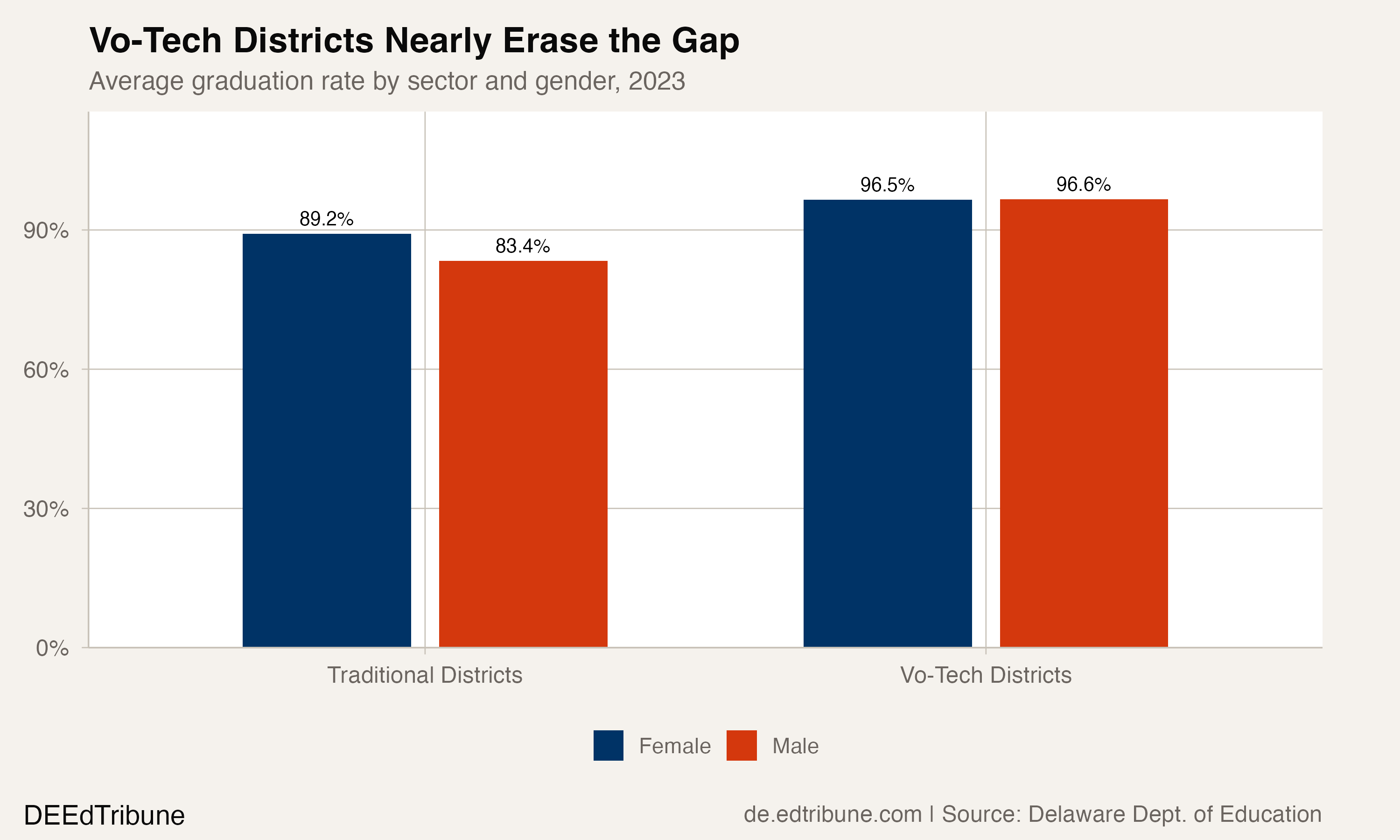
Across Delaware's vo-tech districts, the average male graduation rate was 96.6%. Across traditional districts, it was 83.4%. That is a 13-point difference in male outcomes between two systems operating in the same state, drawing from many of the same communities.
The obvious caveat: vo-tech districts admit students through an application process, which creates a selection effect. Students who apply to vo-tech programs are, by definition, more engaged with their education than a random sample. Comparing vo-tech outcomes to open-enrollment districts overstates the treatment effect of career-technical education.
But the magnitude of the difference is worth sitting with. The gender gap does not just shrink in vo-tech districts. It effectively disappears. Whatever combination of structured career pathways, visible labor-market connection, and smaller learning communities these schools provide, it appears to benefit boys and girls equally, while traditional districts do not.
What the data cannot explain
Delaware reports graduation rates by gender and by race, but not by both simultaneously. That means it is impossible to know whether the 13.1-point gap in Seaford is driven primarily by one racial group or whether it spans the district's diverse student body. Nationally, the Brookings Institution has shown that Black boys graduate at 76% compared to 87% for Black girls, a 9-point gap, while the white gender gap is roughly 5 points. Without intersectional data from Delaware, the precise mechanism in Seaford and Christina remains ambiguous.
The state also does not publicly report how discipline rates, chronic absenteeism, and special education identification differ by gender at the district level in its graduation data. National research shows boys are suspended at higher rates and referred to special education more frequently, both of which correlate with lower on-time graduation. Whether those patterns are more pronounced in Seaford and Christina than in, say, Appoquinimink (where the gender gap is just 2.1 points and the male rate is 94.3%) is a question the current data release does not answer.
The board vote that will not close this gap
The Redding Consortium's proposal to reorganize Wilmington's school boundaries has dominated Delaware education policy conversations since late 2025. If Christina loses its Wilmington schools, the district's demographics and graduation statistics will change mechanically. But redistricting moves students between systems. It does not address why boys in those systems are graduating at rates 13 points below girls.
In Seaford, 80 miles south of Wilmington and outside any redistricting conversation, the male graduation rate has fallen in two of the last three years. The question for both districts, and for the state, is whether anyone is tracking the gender dimension of graduation outcomes with the same attention as the overall rate. The gap between 67% and 97%, between boys in Christina and boys at New Castle Vo-Tech, is not a rounding error. It marks two very different sets of outcomes within the same state system.
Detailed code that reproduces the analysis and figures in this article is available exclusively to EdTribune subscribers.
Discussion
Sign in to join the discussion.
Loading comments...