In Laurel↗ET, about two in three Hispanic seniors graduated in 2023. In the same town, nearly nine in 10 white seniors did. The 24.3 percentage-point gap between them is the widest in the state, three times the statewide average, and it is not an anomaly confined to one small Sussex County district.
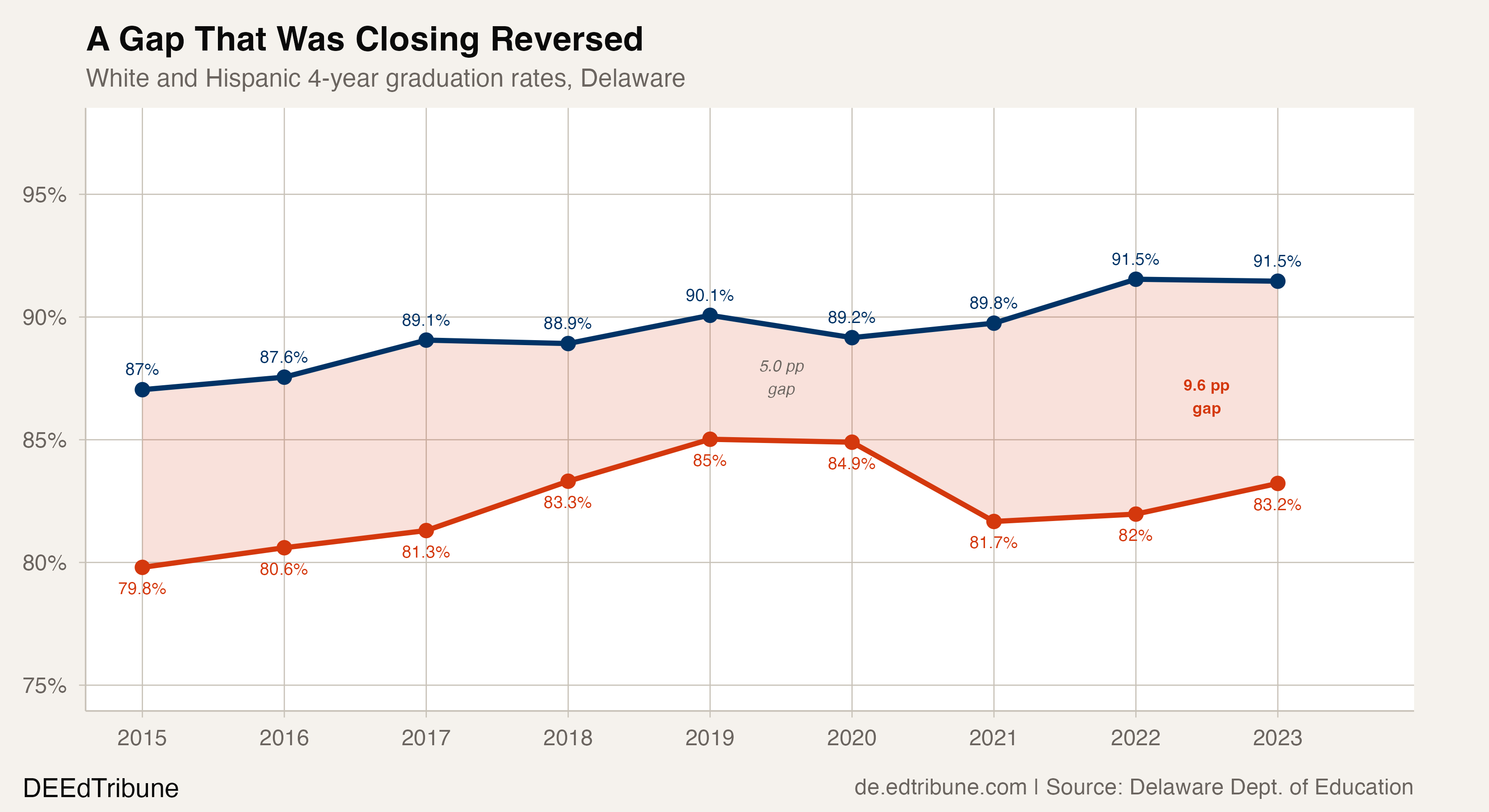
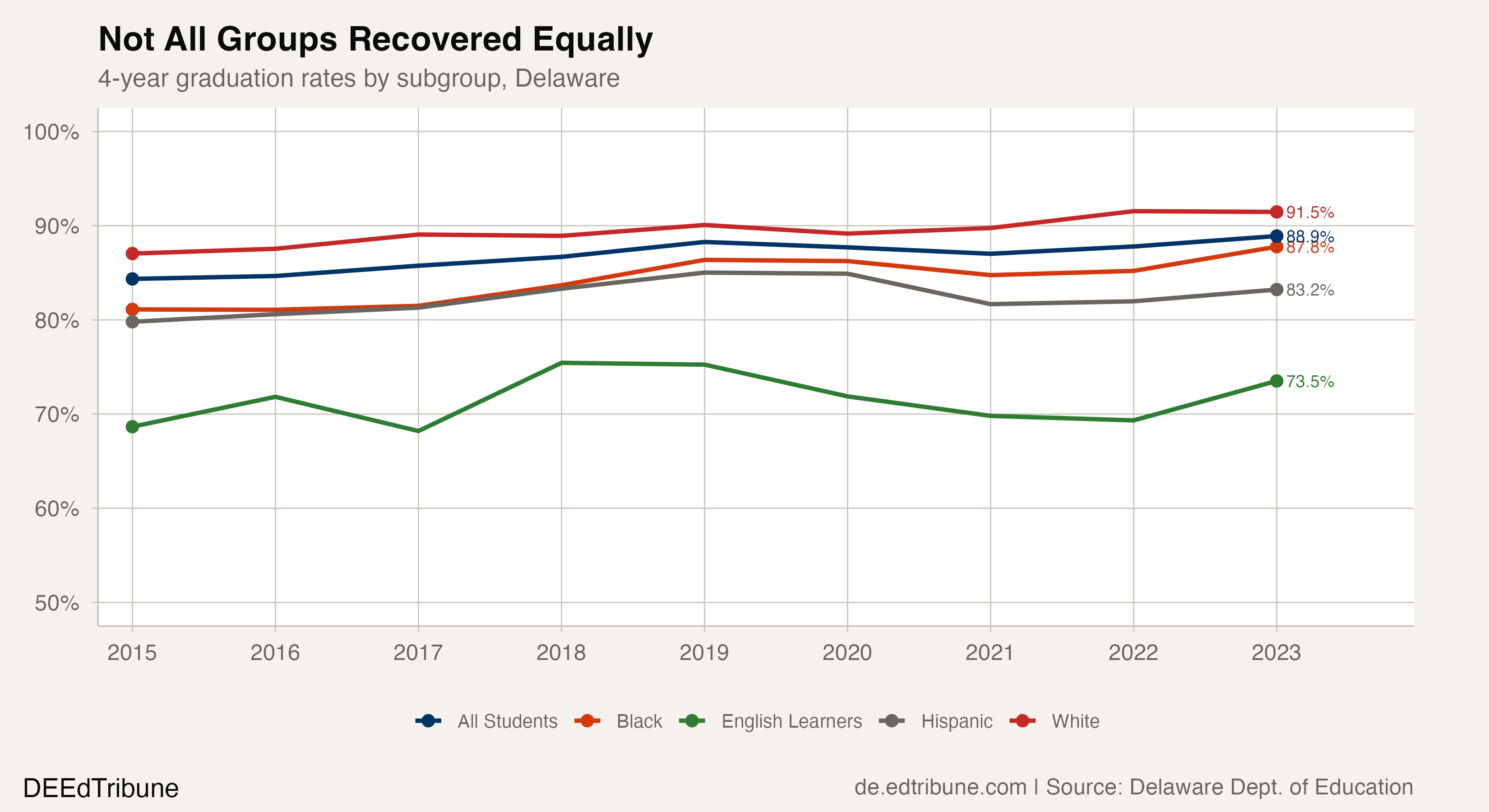
Across Delaware, the white-Hispanic graduation gap had been shrinking for four years. From 7.2 percentage points in 2015, it fell to 5.0 points by 2019, as Hispanic students pushed their four-year graduation rate to 85.0%. Then the gap reversed. It jumped to 8.1 points in 2021, peaked at 9.6 points in 2022, and in the most recent data sits at 8.2 points. The reversal happened not because Hispanic graduation rates collapsed but because they stalled while white rates climbed. White students graduated at 91.5% in 2023, up 1.4 points from their pre-pandemic rate. Hispanic students graduated at 83.2%, still 1.8 points below where they stood in 2019.
The two recoveries
Delaware's overall four-year graduation rate hit a new high of 88.9% in 2023, surpassing its pre-pandemic peak. But that headline obscures a split recovery. White students bounced back quickly, rising from 89.8% in 2021 to 91.5% by 2022 and holding there. Hispanic students recovered just 1.5 points from their 2021 low of 81.7%, regaining less than half the ground they lost.
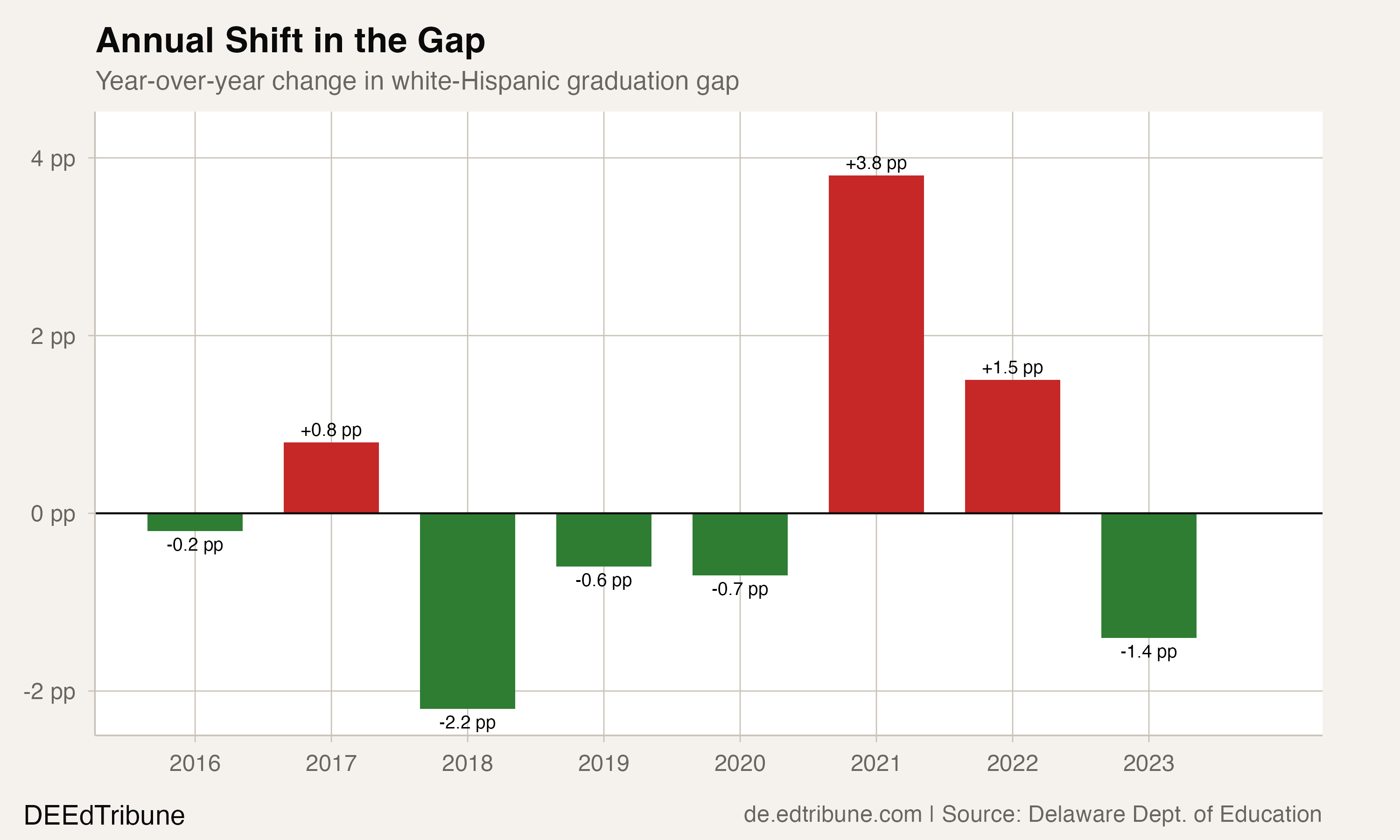
The year-over-year shifts tell the story more sharply. In 2021, the gap widened by 3.8 points in a single year, the largest annual expansion in the nine-year dataset. That jump was driven almost entirely by Hispanic rates falling 3.2 points while white rates rose. The gap narrowed by 1.4 points in 2023, but at that pace it would take four more years to return to the 2019 level.
Black students, by contrast, followed a different recovery arc. Their graduation rate fell from 86.4% in 2019 to 84.8% in 2021, a smaller dip, and by 2023 reached 87.8%, their highest on record. The white-Black gap has returned to 3.7 points, matching its pre-pandemic level. The white-Hispanic gap remains more than 3 points wider than its 2019 low.
Sussex County: 20-point chasms
The statewide gap of 8.2 points obscures what is happening in southern Delaware. Four Sussex County districts, Milford↗ET, Cape Henlopen↗ET, Indian River↗ET, and Seaford↗ET, all report white-Hispanic gaps above 12 points. Laurel tops the list at 24.3 points.
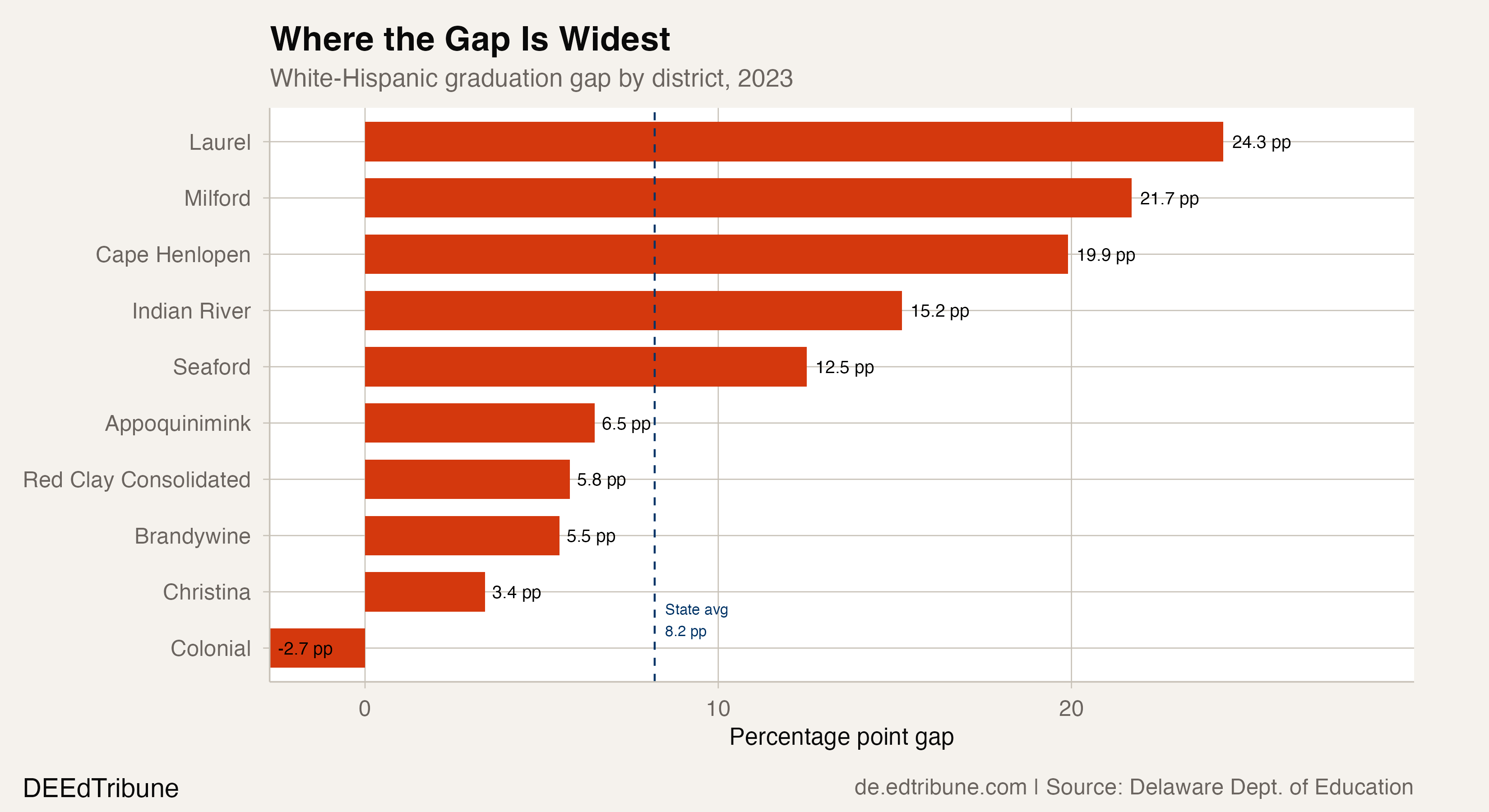
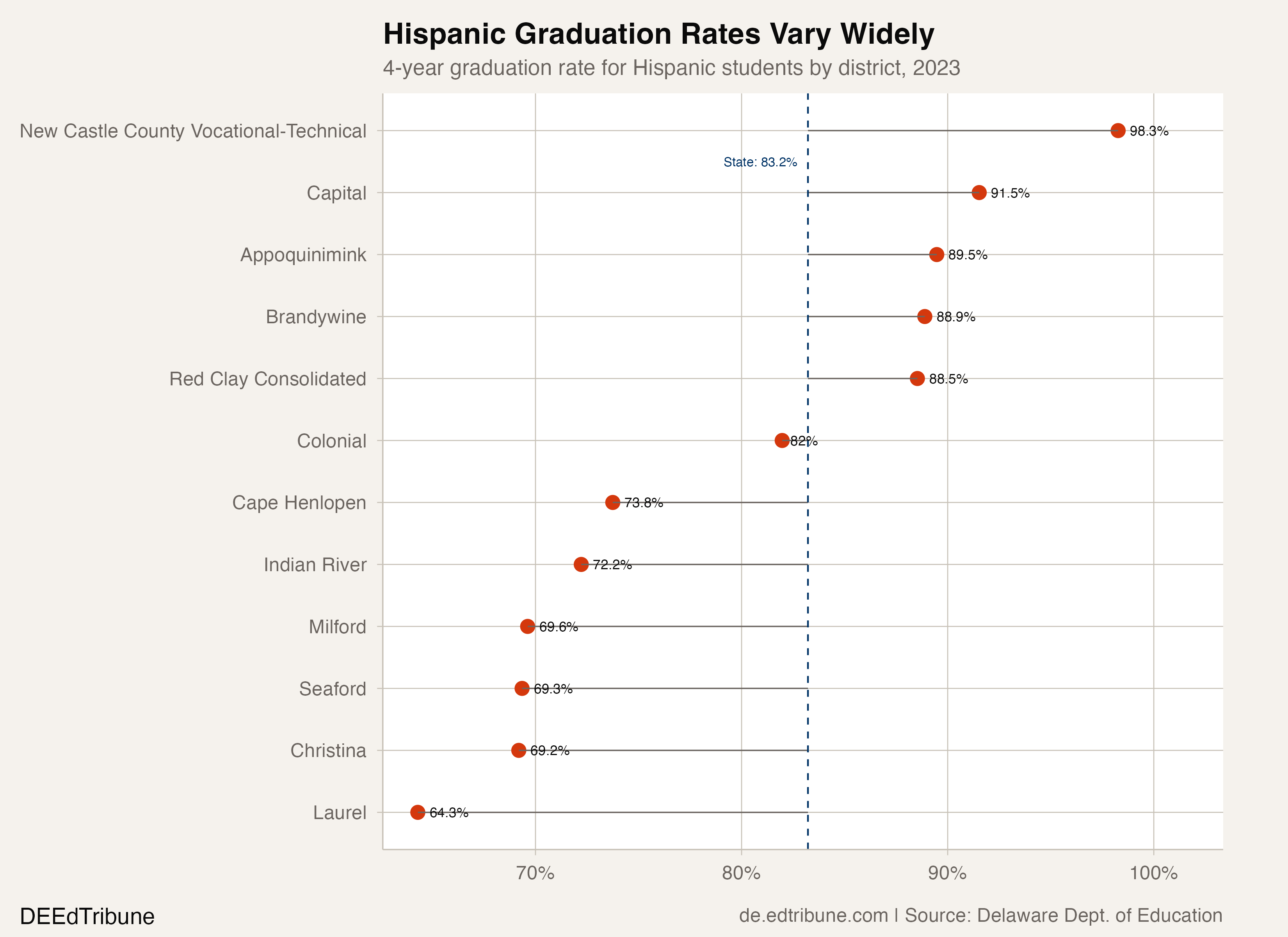
These are the same districts where Hispanic enrollment has grown fastest, driven by families working in Sussex County's poultry processing and agriculture industries. The Hispanic graduation rate in Milford dropped from 83.3% in 2019 to 69.6% in 2023, a decline of 13.7 points. Seaford fell from 87.5% to 69.4%, a drop of 18.1 points. Cape Henlopen's Hispanic rate plunged from 92.1% in 2018 to 73.8% in 2023, while its white rate rose to 93.7%.
The pattern in northern New Castle County is different. Brandywine↗ET, Red Clay↗ET, and Appoquinimink↗ET all posted Hispanic graduation rates above 88%, with gaps under 7 points. The New Castle County Vocational-Technical↗ET district graduated 98.3% of its Hispanic students, the highest rate in the state, with no meaningful gap at all.
Language, not ethnicity, may be the fault line
English learners graduate at far lower rates than any racial or ethnic group in Delaware. Their four-year rate was 73.5% in 2023, nearly 10 points below the Hispanic rate and 18 points below the white rate. The ELL rate has been volatile, swinging from 68.2% (2017) to 75.4% (2018) to 69.3% (2022), never establishing sustained upward momentum.
The overlap between these populations is substantial, though the data does not allow precise measurement. Hispanic students make up the majority of Delaware's English learner population, particularly in Sussex County, where districts like Cape Henlopen reported a nearly 10% decline in multilingual learner enrollment during the 2025-26 school year amid immigration enforcement fears.
The distinction matters because a graduation gap driven by language acquisition challenges calls for different interventions than one driven by systemic inequity across an entire ethnic group. In districts where Hispanic families have been established for generations, the gap is small. Where the population is newer and includes more first-generation English learners, the gap widens.
Only 34 of 227 Delaware schools have a bilingual or ESL-certified teacher, according to a Rodel Foundation report. That means roughly 60% of the state's multilingual learners attend a school with no certified language specialist. Delaware allocates $1,100 per multilingual learner in supplemental funding. New Jersey and Maryland allocate $6,000 to $9,000 per student.
"Our graduation rates across the state are the lowest compared to our Black and white counterparts." -- Rony Baltazar-Lopez, vice chair of the Delaware Hispanic Commission
Christina's parallel crisis
Christina School District↗ET, which serves part of Wilmington and its western suburbs, posted a Hispanic graduation rate of 69.2% in 2023, down from 80.3% in 2019, a decline of 11.2 points. But Christina's white rate also fell, to 72.6%, producing a relatively narrow gap of 3.4 points. Both groups are graduating at rates well below the state average, a sign that Christina's challenges extend beyond any single demographic.
Christina's overall graduation rate, 73.2% in 2023, ranks among the lowest of any traditional district. The Redding Consortium for Educational Equity, a task force studying the four districts that serve Wilmington, voted in December 2025 to recommend merging Christina, Brandywine, Colonial, and Red Clay into a single district. If the merger proceeds, it would create one of the largest districts on the East Coast and fundamentally reshape how Wilmington students, many of them Hispanic, are served.
What the state is not measuring
Delaware publishes graduation rates by race and by English learner status, but it does not cross-tabulate the two. There is no public data showing the graduation rate of Hispanic English learners separately from Hispanic students who are fluent in English. That missing data point would clarify whether the widening gap is concentrated among recent arrivals or distributed across the broader Hispanic population.
The state's Multilingual Learners Strategic Plan, published in 2023, acknowledges the rapid growth of this population, now 19,000 students speaking more than 100 languages, but does not set graduation rate targets. Las Americas ASPIRA Academy, a bilingual charter school, plans to open a second campus in Georgetown in fall 2026 to serve Sussex County families. Whether one charter school can move the needle for a population spread across five rural districts is an open question.
The vo-tech model offers a counterpoint. New Castle County Vo-Tech graduated 98.3% of its Hispanic students in 2023 and has not dipped below 93.9% in nine years. The program's structured pathways, industry certifications, and direct employment connections appear to produce outcomes that the traditional high school model, particularly in Sussex County, does not.
The gap narrowed by 1.4 points in 2023. Whether that is the beginning of a sustained correction or a one-year fluctuation depends on what happens in the districts where the gap is widest: whether Milford and Seaford and Indian River can do for their Hispanic students what New Castle Vo-Tech already does for theirs.
Detailed code that reproduces the analysis and figures in this article is available exclusively to EdTribune subscribers.
Discussion
Sign in to join the discussion.
Loading comments...