At New Castle County Vocational-Technical School District↗ET, Black students graduate at 98.0%. White students graduate at 95.3%.
That is not a typo. In a state where a 3.7 percentage point gap separates Black and white graduation rates, and where some traditional districts lose more than a quarter of their Black students before they earn a diploma, NCC Vo-Tech has inverted the equation. Its Black graduation rate exceeds its white rate by 2.6 points.
The district's 1,028-student cohort for the class of 2023 crossed the stage at a 97.5% overall rate. But the aggregate number obscures the more striking fact: NCC Vo-Tech has closed equity gaps that the rest of Delaware's education system treats as structural inevitabilities.
The gap that does not exist
Delaware's four-year graduation rate hit an all-time high of 88.9% for the class of 2023. The state's trajectory has been steady: 84.4% in 2015, a COVID dip to 87.0% in 2021, then a recovery to the current peak. By national standards, 88.9% is solid, roughly two points above the national average.
But the statewide number hides a familiar pattern. Black students graduate at 87.8%, white students at 91.5%. Students who are economically disadvantaged graduate at 81.6%. Students receiving special education services graduate at 73.3%, a 15.6-point gap below the overall rate.
NCC Vo-Tech's numbers operate in a different universe.
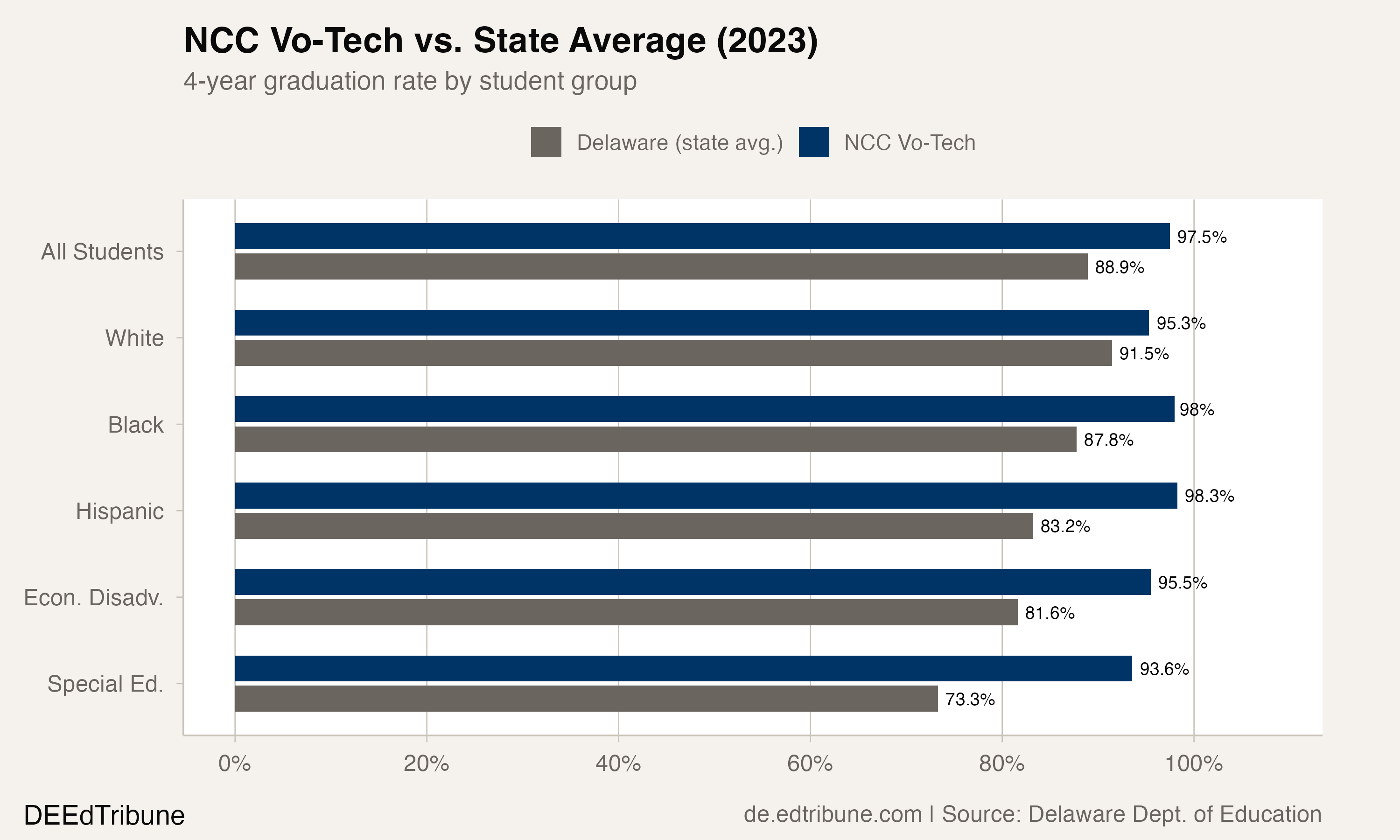
Hispanic students at NCC Vo-Tech graduate at 98.3%, compared to 83.2% statewide, a 15.1-point advantage. Students who are economically disadvantaged graduate at 95.5%, compared to 81.6% statewide, a 13.9-point advantage. Students receiving special education services graduate at 93.6%, compared to 73.3% statewide, a 20.3-point advantage.
That last number bears repeating. The special education gap between NCC Vo-Tech and the state average is 20 points.
Not new, and not a fluke
NCC Vo-Tech's Black graduation rate has exceeded 93% in every year since 2015.
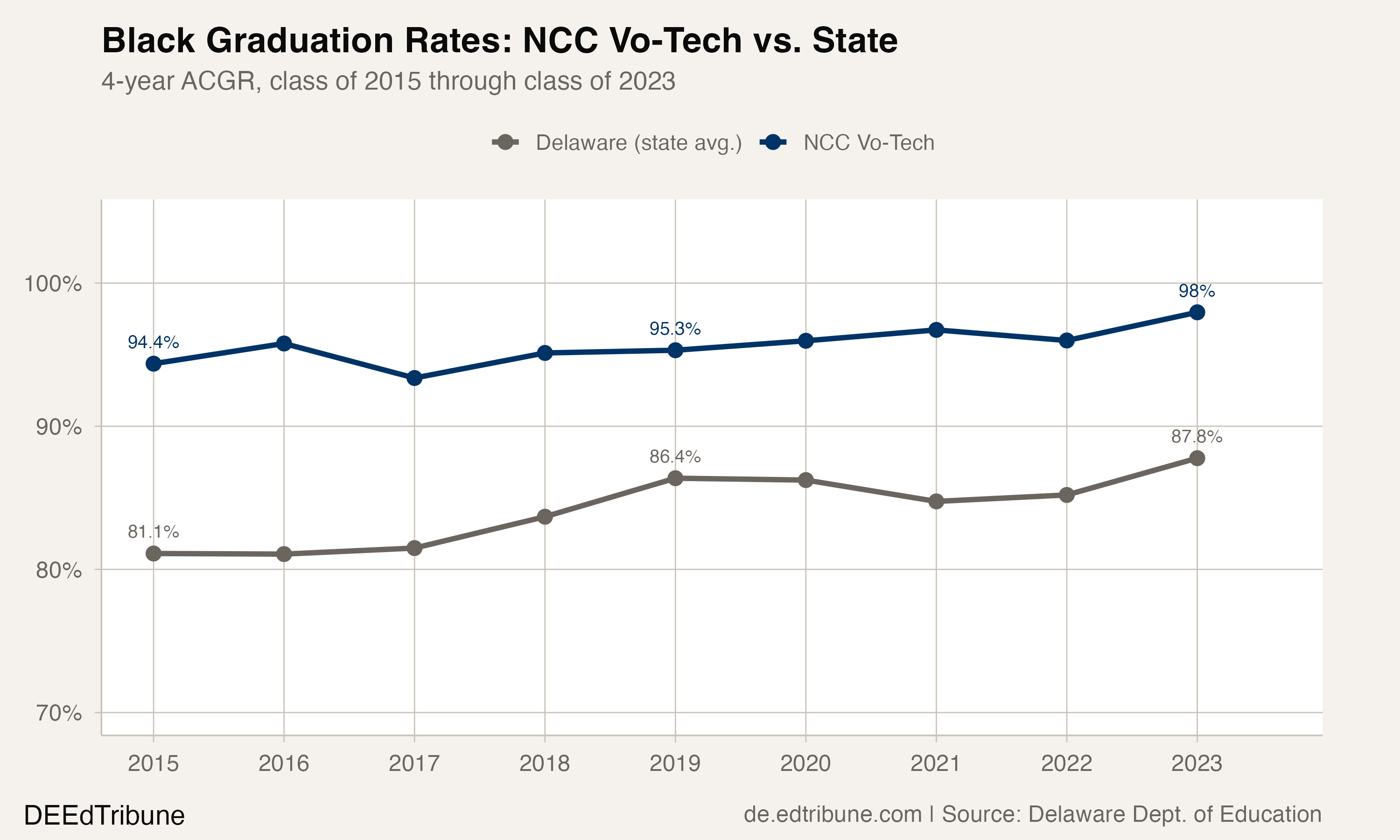
The trajectory is upward. In 2015, NCC Vo-Tech graduated 94.4% of Black students while the state graduated 81.1%. The gap was 13.3 points. By 2023, with the district at 98.0% and the state at 87.8%, the gap had narrowed only slightly to 10.2 points, because NCC Vo-Tech was already so high there was little room to improve. The state moved; the district was already there.
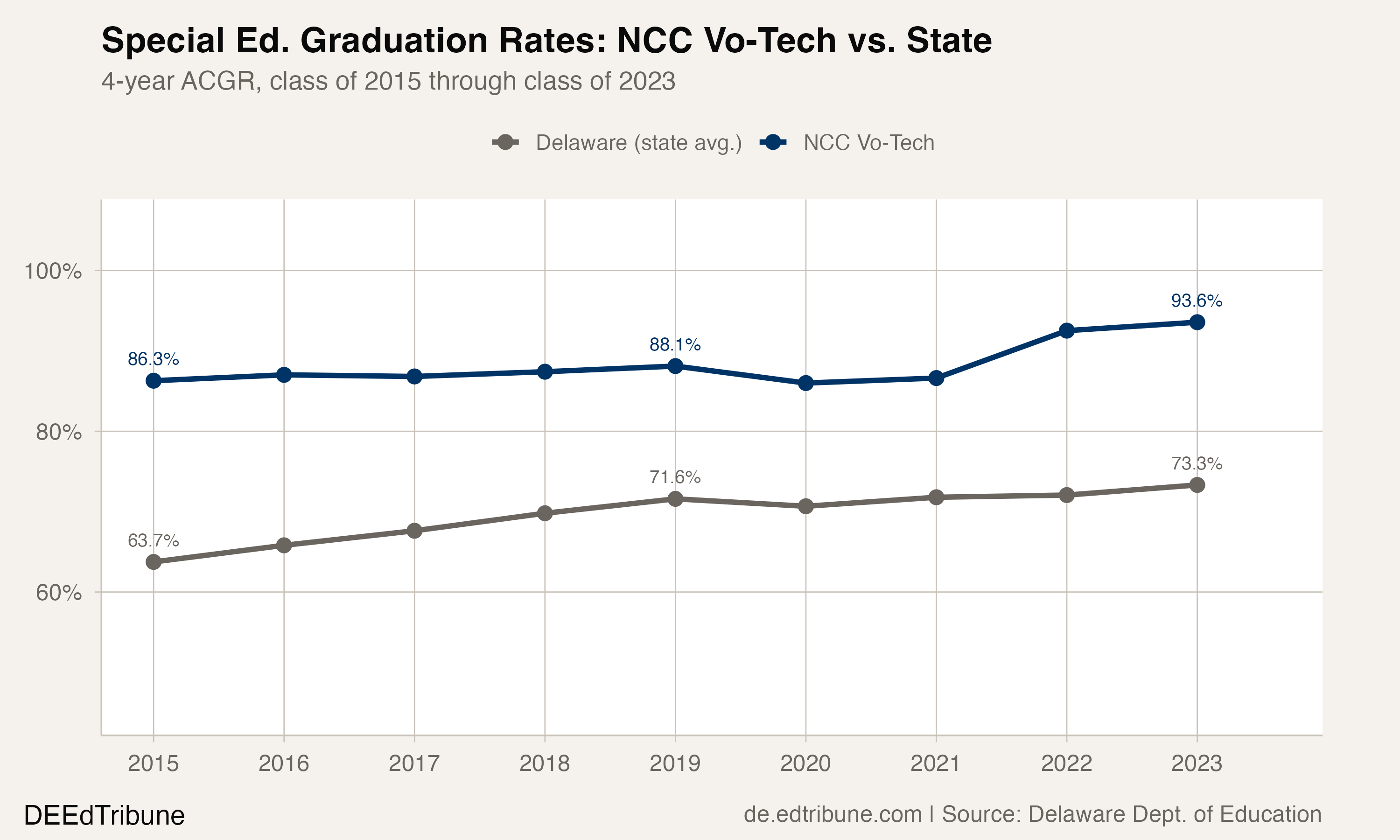
The consistency extends across subgroups. NCC Vo-Tech's economically disadvantaged rate has climbed from 92.3% in 2015 to 95.5% in 2023. Its special education rate has risen from 86.3% to 93.6%, a 7.3-point gain that accelerated sharply between 2021 (86.6%) and 2022 (92.5%).
Where the contrast is sharpest
The district-level comparison for Black students is stark.
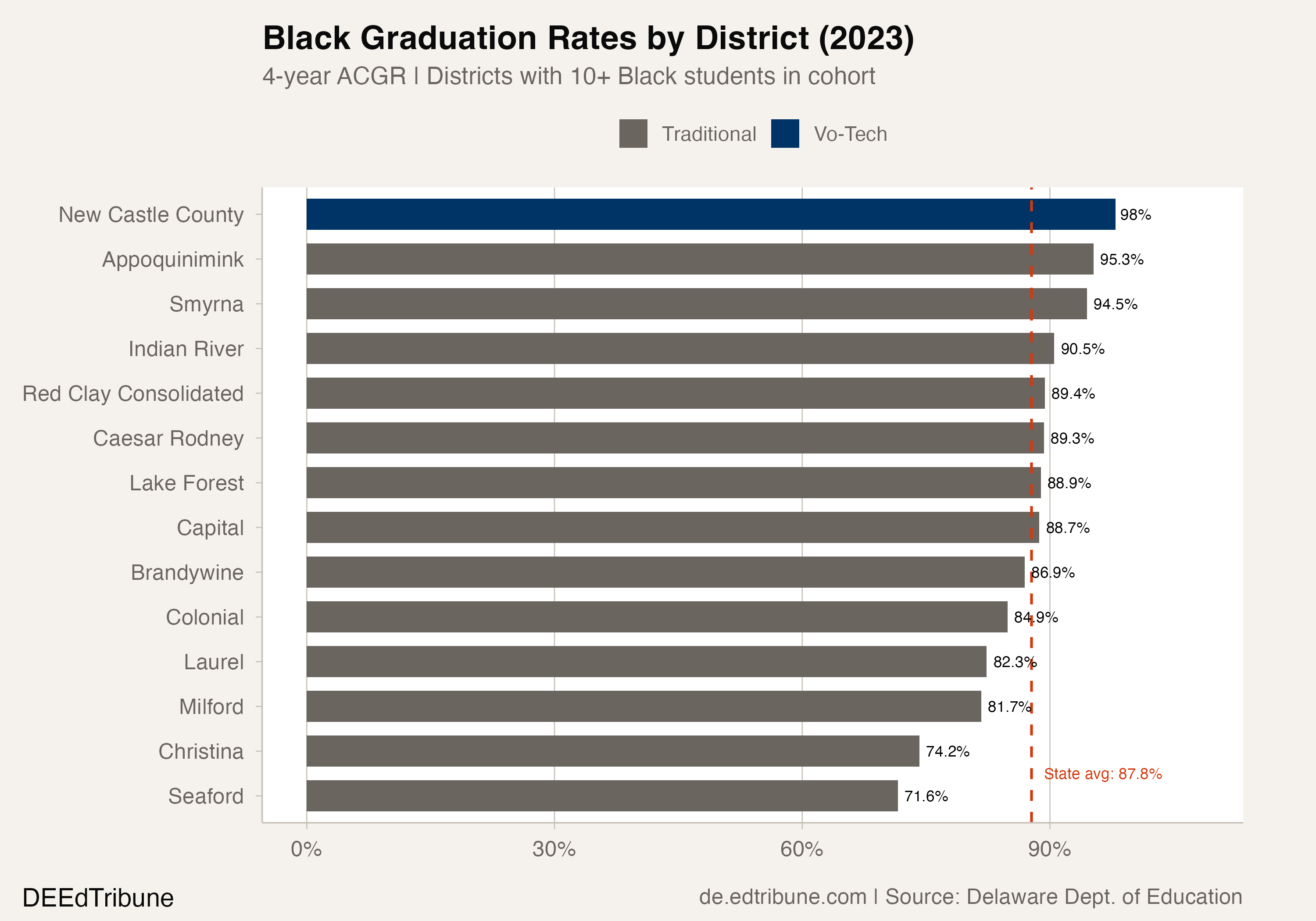
At Christina School District↗ET, 74.2% of Black students in a 376-student cohort graduated. At Seaford School District↗ET, 71.6% of a 95-student cohort graduated. NCC Vo-Tech's 98.0% rate for a 392-student Black cohort is not just the highest in the state. It is 23.8 points above Christina and 26.4 points above Seaford.
Christina's special education graduation rate is 50.9%, the lowest in the state, meaning roughly half of the district's 220 students receiving special education services do not earn a four-year diploma. NCC Vo-Tech graduates 93.6% of its 140 students receiving special education services. The gap between these two districts, both in northern New Castle County, both drawing from overlapping communities, is 42.7 percentage points.
The admissions question
The obvious objection: NCC Vo-Tech is a choice district. Students apply, and when programs are oversubscribed, the district ranks applicants by attendance and core academic grades. Students who apply to vocational-technical schools are signaling motivation. The admissions filter selects for students who were likely to graduate anyway.
This is a real caveat, and it is not sufficient to explain the data.
NCC Vo-Tech's cohort is not a gifted-and-talented program. The district's minority enrollment is 74%, well above Delaware's 61% average, with 39% Black, 27% Hispanic, and 27% white enrollment. Its economically disadvantaged share, 27.9% of the graduation cohort in 2023, is substantial. Its special education share, 13.6% of the cohort, is close to the state average.
A selection effect would predict a higher overall rate. It would not predict the near-elimination of gaps between subgroups. If admissions were simply creaming high-performing students, the internal equity gaps would mirror the state's, just shifted upward. Instead, NCC Vo-Tech's Black-white gap is +2.6 points (favoring Black students), while the state's is -3.7 points.
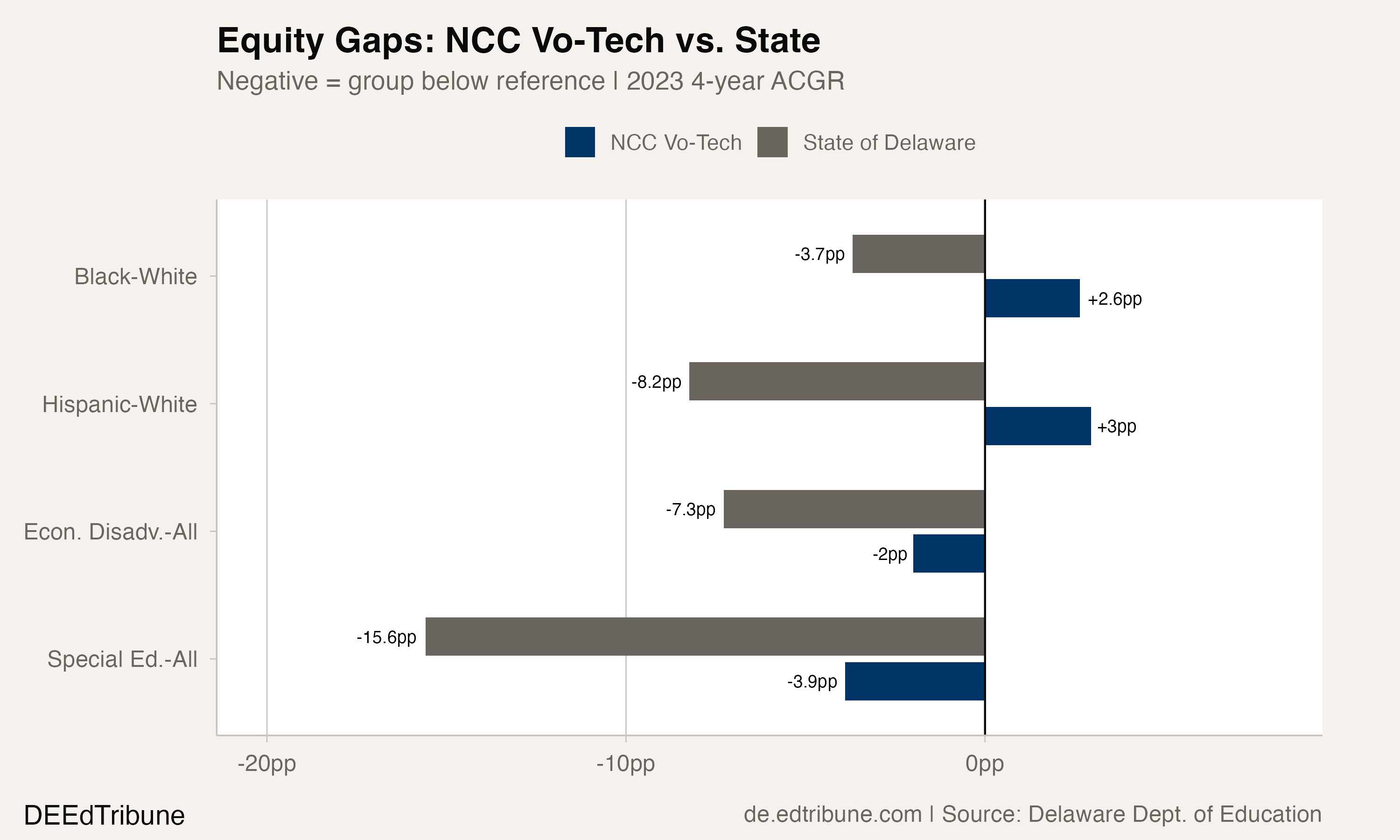
Something about the model, not just the students, is producing these outcomes.
What CTE research says
A Community Service Society of New York study found that Black and Latino male students in CTE schools graduated at 63% and 66% respectively, compared to 52% for the same groups in traditional schools, an 11-to-14 point advantage. Newer CTE schools with smaller enrollments and single-industry focus outperformed older, larger programs.
"Today these schools are showing some of our most vulnerable students the value of career-oriented programming as a pathway to obtaining their diploma." -- David R. Jones, CSS President and CEO
Delaware's own data corroborates the pattern. According to Advance CTE's state profile, Delaware's CTE concentrators achieved a 96.4% graduation rate in 2023-24. The state enrolled 30,616 secondary CTE students across 40 public high schools, with 16,845 classified as CTE concentrators.
NCC Vo-Tech operates four comprehensive high schools: Delcastle Technical, Hodgson Vocational-Technical, Howard High School of Technology, and St. Georges Technical. Each offers career programs across 40 pathways ranging from aviation technology and surgical technology to carpentry and culinary arts. Ninth graders rotate through exploratory programs before selecting a career pathway, a structure that builds engagement before demanding specialization.
The harder question
The sector-level comparison reinforces the pattern. Across all three vo-tech districts, the weighted overall graduation rate is 97.3% for 1,565 students. For the 16 traditional districts, it is 87.2% for 8,467 students. POLYTECH (98.1%) and Sussex Technical (95.7%) post rates in the same range as NCC Vo-Tech, though their smaller cohorts suppress subgroup breakdowns. Where the data is reportable, the results are consistent: vo-tech students graduate at rates the traditional sector has not matched in any recorded year.
Delaware is currently debating whether to merge the four traditional districts that serve Wilmington, Brandywine, Christina, Colonial, and Red Clay, into a single consolidated entity. The Redding Consortium voted 19-2 in December 2025 to recommend the merger, though the timeline has since slipped to 2027 as consultants develop a detailed plan.
That conversation is about district boundaries and resource allocation. NCC Vo-Tech's data suggests a parallel question: whether the instructional model matters more than the boundary lines. A consolidated northern New Castle County district would still need to decide what its high schools look like inside. The vo-tech model, where every student is on a career pathway and every classroom connects to a tangible outcome, is graduating Black students and students receiving special education services at rates the traditional system has never approached.
The state does not need to speculate about whether this works. The data is nine years deep and the gaps keep shrinking.
Detailed code that reproduces the analysis and figures in this article is available exclusively to EdTribune subscribers.
Discussion
Sign in to join the discussion.
Loading comments...