At Colonial↗ET School District's William Penn High School, the hallways thin out noticeably once students cross from middle school into 9th grade. Across Delaware, the pattern repeats: something happens between 8th and 9th grade that causes chronic absenteeism to spike nearly five percentage points in a single year.
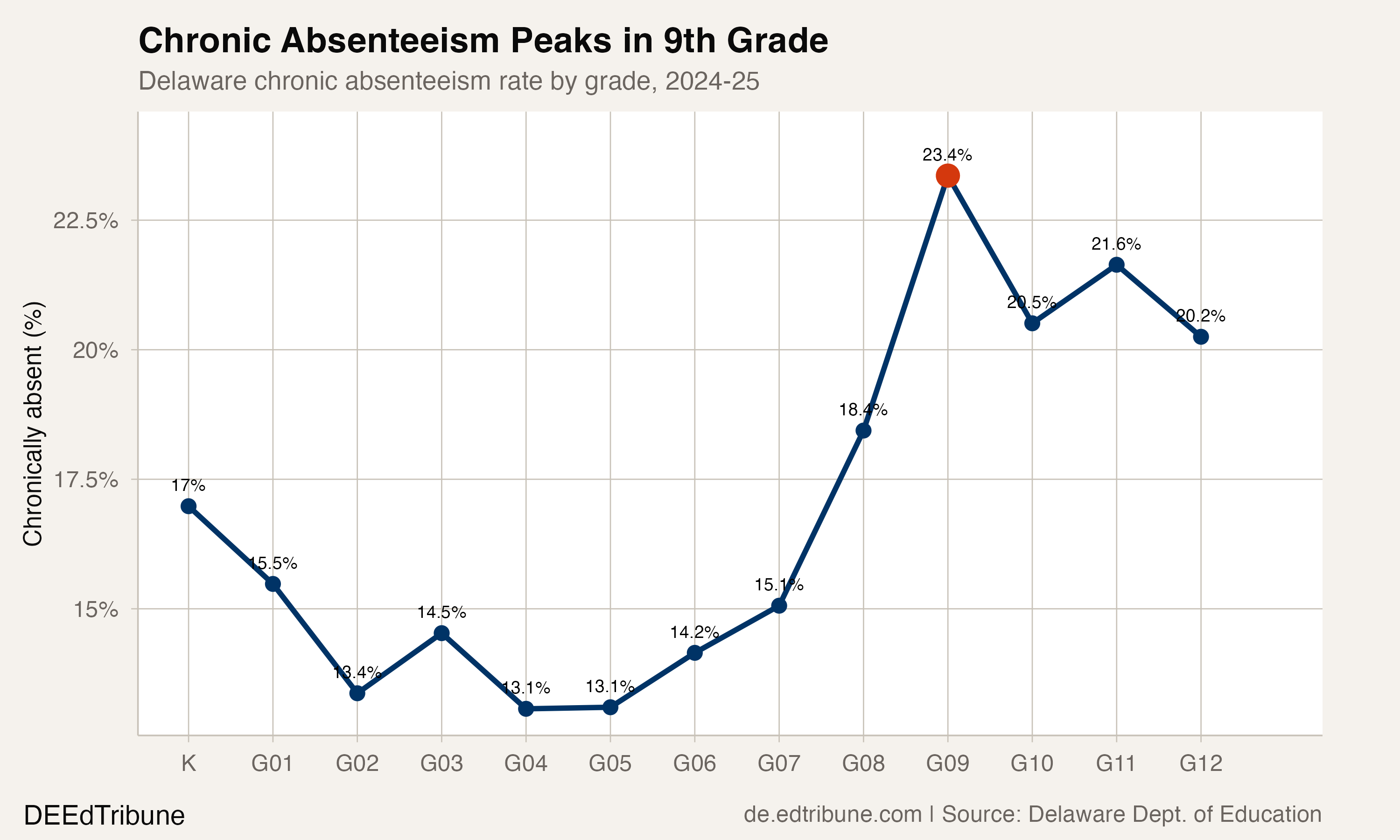
In 2024-25, 23.4% of Delaware's 9th graders were chronically absent, missing at least 18 of 180 school days. That is 3,185 teenagers. The rate is nearly double the elementary school average of 14.4%, higher than any other grade in Delaware's K-12 system, and it sits at the exact grade that research from the University of Chicago Consortium on School Research identifies as the inflection point for high school completion: on-track 9th graders are more than three and a half times more likely to graduate in four years than those who fall off track.
The cliff between 8th and 9th
The grade-by-grade profile in 2025 tells a story with a clear turning point. Chronic absenteeism holds relatively steady through grades 2 through 5, hovering between 13.1% and 14.5%. It begins climbing in 6th grade at 14.2%, ticks up to 15.1% in 7th, then jumps to 18.4% in 8th. The transition to 9th grade is where the line breaks: 23.4%, a 4.9 percentage point leap in a single grade. No other grade-to-grade transition in Delaware produces anything close to that magnitude.
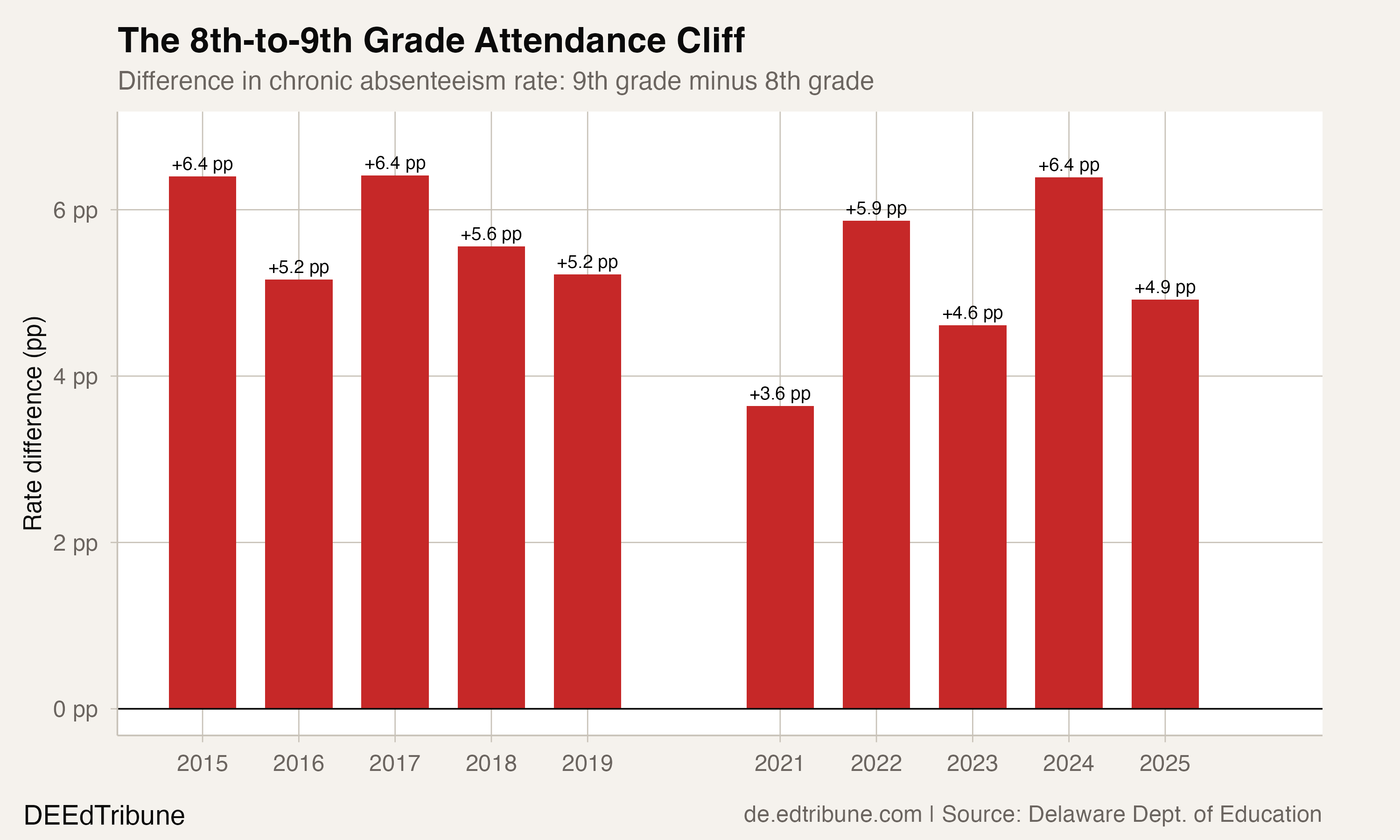
This is not a COVID artifact. The 8th-to-9th gap has existed in every year of available data, ranging from 3.6 to 6.4 percentage points since 2015. In 2017 and 2024, the jump was 6.4 points. Even in 2019, Delaware's best pre-pandemic year, the gap was 5.2 points. The transition to high school consistently produces an attendance shock that elementary and middle school patterns do not predict.
Researchers call this the "9th grade shock." A longitudinal study tracking cohorts through the transition found that the proportion of students with GPAs below 2.0 nearly doubled from 23% to 39% upon entering high school, and that students whose grades dropped below 2.0 in their first semester showed only a 25% graduation rate. The attendance dimension of this shock is equally consequential. A separate study by the UChicago Consortium found that 9th-grade on-track status, which incorporates attendance, predicts graduation more accurately than 8th-grade test scores.
Who is missing 9th grade
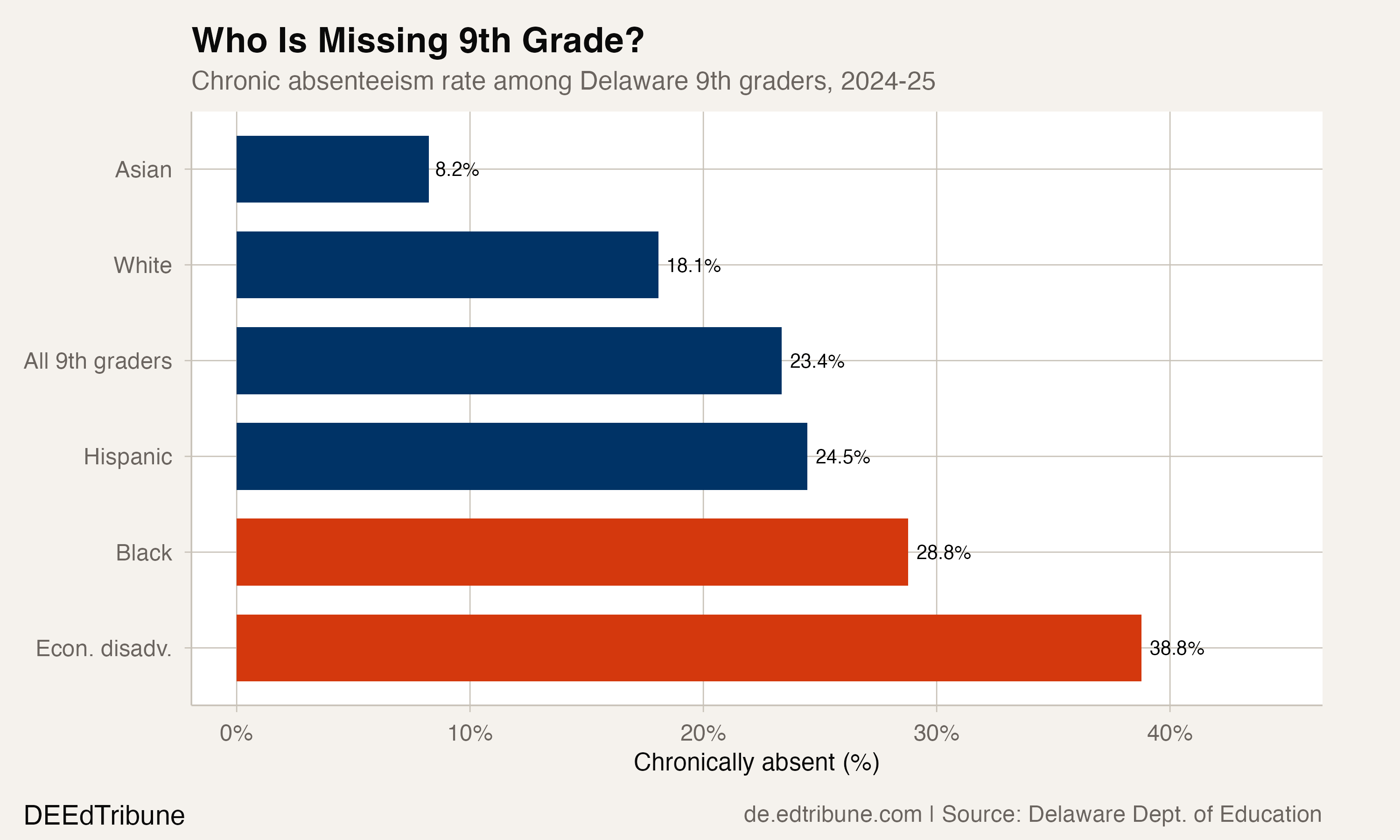
The statewide 23.4% average obscures deep disparities. Among Black 9th graders, 28.8% are chronically absent, 5.4 percentage points above the 9th-grade average and more than 10 points above their white peers at 18.1%. Hispanic freshmen sit at 24.5%, just above the overall rate, while Asian 9th graders have the lowest rate at 8.2%.
Separately, economically disadvantaged 9th graders, a category that overlaps heavily with racial minorities, face a 38.8% chronic rate. That means nearly two in five low-income freshmen are missing enough school to be classified as chronically absent.
Ninth graders who are homeless face the most extreme rates: 58.2% are chronically absent, meaning 239 of 411 identified freshmen who are homeless missed at least 18 days. For these students, the question is not whether they are on track to graduate. It is whether they are attending school at all.
The racial gap at 9th grade is wider than the gap at the state level. Across all grades, Black students' chronic rate is 20.3% versus 14.0% for white students, a 6.3-point spread. In 9th grade specifically, Black students hit 28.8% versus 18.1% for white students, a 10.7-point gap. The high school transition amplifies existing inequities rather than merely reflecting them.
Three districts where 9th grade attendance has collapsed
The district-level data reveals that Delaware's 9th-grade attendance crisis is concentrated in a specific geography: New Castle County's urban core.
At Colonial↗ET, 38.7% of 9th graders were chronically absent in 2025, the worst rate among districts with at least 50 freshmen. That means 335 of 866 freshmen at Colonial's high schools missed at least 18 days. Christina↗ET follows at 38.0%, with 440 of 1,158 freshmen chronically absent. Capital↗ET School District in Dover rounds out the top three at 36.6%.
These are not small margins above the state average. Colonial and Christina's 9th-grade rates are more than 15 percentage points above the statewide 23.4%. By contrast, Smyrna↗ET School District posted an 8.7% chronic rate among its 9th graders, and New Castle County Vocational-Technical came in at 5.9%.
Delaware's then-Secretary of Education Mark Holodick put the stakes plainly: "If students are not in school, they're not learning. That is a problem." At Colonial and Christina, the problem is concentrated in the year that matters most.
A peak that predates COVID
One persistent misunderstanding about 9th-grade absenteeism: it is not a pandemic creation. In 2015, before COVID was a word in education policy, Delaware's 9th-grade chronic rate was 23.1%. It climbed to 24.2% by 2017. The pre-COVID low was 20.7% in 2019, still the highest of any grade except 12th.
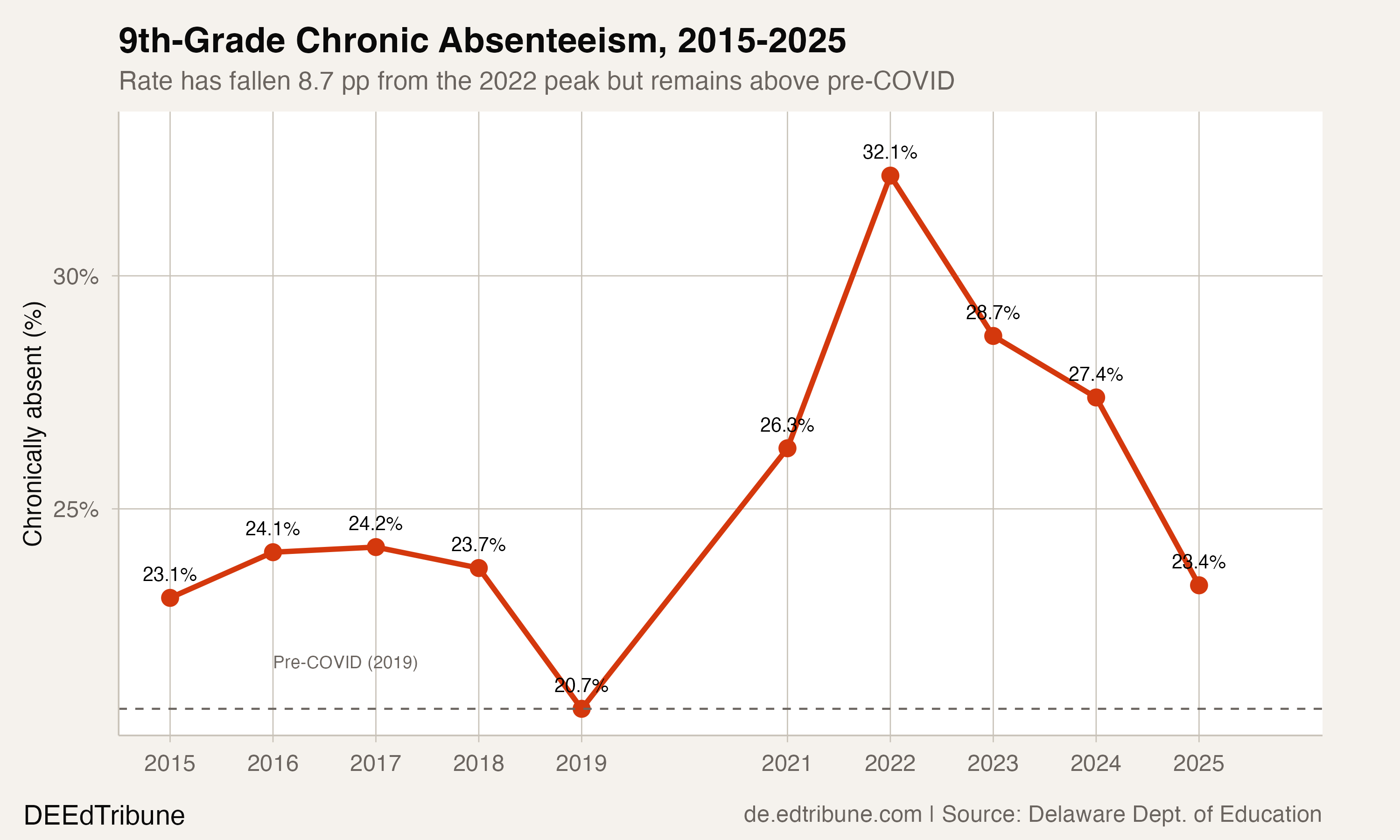
COVID made the problem worse. The rate spiked to 32.2% in 2022, when 4,552 of 14,159 freshmen were chronically absent. The recovery since then has been substantial: down to 28.7% in 2023, 27.4% in 2024, and 23.4% in 2025. That 8.8-point improvement recovers 76.8% of the pandemic spike.
But the current 23.4% remains 2.7 points above the 2019 low of 20.7%. And the 2019 low was itself a problem, not a target. A state where one in five freshmen was chronically absent even in a good year has a structural attendance issue that pandemic recovery alone will not solve.
12th grade tells the other half of the story
The high school grade pattern contains a second finding that is easy to miss. While 9th grade has the highest chronic rate (23.4%), 12th grade sits lower at 20.2%, and the gap between them has changed dramatically over time.
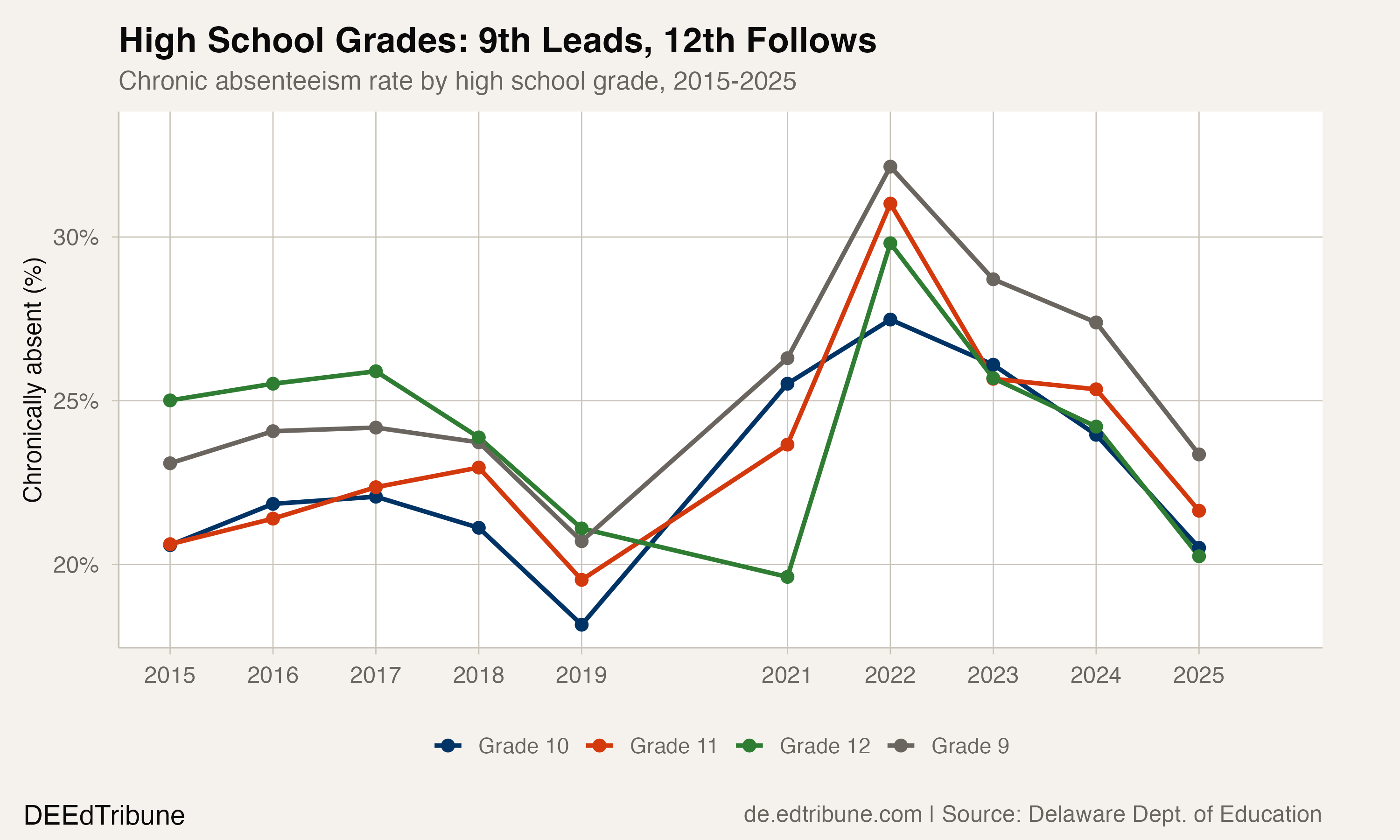
Before COVID, 12th grade actually had the worst chronic rate in high school: 25.0% in 2015 versus 23.1% for 9th. The pattern flipped in 2021, when 9th grade shot to 26.3% while 12th dropped to 19.6%, likely because COVID-era 12th graders were a smaller, more engaged cohort (students who were going to disengage had already left). By 2025, 9th grade remains 3.2 points higher than 12th.
The crossover raises an unsettling possibility: the students who were chronically absent in 9th grade are not appearing in 12th-grade statistics because they are no longer enrolled. Delaware's four-year graduation rate does not track the attendance pattern of its non-completers, but the divergence between 9th-grade enrollment (13,637) and 12th-grade enrollment (11,860), a 13% difference, is consistent with substantial attrition between freshman year and senior year, though transfers, GED programs, and grade retention also contribute to the gap.
What the data cannot show
The chronic absenteeism rate measures a threshold: 10% or more of enrolled days missed. It does not distinguish a student who missed 18 days from one who missed 90. It does not capture whether a 9th grader's absences cluster in the fall, when the transition shock is acute, or spread across the year. It does not reveal whether students who are chronically absent in 9th grade recover by 10th, or whether the same students simply leave.
What the data does show is that the 8th-to-9th transition is the single sharpest attendance cliff in Delaware's K-12 system, that it predates COVID, that it fell hardest on Black and low-income students, and that at districts like Colonial and Christina, it has reached rates where more than one in three freshmen is disengaging from school during the year research identifies as the most consequential for whether they will finish.
The Wilmington Learning Collaborative joined Digital Promise's national chronic absenteeism initiative in 2024, one of 19 districts participating in a six-month research effort reaching over 210,000 students. The 8th-to-9th transition is the single sharpest attendance cliff in Delaware's K-12 system, it predates COVID, and it falls hardest on Black and low-income students. Fixing the statewide number without fixing 9th grade means leaving the most consequential grade untouched.
Detailed code that reproduces the analysis and figures in this article is available exclusively to EdTribune subscribers.
Discussion
Sign in to join the discussion.
Loading comments...