Smyrna↗ET School District, in the heart of Kent County, has posted a chronic absenteeism rate below the state average every year for a decade. Its 2025 rate of 12.1% is among the lowest of any traditional district in Delaware. It missed its pre-COVID rate by a quarter of a percentage point.
Smyrna is one of four districts within a single percentage point of recovery. It is not counted among the eight that made it. In a state with just 35 districts reporting comparable data, margins like that shape the narrative. Delaware's statewide chronic absenteeism rate has recovered 81% of the ground lost during COVID, falling from 25.7% in 2022 to 17.1% in 2025. At the district level, that recovery is far less evenly distributed: only eight districts, or 22.9%, have returned to or surpassed their pre-COVID chronic absenteeism rates.
The other 27 still carry excess absence from the pandemic. They enroll 134,451 students, roughly 89.9% of Delaware's public school population.
Who recovered, and who they are
The eight recovered districts share a profile. Five are charter schools: Academy of Dover (from 12.8% to 1.1%), Edison Charter (12.3% to 2.6%), Early College High School at Del State (21.1% to 2.2%), Sussex Academy (8.8% to 3.5%), and First State Montessori (5.8% to 5.0%). Two are small traditional districts in Sussex County: Woodbridge↗ET (18.3% to 5.2%) and Seaford↗ET (18.1% to 8.7%). One is a vocational-technical district: New Castle County Vo-Tech (13.3% to 9.4%).
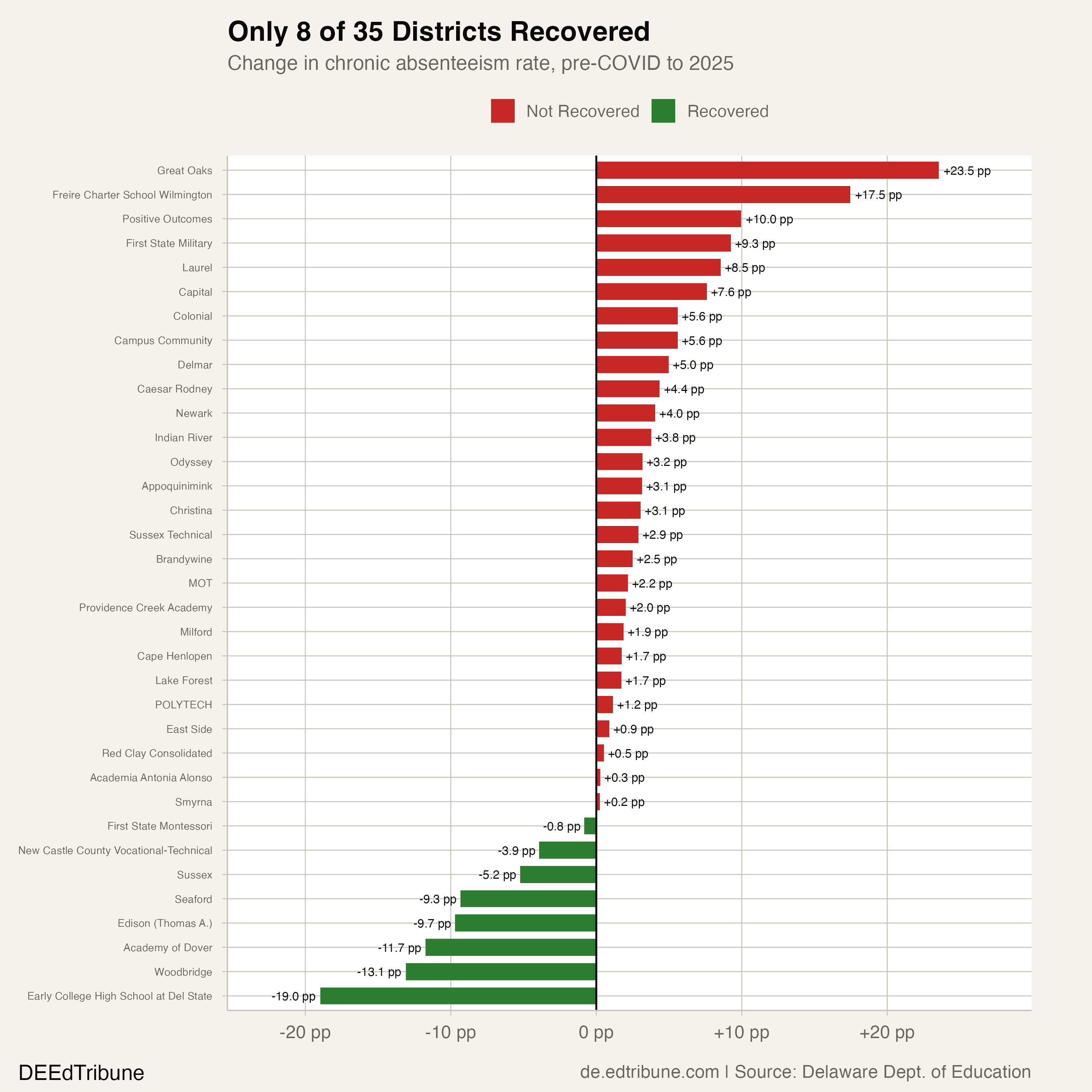
None enrolls more than 5,000 students. The largest, NCC Vo-Tech, serves 4,901. Together, the eight recovered districts account for 15,051 students, just over 10% of the state total. The pattern is clear: recovery happened at the margins of the system, not at its center.
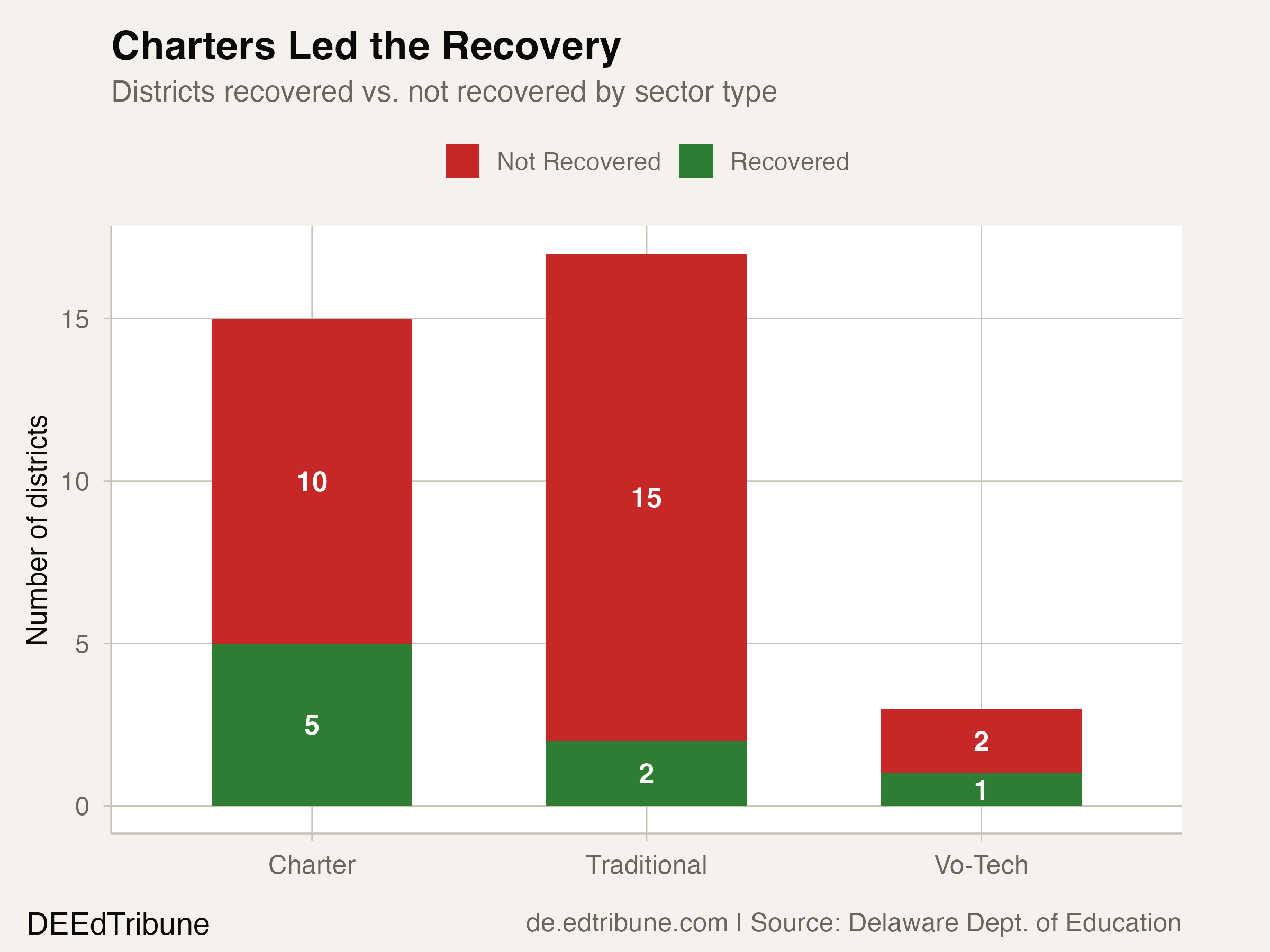
Of the 17 traditional districts, only two recovered. Of the 15 charter schools with comparable data, five did. One of three vo-tech districts crossed back below its pre-COVID line. Charters recovered at roughly triple the rate of traditional districts, 33.3% to 11.8%, though the charter sector's performance is wildly uneven. Great Oaks Charter School went the opposite direction entirely, posting a 54.9% chronic absenteeism rate in 2025, up 23.5 percentage points from its pre-COVID level.
The four largest districts, and the gap they carry
Red Clay↗ET Consolidated, the state's largest district at 17,322 students, came closest. Its 2025 rate of 16.8% sits just half a percentage point above its 2019 rate of 16.3%. Christina↗ET, the second largest with 14,510 students, remains 3.1 points above pre-COVID at 19.9%. Appoquinimink↗ET, third at 13,942, jumped from 10.9% to 14.1%. Indian River↗ET, the largest in Sussex County at 11,563, went from 16.4% to 20.2%.
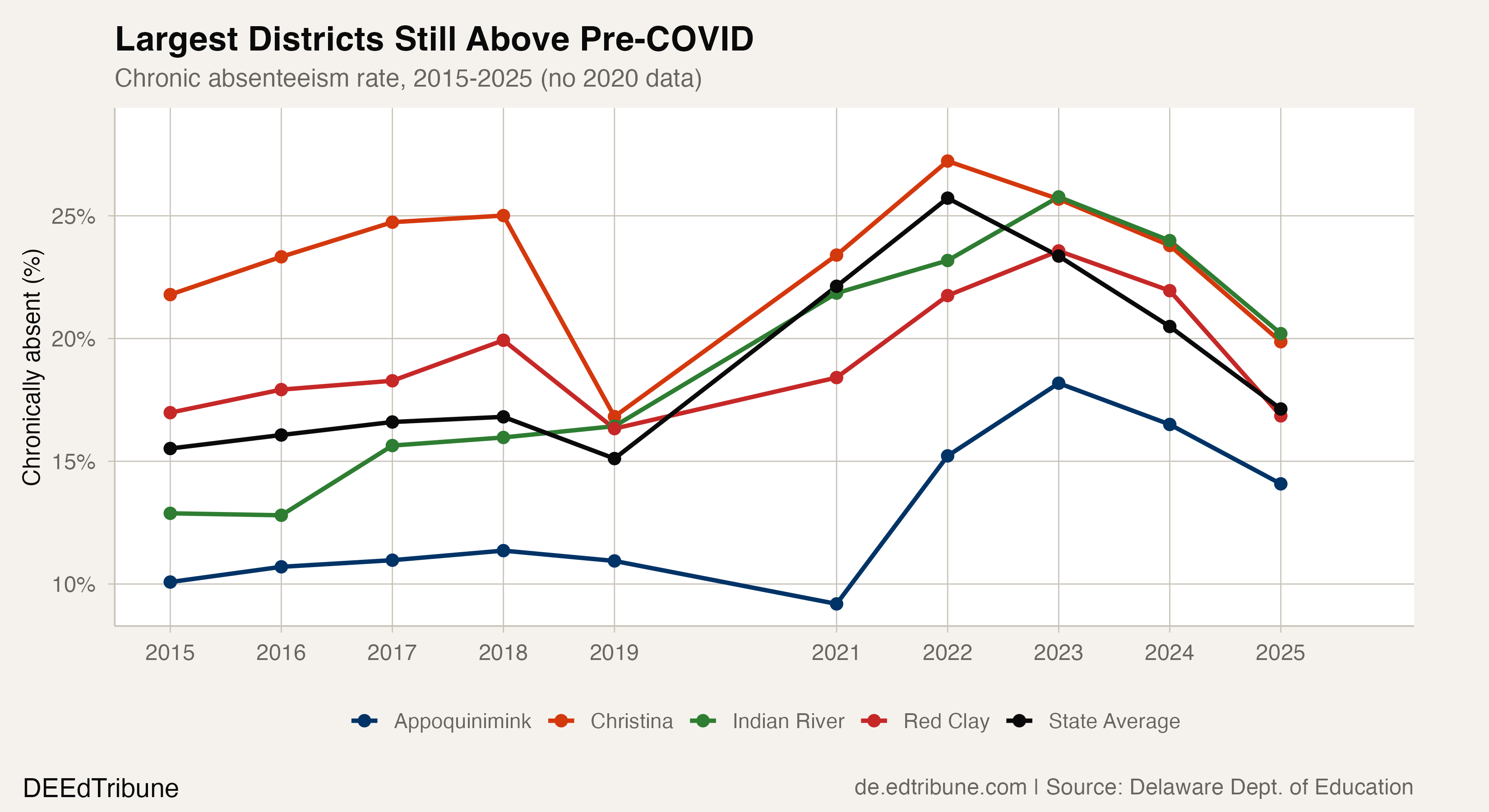
These four districts alone enroll 57,337 students. Their combined excess chronic absenteeism, the gap between their current rates and their pre-COVID baselines, accounts for an estimated 1,407 students who would not have been chronically absent before the pandemic. Add Colonial↗ET (5.6 points above pre-COVID, 553 excess students) and Capital↗ET (7.6 points above, 579 excess students), and the six largest non-recovered districts account for roughly 2,539 of the state's 4,335 estimated excess chronically absent students.
Capital's trajectory is particularly stark. Before COVID, 18.5% of its students were chronically absent. The rate hit 39.3% in 2021, stayed at 37.3% in 2022, and has come down to 26.1%, still meaning more than one in four students misses at least 18 school days per year. Capital's 7.6 percentage-point gap is the largest of any traditional district.
What separates recovered from not recovered
The distinction between sectors is real but imperfect. Charter schools that recovered tend to be small, with enrollment under 1,200, and several operate specialized models: Early College High School at Del State combines high school with college coursework, Sussex Academy is an application-based school, and First State Montessori uses a pedagogical model built around self-directed learning. These are schools with high levels of intentional family engagement, which is one of the strongest predictors of attendance.
The two traditional districts that recovered, Seaford and Woodbridge, are both in Sussex County and both undertook documented interventions. Seaford adopted PowerSchool's Attendance Intervention system, and a quasi-experimental evaluation by Johns Hopkins University's Center for Research and Reform in Education found that elementary students in treatment schools attended roughly two more days than their peers. Seaford's rate fell from 29.7% at its 2022 peak to 8.7%, one of the steepest drops in the state.
Woodbridge's improvement, from 24.2% at peak to 5.2%, is equally striking but less publicly documented. The district updated its attendance policy in August 2024 with detailed escalating intervention protocols. Whether that policy caused the turnaround or codified one already underway is not clear from public records.
Large traditional districts face a different structural challenge. Christina serves four Wilmington elementary schools through the Wilmington Learning Collaborative, a state agency created to address chronic underperformance in city schools. In 2024, the WLC joined Digital Promise's "Chronic Absenteeism: Insights and Innovations" cohort, a 17-district national initiative. The collaborative's stated goal was to pilot a response strategy by winter 2024. Christina's rate has come down from a peak of 27.2% in 2022 to 19.9%, but it remains 3.1 points above its pre-pandemic baseline.
The academic cost of still-elevated absence
Chronic absenteeism is not just an attendance metric. It tracks closely with academic recovery, and Delaware's district-level data suggests why the state's academic rebound has been uneven.
The Education Recovery Scorecard, a joint project of Harvard and Stanford, ranks Delaware 49th nationally in math recovery and 47th in reading recovery between 2019 and 2024. Students remain behind by roughly 0.86 grade equivalents in math and 0.84 in reading. Not a single Delaware district has returned to 2019 achievement levels in either subject.
The districts with the largest remaining attendance gaps, Capital, Colonial, Caesar Rodney, Indian River, and Laurel, overlap substantially with the districts the scorecard identifies as remaining more than a grade equivalent below 2019 performance. Delaware received $637 million in pandemic relief funds, approximately $4,600 per student, exceeding the national average of $3,700. Those funds expired in September 2024.
The near misses
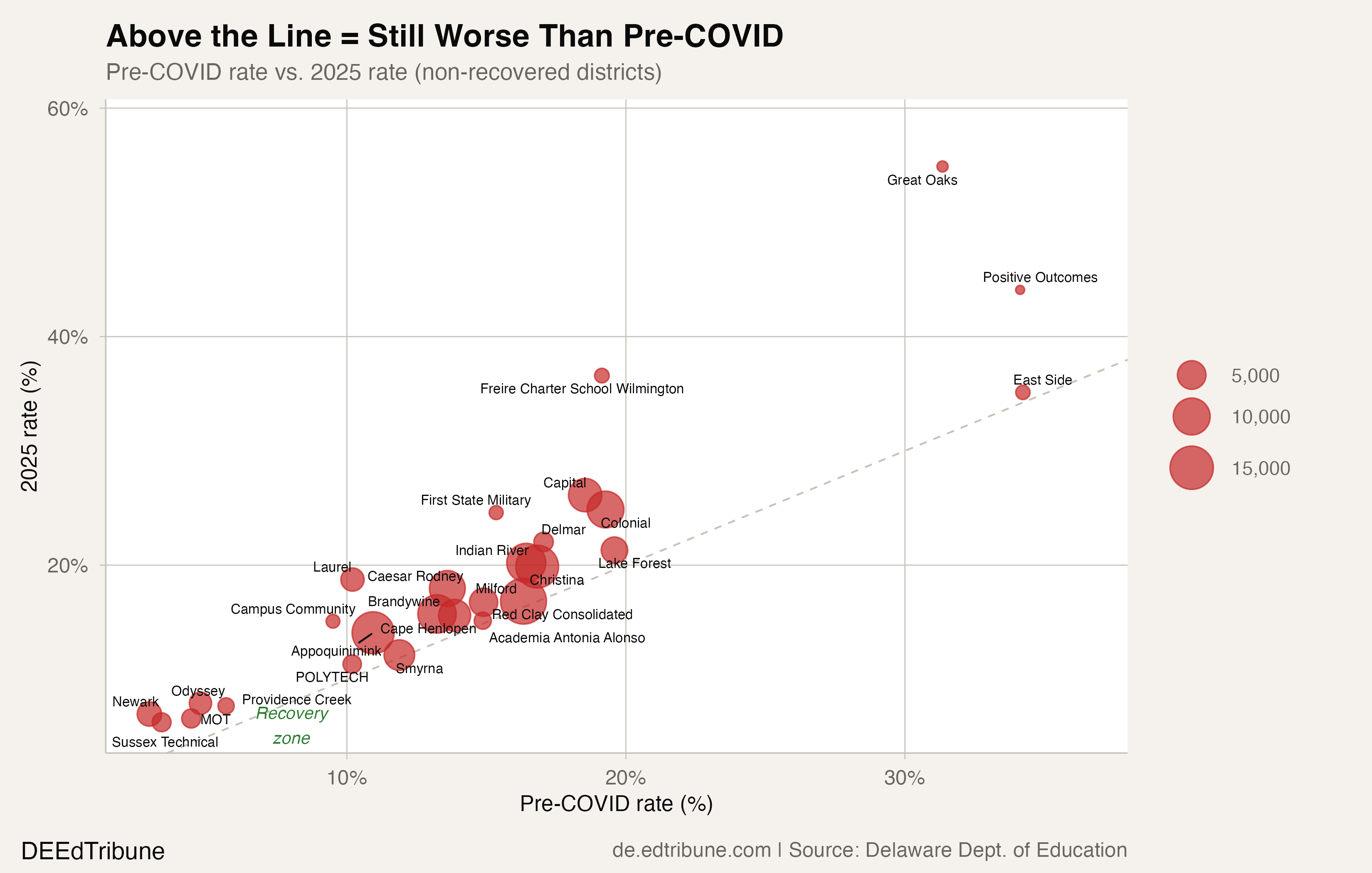
Not all 27 non-recovered districts are far from the line. Eight sit within two percentage points of their pre-COVID rates. Smyrna needs to close a 0.25-point gap. Academia Antonia Alonso, a dual-language charter in Wilmington, is 0.27 points away. Red Clay, the state's largest district, is 0.52 points short.
But "within two points" cuts both ways. Brandywine↗ET (2.5 points above), Cape Henlopen↗ET (1.7 points), and Lake Forest↗ET (1.7 points) are close enough that a single strong year could push them across. Whether they get that year without the federal relief dollars that funded many attendance interventions is the open question.
The distinction between recovered and not recovered is binary, but the underlying reality is a gradient. Smyrna's 12.1% rate is lower than NCC Vo-Tech's recovered rate of 9.4% only in that Smyrna's pre-COVID rate was also lower, 11.9% versus 13.3%. The metric measures trajectory, not destination: a district with a low rate can still be "not recovered" because it was even lower before.
What a 22.9% recovery rate means for the 81% headline
Delaware's statewide attendance recovery is genuine. Cutting chronic absenteeism from 25.7% to 17.1% in three years is a substantial accomplishment that outpaces most states. But the statewide number is enrollment-weighted, which means large districts that improved significantly, even without fully recovering, pull the average down. Red Clay dropping from 23.6% to 16.8% moves the statewide number substantially even though the district remains above its own 2019 level.
The district-level view surfaces what the statewide figure obscures: the pandemic permanently raised the floor for most Delaware school systems. Only special education students have recovered to pre-COVID absence levels as a statewide subgroup. Black students remain 2.0 percentage points above their 2019 rate. Economically disadvantaged students are 3.0 points above. English learners are 3.4 points above. The groups with the highest pre-COVID rates have recovered the least ground proportionally.
The 2025-26 school year was the first full year without federal relief funding; when attendance data for that year are published, they will test whether the eight districts that crossed back below their pre-COVID lines can stay there. For the 27 that have not, the math is starker: at the current pace, some will not close the gap before the next crisis arrives.
Detailed code that reproduces the analysis and figures in this article is available exclusively to EdTribune subscribers.
Discussion
Sign in to join the discussion.
Loading comments...