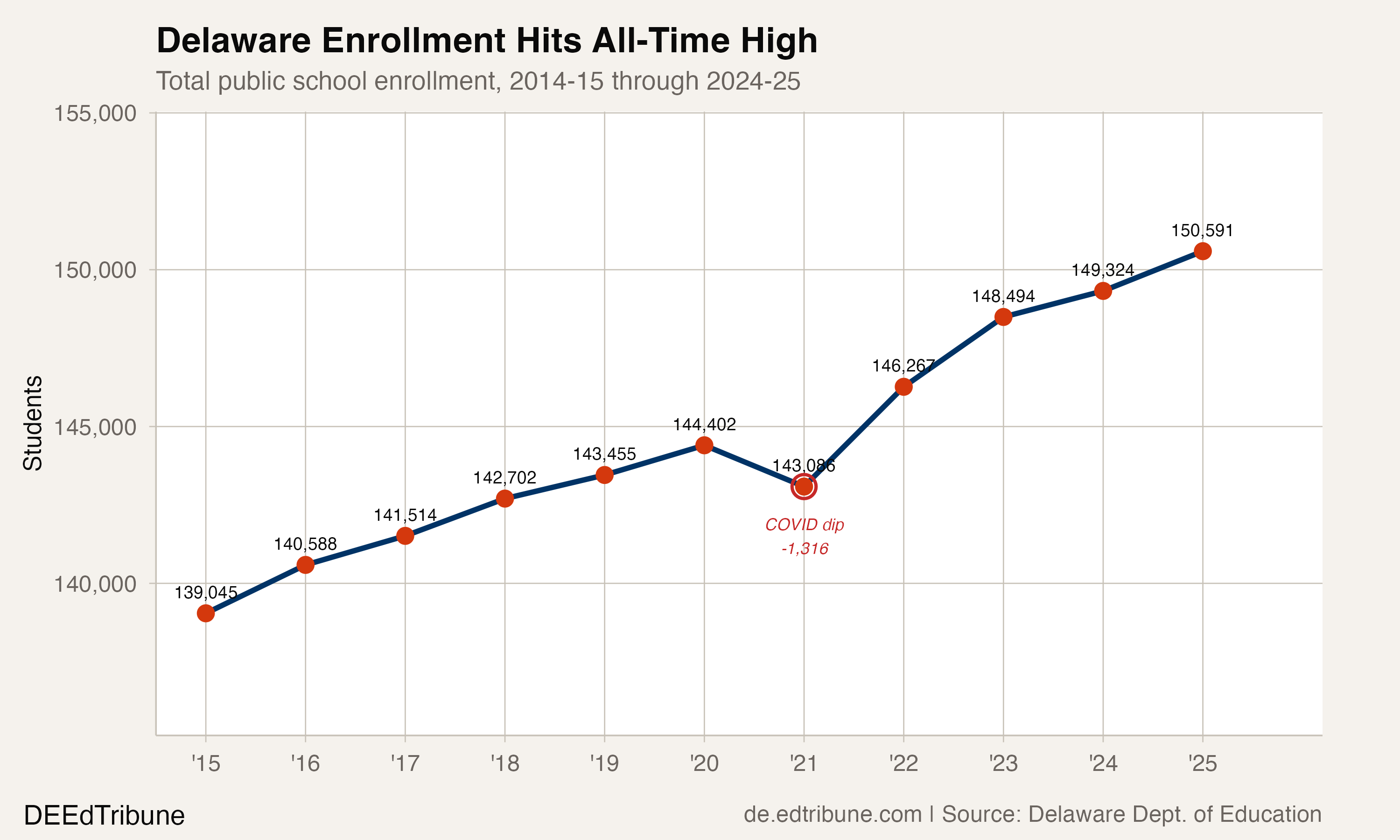
In a country where most states are watching their school enrollment shrink, Delaware is doing the opposite. The state's public schools enrolled 150,591 students in 2024-25, the highest figure in at least 11 years of available data and an 8.3% increase from 139,045 a decade earlier. Delaware grew in nine of the last 10 years. The only interruption was a single COVID-year dip of 1,316 students, which the state erased within 12 months.
That trajectory puts Delaware in rare company. Nationally, public school enrollment fell by roughly 1.2 million students between 2019 and 2022, and most states have not recovered. Delaware not only recovered but now sits 6,189 students above its pre-pandemic level.
Nine green bars and one red one
The year-over-year pattern is striking for its consistency. Pre-COVID growth ranged from 753 to 1,543 students per year. The single decline in 2020-21, at -1,316 students (0.9%), was modest by national standards, and the bounce-back in 2021-22 was the decade's largest single-year gain at +3,181 students, a 2.2% surge. Growth has continued at a steadier pace since then: +2,227 in 2022-23, +830 in 2023-24, and +1,267 in 2024-25.
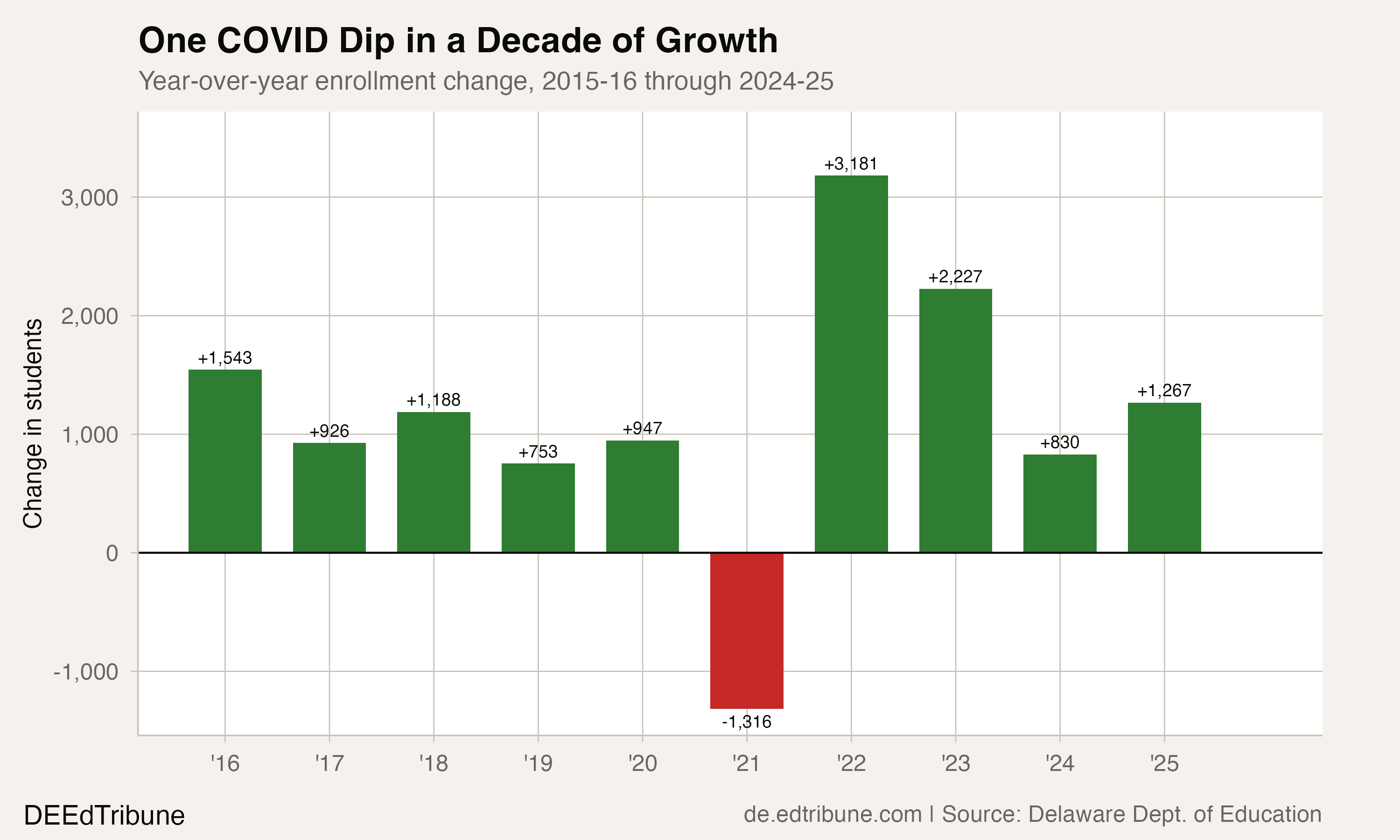
The 2021-22 rebound was not simply students returning from pandemic-era disengagement. The state added 1,865 students above its pre-COVID total in a single year, suggesting new enrollment rather than just recovery.
A state being remade from the south
The growth is not uniform. It is overwhelmingly concentrated in Sussex County and the southern reaches of New Castle County, where housing development has outpaced much of the Mid-Atlantic. Sussex County's population grew 20.4% between 2010 and 2020, far outpacing New Castle County's 6%, and has continued absorbing in-migrants since.
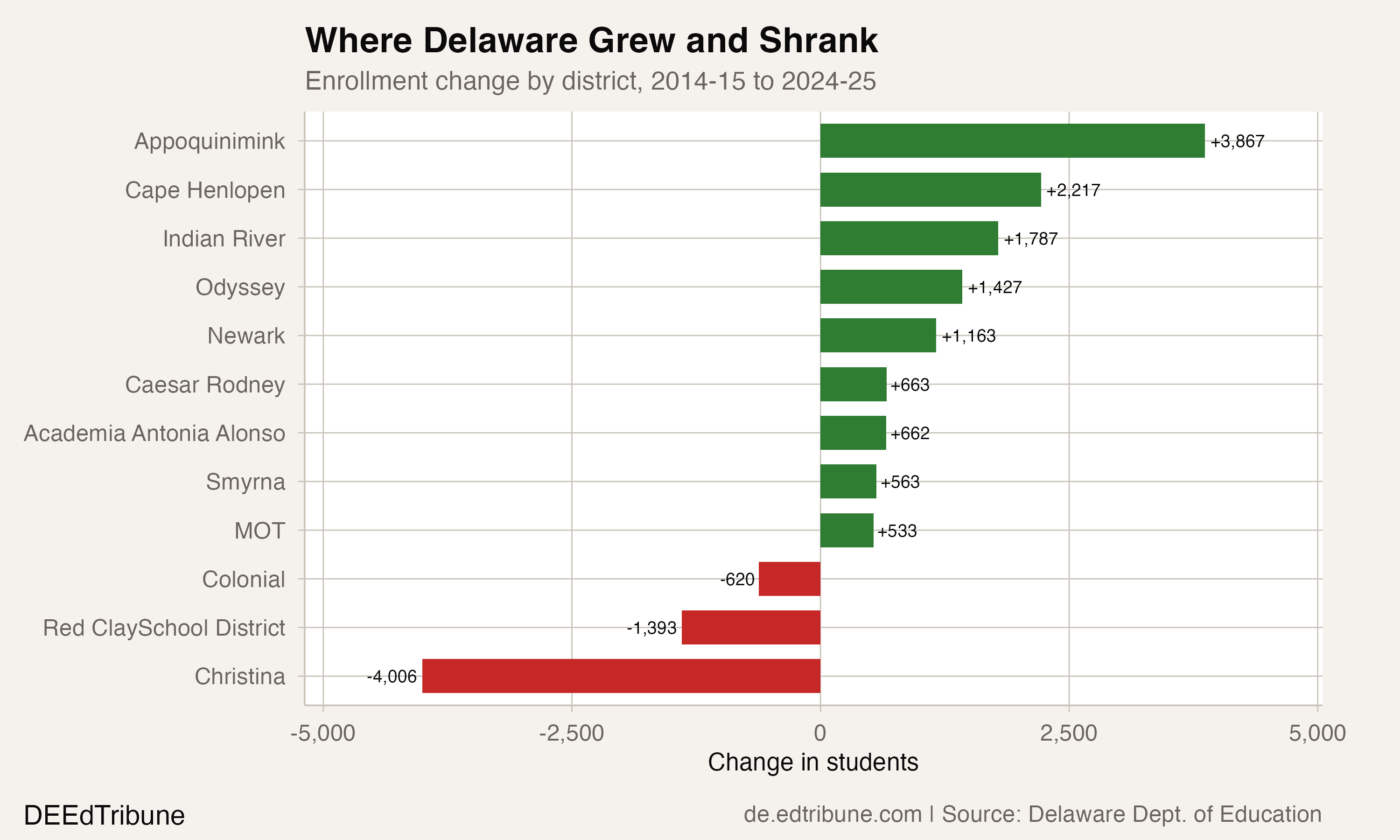
Three districts account for over two-thirds of the state's 11,546-student gain: Appoquinimink↗ET added 3,867 students (+39.9%), Cape Henlopen↗ET added 2,217 (+45.0%), and Indian River↗ET added 1,787 (+17.7%). Together, those three districts added 7,871 students, 68.2% of all state growth over the decade.
Appoquinimink, which has been adding roughly 600 students per year, broke ground in June 2025 on two new schools: Summit Bridge Middle School and Summit High School, approved by referendum in April 2024. It will be the district's fourth high school.
The northern collapse no one can ignore
While the south booms, northern New Castle County is hemorrhaging students. Christina↗ET has lost 4,006 students since 2014-15, a 21.8% decline that has widened the gap behind Red Clay↗ET, the state's largest district. Red Clay itself lost 1,393 students (7.2%), and Colonial↗ET lost 620 (6.1%). Colonial hit its all-time low in 2024-25 with 9,479 students.
The losses in Christina are severe enough to draw the attention of the Redding Consortium for Educational Equity, which in December 2025 voted 19-2 to study merging Brandywine, Christina, Colonial, and Red Clay into a single district serving more than 45,000 students. The proposal, which would undo the 1978 redistricting that split Wilmington's students across suburban jurisdictions, faces stiff opposition.
"It's the only option that meaningfully and fully addresses structural fragmentation and also addresses fiscal instability at the heart of the inequity." State Sen. Tizzy Lockman, Redding Consortium co-chair. Source: Delaware Public Media, Dec. 2025
Brandywine↗ET Superintendent Lisa Lawson and Christina Superintendent Deirdra Joyner cast the only dissenting votes, with Lawson arguing she has not seen "data-driven reasons to believe any changes will actually help Wilmington students".
Who is growing: Hispanic enrollment up 42%
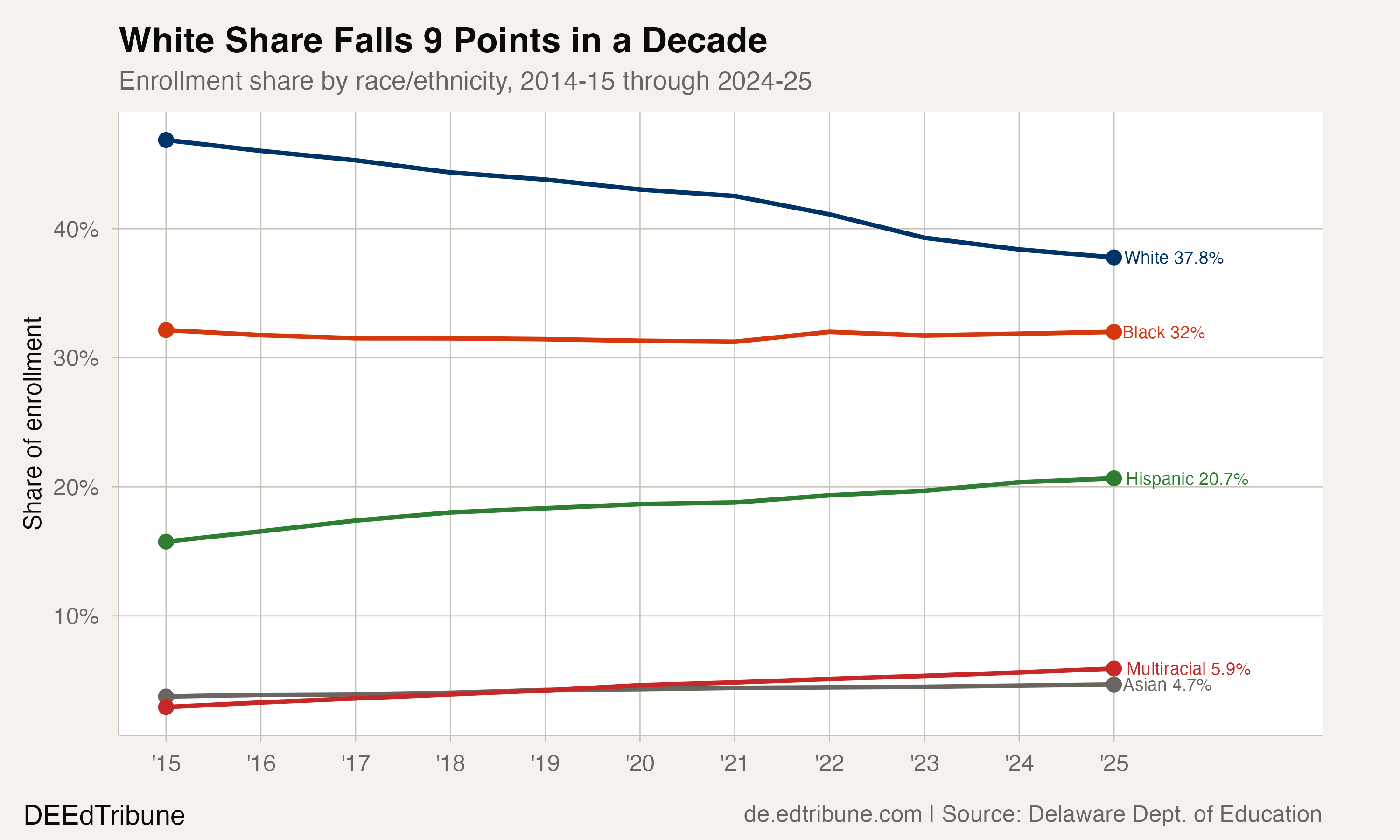
The demographic engine behind Delaware's growth is clear. Hispanic enrollment rose from 21,480 to 31,113 over the decade, a gain of 9,633 students (44.8%) that accounts for 83.4% of all state enrollment growth. Multiracial enrollment more than doubled, from 4,010 to 8,916 (+122.3%). Asian enrollment grew 38.1%, from 5,107 to 7,055.
Black enrollment edged up 9.4% in absolute terms (from 44,066 to 48,205) but held essentially steady as a share of total enrollment, rising from 31.7% to 32.0%.
White enrollment, meanwhile, fell from 64,110 to 56,893, a loss of 7,217 students (11.3%). White students' share of total enrollment dropped 8.3 percentage points, from 46.1% to 37.8%. Delaware is now a majority-minority state by enrollment: no single racial group exceeds 40%.
English learners: the quiet multiplier
Separately from race and ethnicity, Delaware's English learner population has grown 69.5% over the decade, from 11,354 to 19,247 students. EL students now make up 12.8% of total enrollment, up from 8.2% in 2014-15. A federal study of Delaware's EL enrollment found that EL growth was already outpacing total enrollment by a factor of 12 to 1 between 2002 and 2009. That pattern has continued: English learner enrollment grew more than eight times faster than overall enrollment over the last decade.
The state's $63 million Opportunity Funding program distributes weighted per-pupil funding for low-income students and English learners, with allocations approaching $1,000 per eligible student. That funding stream grows as the EL population grows.
But there are early signs of disruption. Spotlight Delaware reported in February 2026 that 11 of 16 traditional districts saw multilingual learner enrollment fall in 2025-26, with Cape Henlopen losing nearly 10% of its MLL students in a single year. The article attributed the decline to families self-deporting amid federal immigration enforcement.
The charter question
Charter enrollment nearly doubled over the decade, from 8,720 to 15,056 students, pushing charter market share from 6.3% to 10.0%. Newark Charter↗ET alone enrolled 3,115 students in 2024-25, up from 1,952 a decade earlier. Odyssey Charter↗ET, the only full Greek-immersion school in the country, grew from 948 to 2,375 students, a 150.5% increase.
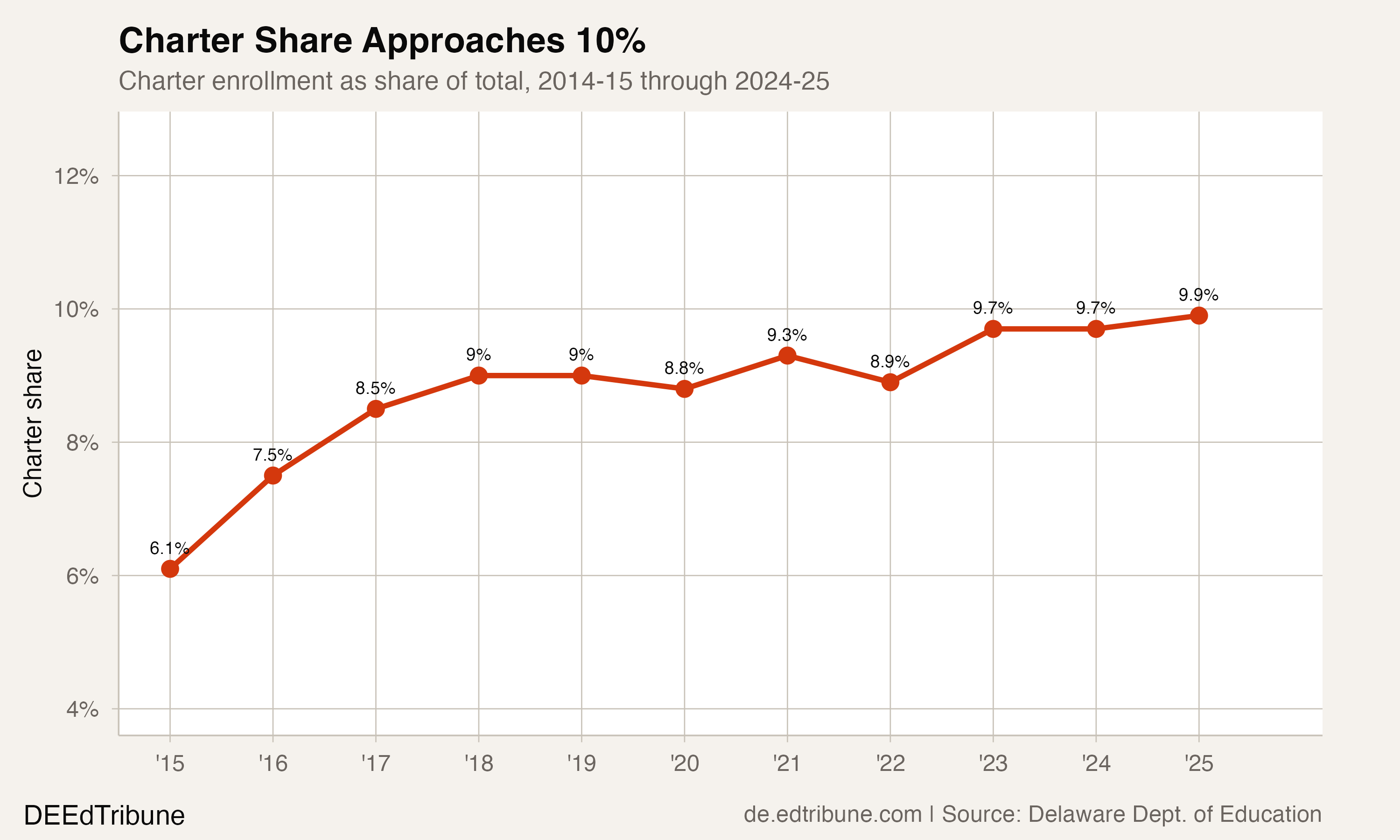
Both sectors grew in absolute terms, but charter growth (+72.7%) vastly outpaced traditional growth (+4.0%). In a school-choice state like Delaware, where open enrollment and three vocational-technical districts already fragment the market, charter growth comes partly at the expense of traditional districts. Christina's 21.8% decline is happening alongside Newark Charter's 59.6% growth, and the two districts share the same geography.
A pipeline question at the bottom
Underneath the all-time high is a structural signal worth watching. Kindergarten enrollment fell 7.0% over the decade, from 11,004 to 10,233, while 12th-grade enrollment rose 25.4%, from 9,472 to 11,875. The K-to-12th ratio dropped from 116.2 to 86.2: Delaware now has more seniors than kindergartners. Elementary enrollment (K-5) is down 1.4% while secondary enrollment (9-12) is up 17.1%.
This pipeline inversion means the current all-time high is being sustained partly by large cohorts working their way through high school. As those cohorts graduate and smaller kindergarten classes replace them, the growth engine will lose momentum absent continued in-migration or rising birth rates.
What to watch
Delaware's growth story is real and, for most states, enviable. But it is also two stories: a booming south absorbing families and construction crews, and a hollowing north wrestling with consolidation proposals, charter competition, and declining white enrollment. The state's 18 districts at all-time highs outnumber the five at all-time lows by more than three to one, and two-thirds of all districts have recovered from COVID losses.
Whether the state can sustain this trajectory depends on forces largely outside the education system: Sussex County housing permits, immigration patterns, and the kindergarten pipeline. The February 2026 reports of multilingual families leaving Delaware schools are the first sign that growth built on new arrivals is vulnerable to policy shocks.
Detailed code that reproduces the analysis and figures in this article is available exclusively to EdTribune subscribers.
Discussion
Sign in to join the discussion.
Loading comments...