Eighteen of Delaware's 39 school districts enrolled more students during the first pandemic year than the year before. Not after the crisis. During it. Cape Henlopen↗ET added 534. Caesar Rodney↗ET added 432. Appoquinimink↗ET, in the fast-growing Middletown corridor, added 416. While most of America was hemorrhaging enrollment, nearly half of Delaware was gaining.
The statewide number tells a story of resilience: Delaware lost just 1,316 students in 2020-21, a 0.9% dip. The following year, enrollment surged by 3,181, erasing the loss 2.4 times over. By 2022-23, the state had exceeded its pre-COVID growth trajectory entirely. In 2024-25, Delaware enrolled 150,591 students, an all-time high for the 11-year dataset and 4.3% above pre-pandemic levels.
But the statewide number conceals a fracture. The four districts that serve Wilmington lost 5,012 students during COVID. The rest of the state's traditional districts gained 350.
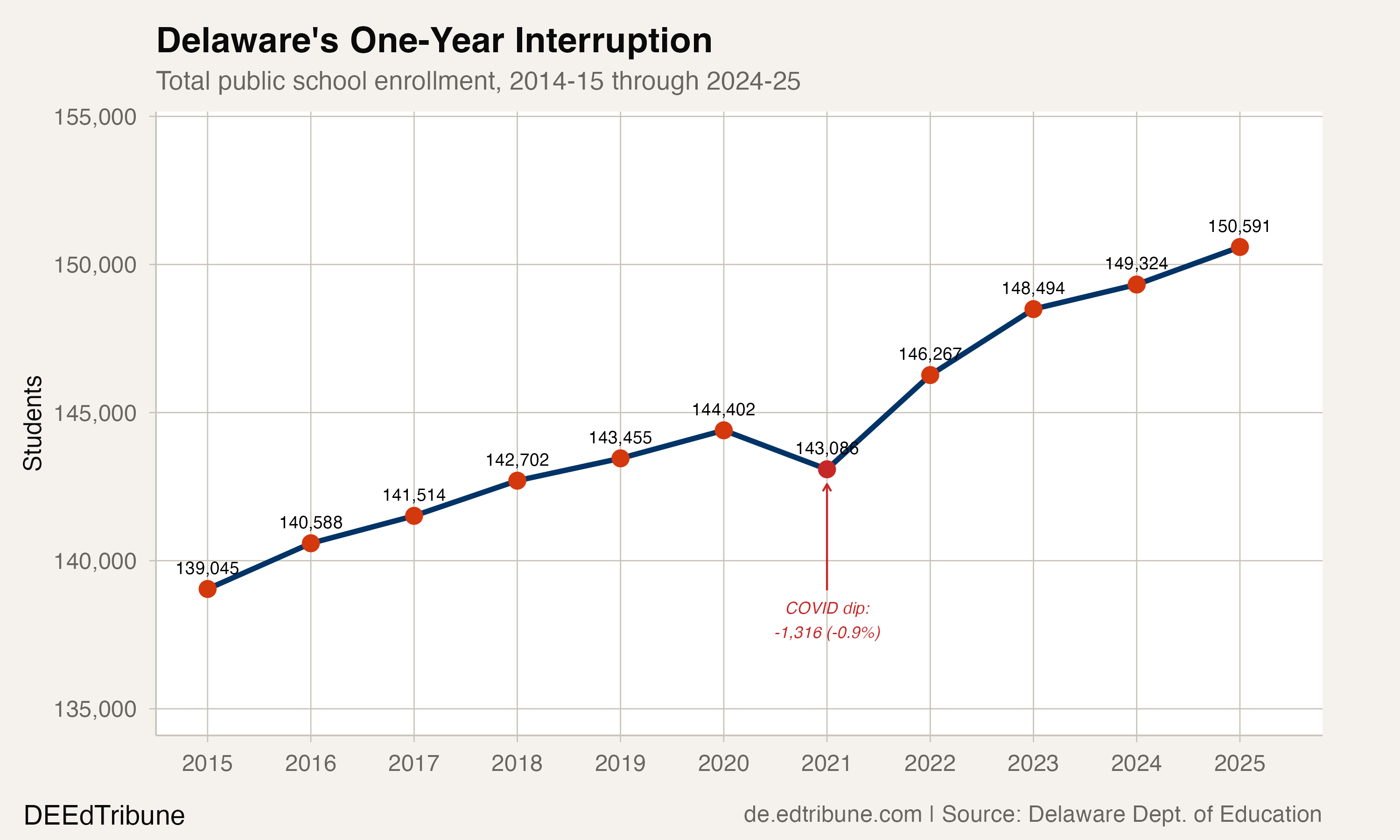
A decade of growth with a single interruption
Delaware grew in nine of 10 years from 2015-16 through 2024-25. The only decline was the pandemic year. No other year came close to negative.
That consistency is unusual. Most states experienced at least two or three years of decline over the same period, and many entered COVID already losing students. Delaware entered the pandemic on a five-year growth streak, adding 5,357 students between 2015 and 2020. The COVID year barely registered as a detour.
The bounce-back was immediate and outsized. The +3,181 gain in 2021-22 was the largest single-year increase in the dataset, more than triple the average annual growth of 1,045 students from 2015 to 2020. The momentum continued: +2,227 the next year, +830, then +1,267 in 2024-25.
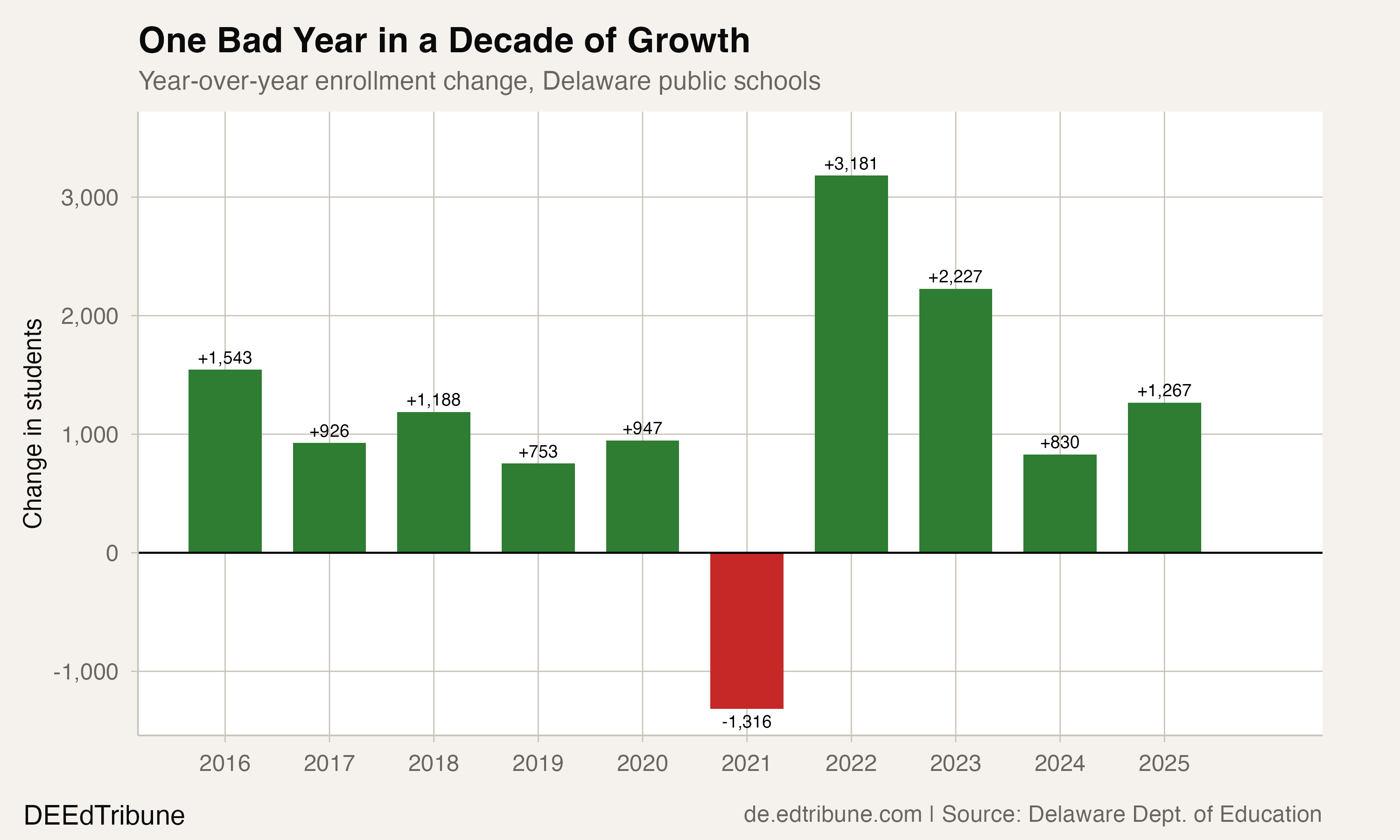
The split no one talks about
The statewide resilience masked a deep geographic divide. The four Brandywine↗ET, Christina↗ET, Colonial↗ET, and Red Clay↗ET districts serving northern New Castle County and Wilmington lost 5,012 students in 2020-21. Brandywine alone lost 1,765, Christina lost 1,525, and Colonial lost 1,221.
Outside those four districts, the rest of Delaware's traditional public schools collectively gained 350 students during the same year. COVID did not hit Delaware uniformly. It hit Wilmington.
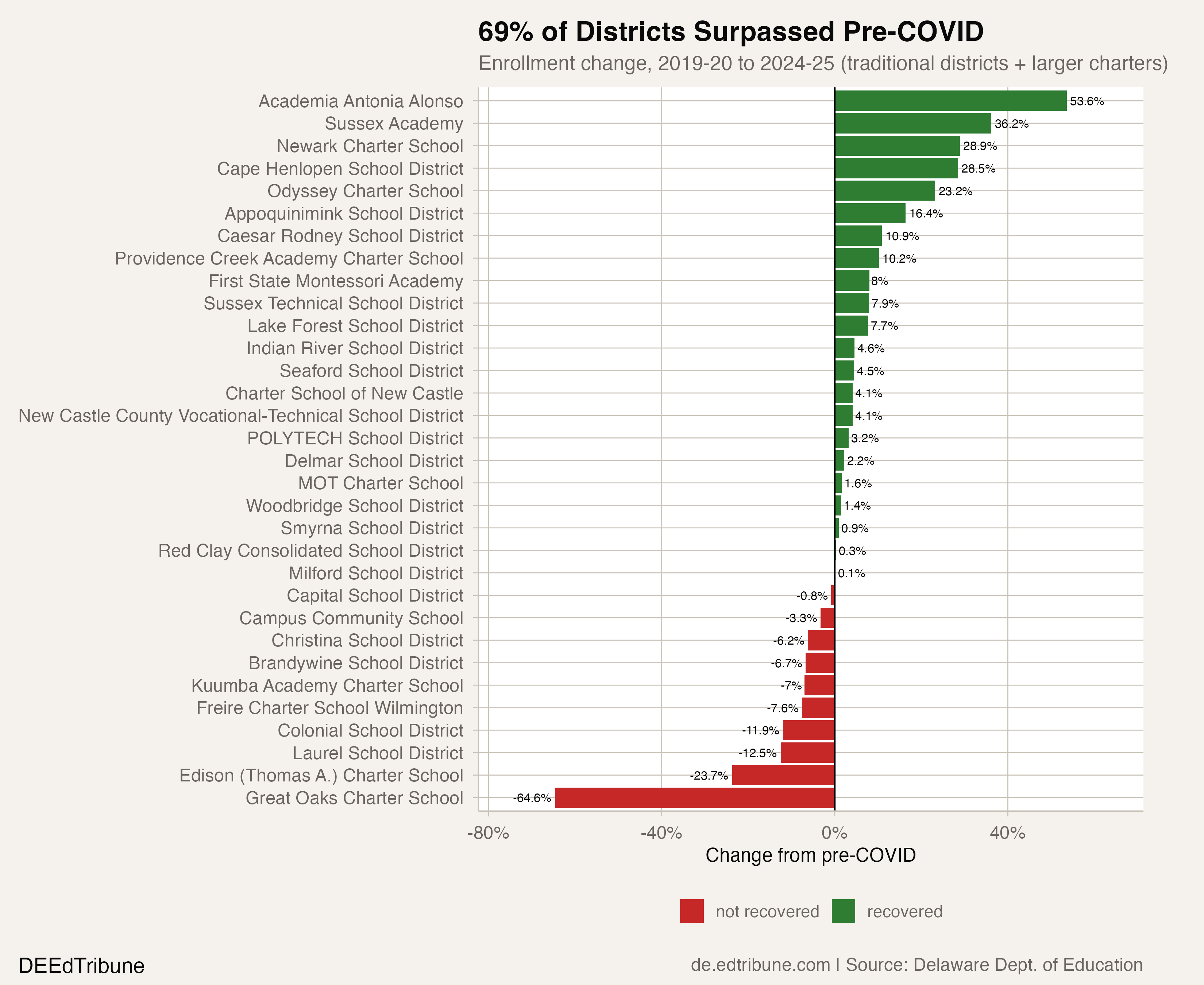
Five years later, the split has hardened. The Wilmington-area districts remain 2,968 students below their pre-COVID levels. Colonial is down 11.9%, Christina 6.2%, Brandywine 6.7%. Only Red Clay has clawed back to roughly even, at +0.3%. The rest of the state's traditional districts, meanwhile, have surged 8.1% above pre-COVID.
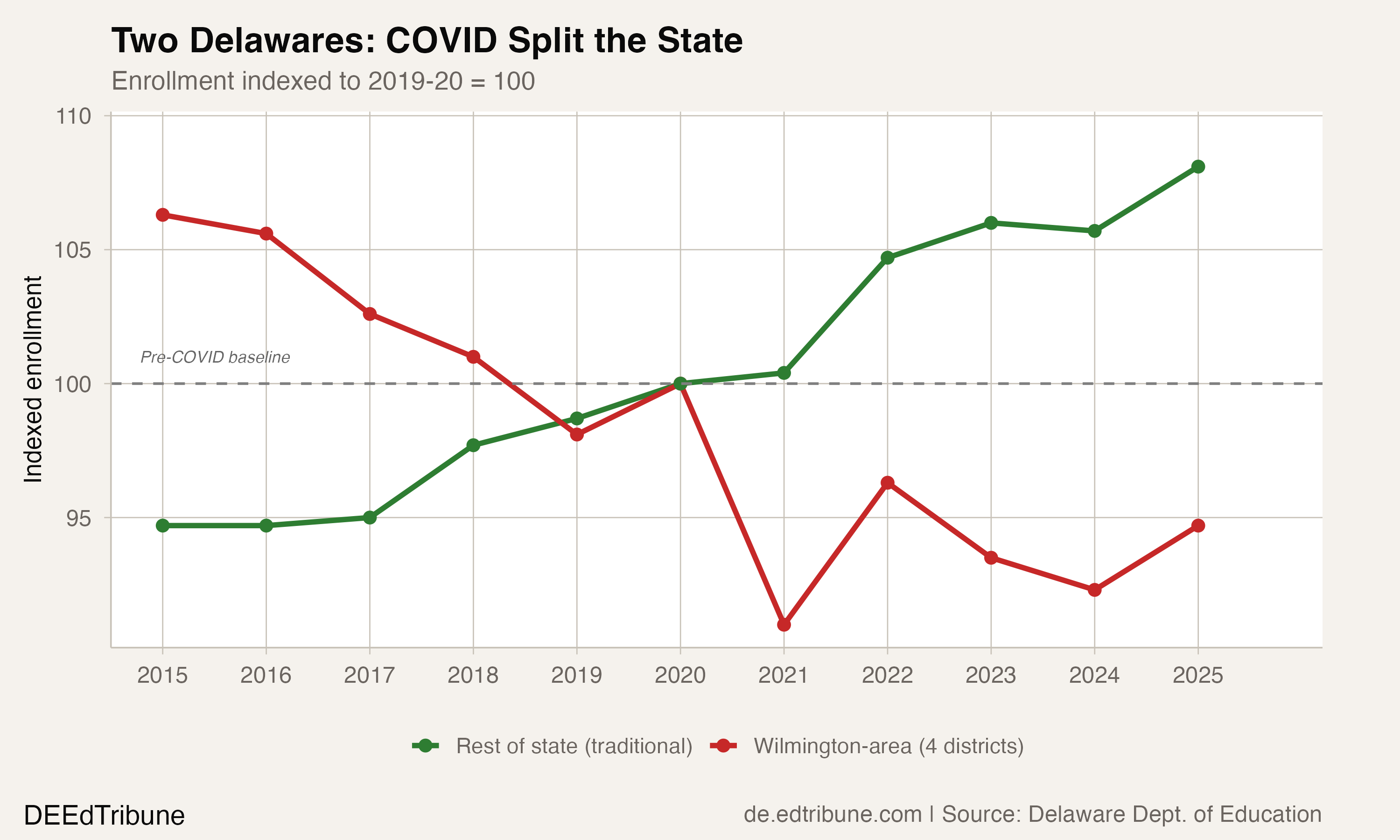
Where Wilmington's students went
The Wilmington-area enrollment collapse was not simply a COVID phenomenon that lingered. It accelerated structural trends already in motion. Christina had been declining since 2015, losing 3,058 students before the pandemic even started. Colonial peaked in 2017 and was already sliding. COVID amplified departures that were happening anyway.
Some families moved south. Sussex County's population grew 29.2% between 2010 and 2022, and 78% of all residential development in Delaware occurred in Sussex. Cape Henlopen's enrollment reflects that shift: up 28.5% since pre-COVID, the largest gain of any traditional district.
Others chose charters. Delaware's charter sector gained 396 students during the COVID year while traditional districts lost 4,662. Charter enrollment has grown from 8,720 in 2015 to 15,056 in 2025, pushing the sector's share from 6.3% toward 10%.
The Wilmington districts also face a structural challenge rooted in desegregation-era boundary lines. The four districts were created in 1981 under a federal court order that assigned each a section of Wilmington to integrate. Those non-contiguous boundaries have created enrollment inefficiencies for decades. Only 41% of Wilmington students zoned for Christina actually attend the district.
"We have a real opportunity in the coming months to develop our final redistricting plan." -- Rep. Nnamdi Chukwuocha, after the Redding Consortium voted 19-2 to recommend merging the four districts, Spotlight Delaware, Dec. 2025
The proposed consolidation would create a single district of more than 45,000 students. Whether it can reverse the enrollment trajectory is an open question. Two of the four superintendents voted against it.
The Middletown engine
While Wilmington contracted, the Middletown corridor expanded. Appoquinimink grew from 9,691 students in 2015 to 13,558 in 2025, a 39.9% gain. It is the only large traditional district in the state that grew during the COVID year itself, adding 416 students as housing subdivisions continued to sprout from former farmland in southern New Castle County.
The district's growth is closely tied to residential development. Middletown, Delaware's fourth-largest city, saw its population jump 23% between 2010 and 2020. The school district has been adding roughly 600 students per year and faces persistent capacity pressure.
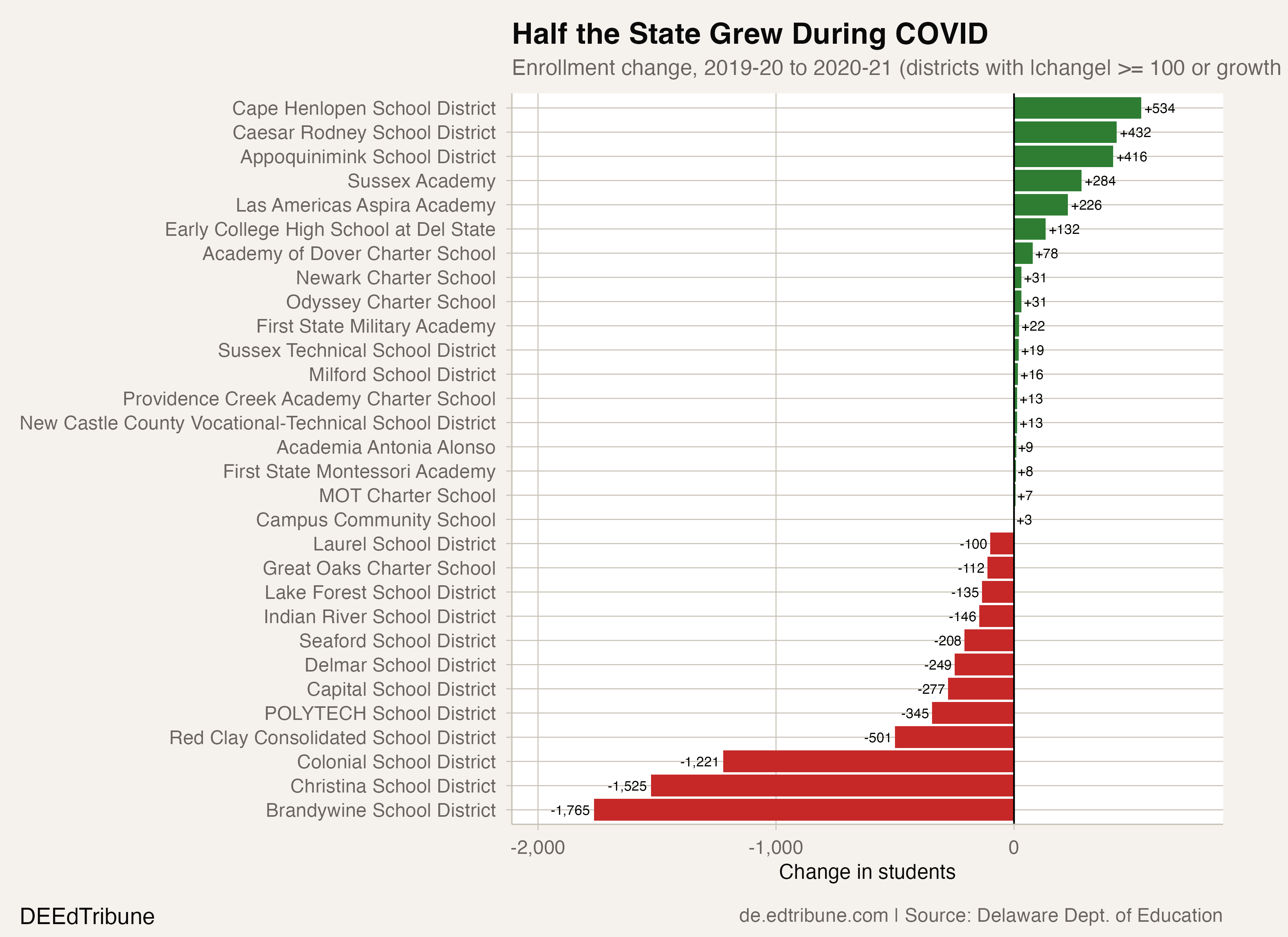
68% recovered, but the holdouts are big
Twenty-five of 37 districts have surpassed their pre-COVID enrollment. That 67.6% recovery rate is strong by national standards. But the 12 districts that have not recovered include some of the state's largest. Colonial, Brandywine, and Christina are the sixth, fifth, and second-largest districts in the state. Together, they are 3,022 students below pre-COVID levels.
The pattern of non-recovery is concentrated in northern New Castle County. Every district still below its 2019-20 mark is either a Wilmington-area traditional district or a Wilmington-area charter school (East Side, Freire, Kuumba Academy, Great Oaks). The geographic concentration suggests the losses are not random attrition, but a sustained outflow from one part of the state.
What exceeded the trajectory
The most striking finding is not just that Delaware recovered. It is that by 2022-23, enrollment exceeded where it would have been if COVID had never happened. A linear projection of the 2015-2020 growth trend (averaging 1,045 students per year) puts 2023 enrollment at 147,698. Actual enrollment was 148,494, nearly 800 students above the projection. By 2025, the state was 803 students above the pre-COVID trajectory.
This does not necessarily mean COVID itself caused growth. Delaware's population boom, particularly in Sussex County and the Middletown corridor, was already accelerating before the pandemic. COVID may have simply redistributed enrollment geographically without reducing the total much.
The question this data cannot answer is whether the families who left Wilmington-area public schools are still in Delaware. If they moved to Sussex County or chose charters, they show up elsewhere in the state total. If they left the state or shifted to private or home schooling, the statewide growth is masking a separate loss. During the pandemic year itself, homeschool enrollment in Delaware surged 63%, adding 1,742 students, while private school enrollment grew 4.4%.
The Redding Consortium's proposed merger of the Wilmington-area districts will be the next enrollment story to watch. If the General Assembly approves consolidation by June 2026, it will reshape the enrollment map for more than 45,000 students. Whether a single district can stabilize what four districts could not is the test that comes next.
Detailed code that reproduces the analysis and figures in this article is available exclusively to EdTribune subscribers.
Discussion
Sign in to join the discussion.
Loading comments...