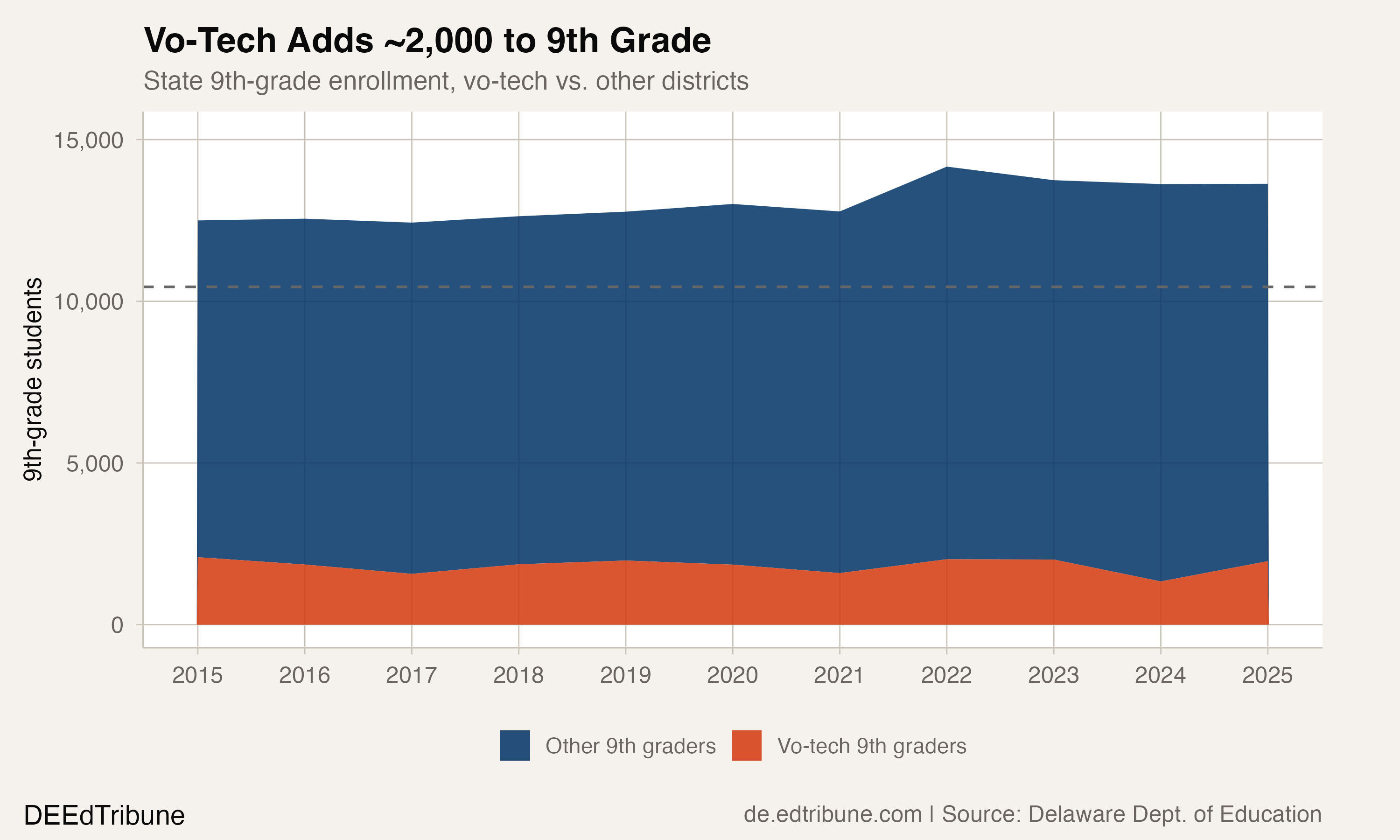
Look at Delaware's enrollment by grade and one bar sticks out like a fence post in a flat field. The state enrolled 11,504 students in 8th grade in 2024-25, then 13,633 in 9th grade: 2,129 more freshmen than the preceding class, an 18.5% jump. Every other grade-to-grade transition in the state hovers within two percentage points of 1:1. The 8th-to-9th spike is nearly nine times larger than any of them.
This is not an error in the data. It is a structural feature of Delaware's school system, and it has persisted for at least a decade.
Three districts that exist only for high school
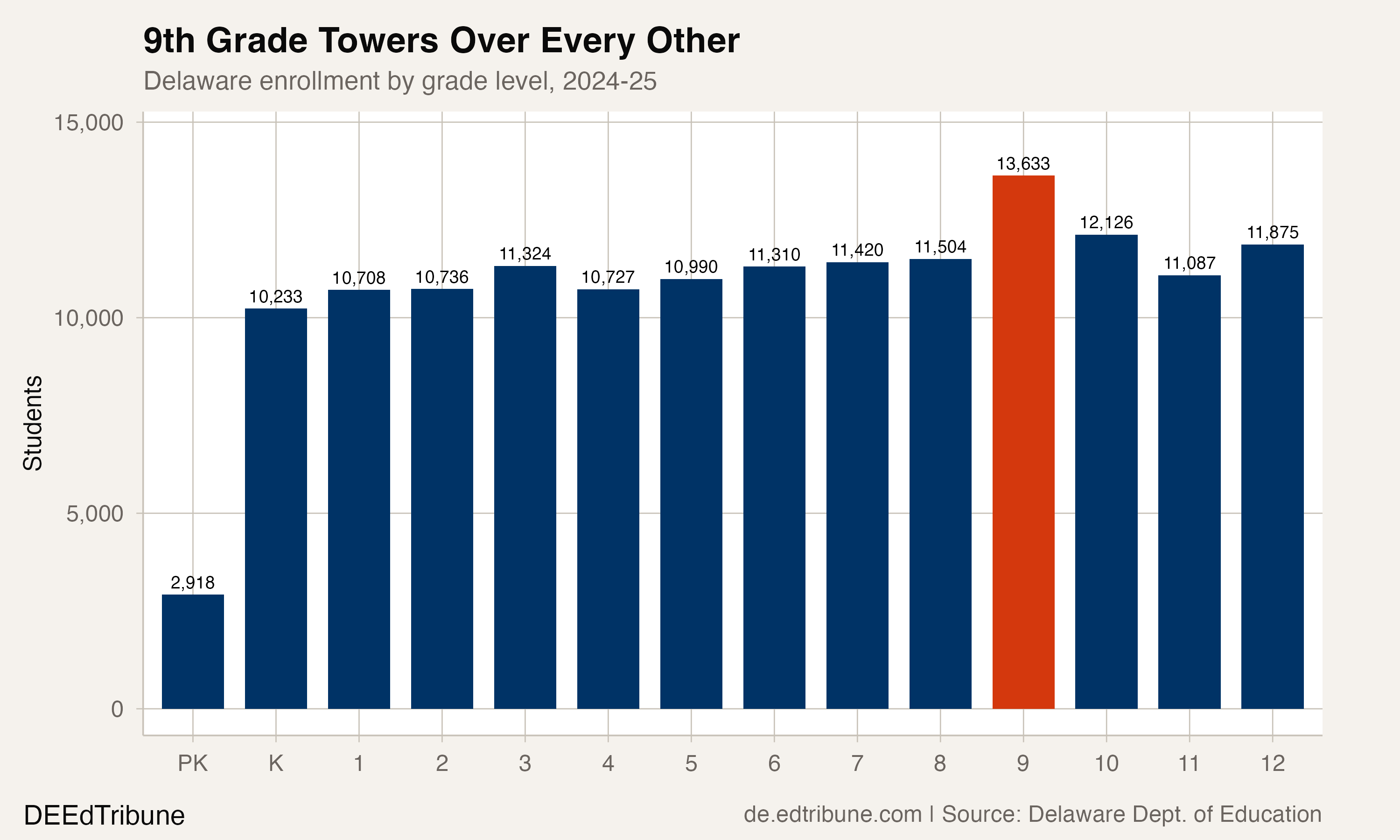
Delaware is one of the few states that operates standalone vocational-technical school districts. Three of them, one per county, serve only grades 9 through 12: New Castle County Vocational-Technical School District↗ET (4,917 students), Sussex Technical School District↗ET (1,358), and POLYTECH School District↗ET (1,244). Together they enrolled 7,519 high schoolers in 2024-25, about 15.4% of the state's total high school population.
These districts have no elementary schools, no middle schools, and no 8th graders. When their freshmen show up in the state enrollment count, they add roughly 1,965 students to 9th grade with no corresponding 8th-grade base. That single fact accounts for nearly all of the bulge.
Strip the three vo-tech districts from the calculation and the 8th-to-9th ratio drops to 101.4%, essentially flat. The "extra" freshmen are not appearing from nowhere. They are 8th graders at traditional districts who apply through Delaware's school choice program and enroll in a vo-tech high school, creating what amounts to a counting illusion at the state level.
A decade of consistency
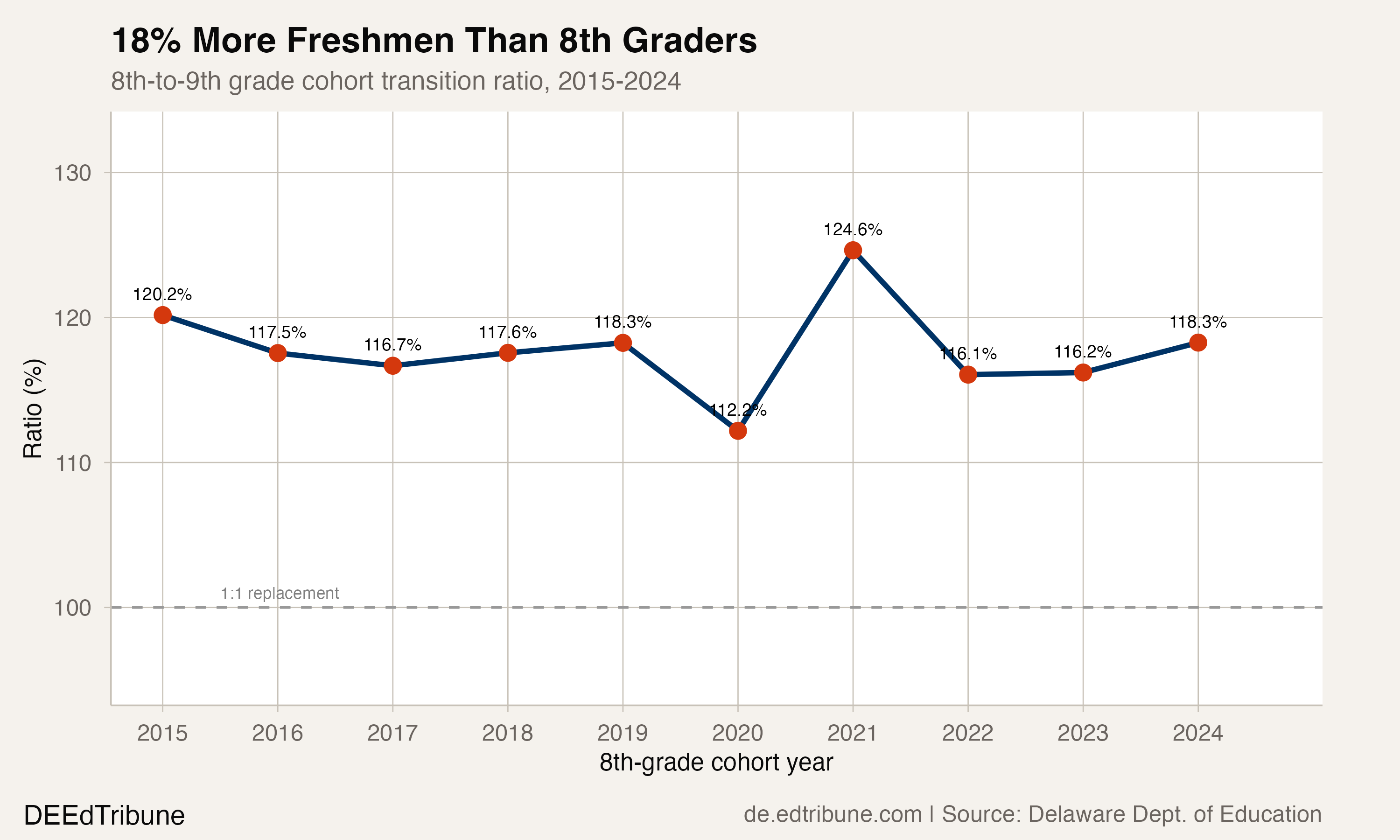
The 8th-to-9th transition ratio has averaged 117.8% across the 10 cohorts from 2015 to 2024, never once falling below 112%. The peak came with the 2021 cohort, when 9th-grade enrollment hit 124.6% of the preceding 8th grade, likely inflated by COVID-era disruptions that delayed some students' entry into high school. But even in a typical year, freshman classes run 16% to 18% larger than the 8th-grade cohort.
The consistency is the point. This is not a one-time event or a trend; it is a permanent feature of how Delaware organizes its schools. Every fall, roughly one in seven 9th graders in the state is sitting in a vo-tech classroom.
Where the students go
The choice flows are not evenly distributed. Capital School District↗ET in Dover is the most extreme case: it enrolled 534 8th graders in 2024-25 but only 44 students in 9th grade. Dover High School, Capital's sole comprehensive high school, reports zero 9th graders in the enrollment data. Its 1,497 students are all in grades 10 through 12. Functionally, Capital's 8th graders disperse entirely for freshman year, most of them to POLYTECH, then many return for 10th grade.
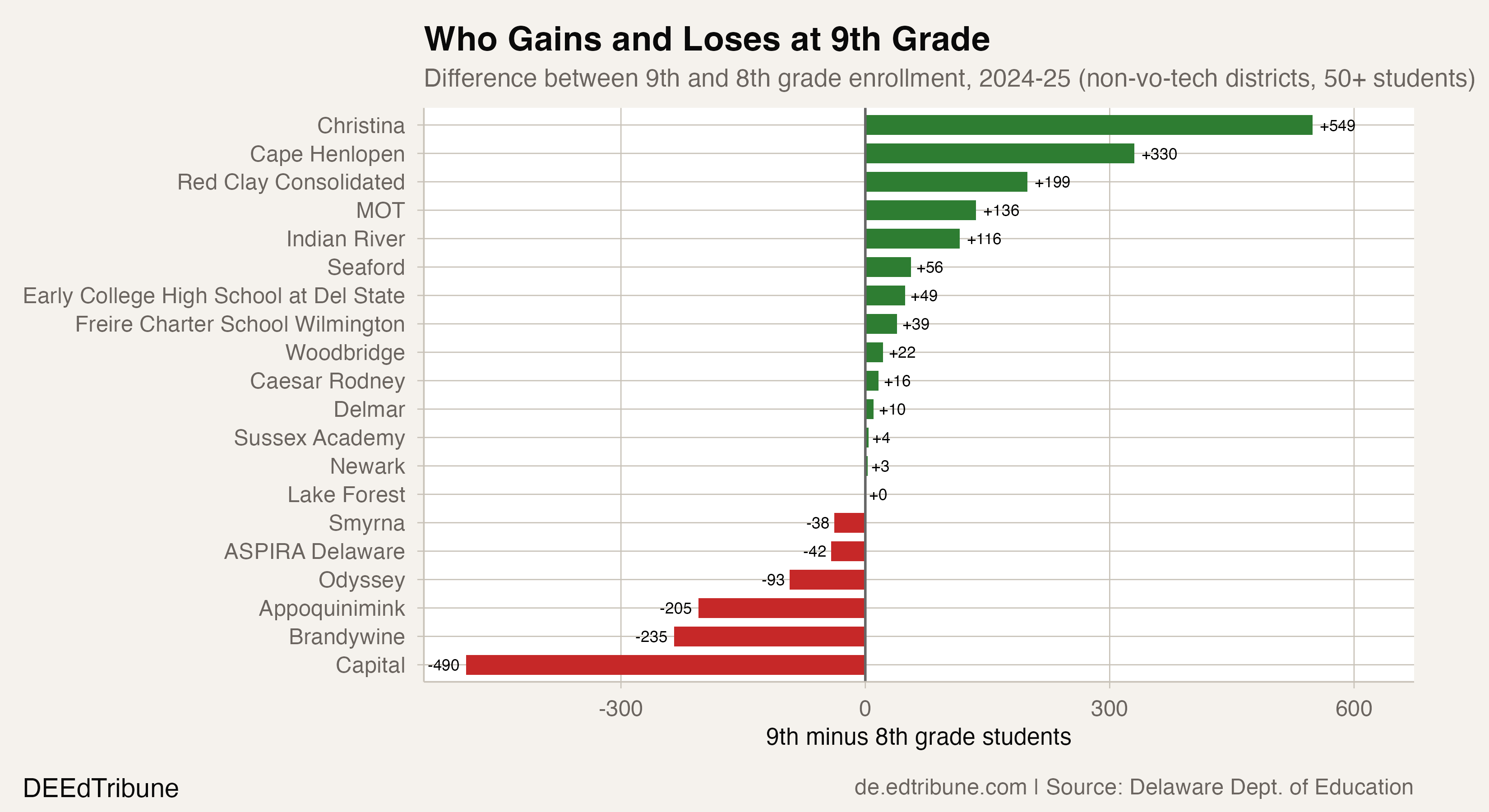
Christina School District↗ET shows the reverse pattern. It enrolled 627 8th graders but 1,176 9th graders, a gain of 549 students, or 87.6%. Cape Henlopen School District↗ET nearly tripled: 296 in 8th grade, 626 in 9th, a 211.5% ratio. These districts are net receivers of choice students at the high school transition, pulling from neighboring districts whose families select their programs.
Brandywine School District↗ET and Appoquinimink School District↗ET, both in New Castle County, lost 235 and 205 students at the 9th-grade boundary respectively. For Brandywine, that is a 26.8% reduction in class size between 8th and 9th grade. Those students go primarily to NCC Vo-Tech's four campuses and to charter high schools.
Then 1,400 disappear
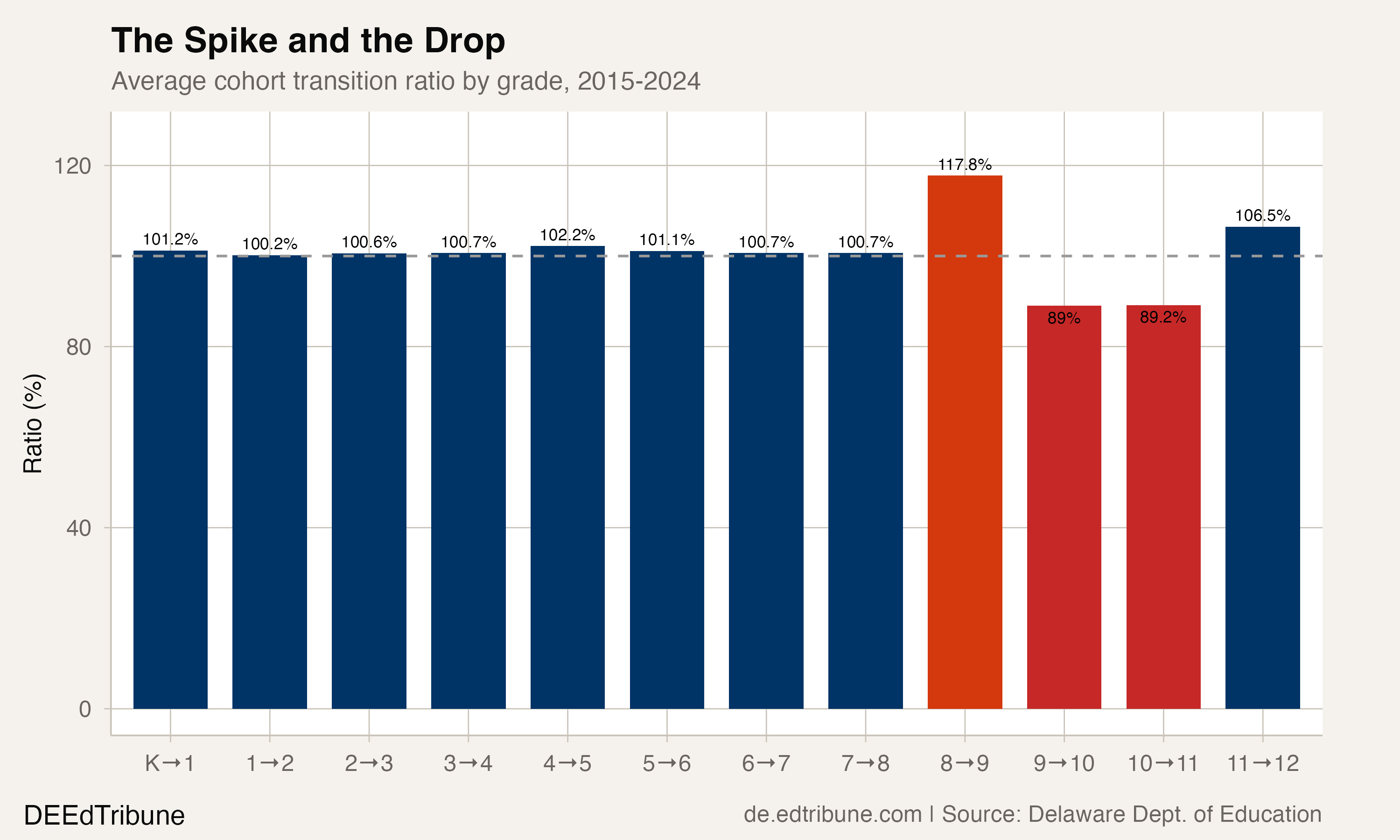
The 9th-grade bulge creates an equally notable dropout on the other side. The average 9th-to-10th cohort transition ratio is 89.0%, meaning roughly 1,431 students vanish between freshman and sophomore year. The 10th-to-11th transition is nearly identical at 89.2%.
Some of this reflects the structural reverse of the vo-tech effect. A student counted in both a feeder district's 8th grade and a vo-tech's 9th grade may return to a comprehensive high school for 10th grade, or simply not be re-enrolled at the vo-tech after a trial year. The NCC Vo-Tech admissions page notes that students apply specifically for 9th grade, with a separate application process for 10th-grade entry, suggesting that the freshman year serves as a selective intake point.
But the magnitude of the drop, 11% of the freshman class, exceeds what a simple return-to-home-district transfer would explain. National research on the ninth-grade bottleneck has documented that 9th grade is the highest-risk year for retention and dropout, with students who are held back in 9th grade far more likely to leave school entirely. Delaware's enrollment data cannot distinguish between students who transferred, were retained in grade, or dropped out. The 11% gap likely reflects a combination of all three.
The 11th-to-12th rebound
One more anomaly appears at the end of the pipeline. The 11th-to-12th transition ratio averages 106.5%, meaning 12th-grade classes are consistently 6% to 8% larger than the 11th-grade cohort that preceded them. This has been rising: the 2024 cohort hit 108.5%.
The most likely explanation is a growing population of students who take five years to complete high school. Delaware counts these students in 12th grade regardless of when they started, and the ratio has climbed steadily from 103.9% in the 2018 cohort to 108.5% in the 2024 cohort. Over six years, the 12th-grade surplus has grown from 386 to 933 students. Whether this reflects expanded credit-recovery programs, changing graduation requirements, or students returning after leaving school is not clear from enrollment data alone.
The funding question
Delaware's unit-count funding system, which allocates staff and resources based on a single-day September 30 enrollment snapshot, amplifies the stakes of these transitions. As a Rodel Foundation analysis noted, the attendance-based approach means that "when a district undercounts, they receive fewer units, or resources, to serve their students."
"Since the student count determines how we calculate units and allocate funds to schools each year, it is a critical component of the funding system." -- Rodel Foundation, "Not Counting on the Count"
For districts like Capital that export nearly their entire 8th-grade class, the September count captures a 9th grade of 44 students where weeks later, some may return or new students enroll. For vo-tech districts that absorb 2,000 freshmen, the count must capture them on that exact day or lose funding for the year.
Delaware's unit-count statute addresses the overlap with a partial deduction: students counted in vo-tech units are deducted at a 0.5 ratio from their home district's entitlement. The formula acknowledges that the same student generates costs in two places, but the half-unit adjustment is a rough proxy for what is actually a complex flow of students across district lines.
What this means for the districts caught in the middle
Delaware's school choice program, established in 1996, allows any family to apply to any public school in the state regardless of address. Approximately one in three Delaware students exercises some form of school choice. The application window runs from the first Monday in November to the second Wednesday in January, with decisions communicated by the last day of February.
For sending districts, the 9th-grade transition creates annual uncertainty about how many students will leave for vo-tech, charter, or magnet programs, and how many will return after a year. Capital's experience is the most extreme version: the district must plan for 534 8th graders, then staff for 44 freshmen at one campus and 1,497 upperclassmen at Dover High. The mismatch between the district's elementary pipeline and its high school capacity is a permanent structural feature, not a planning failure.
For NCC Vo-Tech, the state's largest vo-tech district at 4,917 students, the admissions process is explicitly selective: applicants submit 7th- and 8th-grade report cards and discipline records, and selection is based on academic performance and available space. Each year, roughly one-fourth of all 8th graders in New Castle County public schools apply. That the district's enrollment has held steady between 4,700 and 4,900 for a decade suggests stable demand for CTE programs even as the broader education landscape fragments.
The question the data cannot answer is what happens to the 1,431 students who disappear between 9th and 10th grade. Some transferred. Some were retained. Some left school. In a state where one-third of students exercise choice, untangling voluntary mobility from involuntary attrition requires student-level tracking that enrollment snapshots do not provide.
Detailed code that reproduces the analysis and figures in this article is available exclusively to EdTribune subscribers.
Discussion
Sign in to join the discussion.
Loading comments...