In 2014-15, Odyssey Charter School↗ET enrolled 948 students and was majority white. A decade later it has 2,375 students, no racial majority, and a waitlist that exceeds the enrollment of most Delaware charter schools. It is the only full Greek language immersion program in the United States.
The 150.5% enrollment increase over 10 consecutive years of growth makes Odyssey the charter with the largest absolute student gain in Delaware and the 18th-largest district of any kind in the state. Its growth accounts for 22.5% of all charter sector expansion over the period, more than any other single school.
Two hours of Greek, every day
Greek is not an elective at Odyssey. Every student receives two hours of daily instruction in Greek language and culture, a commitment that initially appealed to families in Delaware's Greek diaspora but has since drawn a far broader cross-section of the state. Ninety-eight percent of the student body has no Greek heritage.
The model has drawn national recognition. In 2023, Odyssey was named a Yass Prize finalist and awarded a $500,000 STOP Award for its "sustainable and transformational" immersion program. The school is building out a K-16 pathway that would connect Delaware students to universities in Greece and Cyprus, with students earning a Greek Seal of Biliteracy gaining eligibility for European Union work visas.
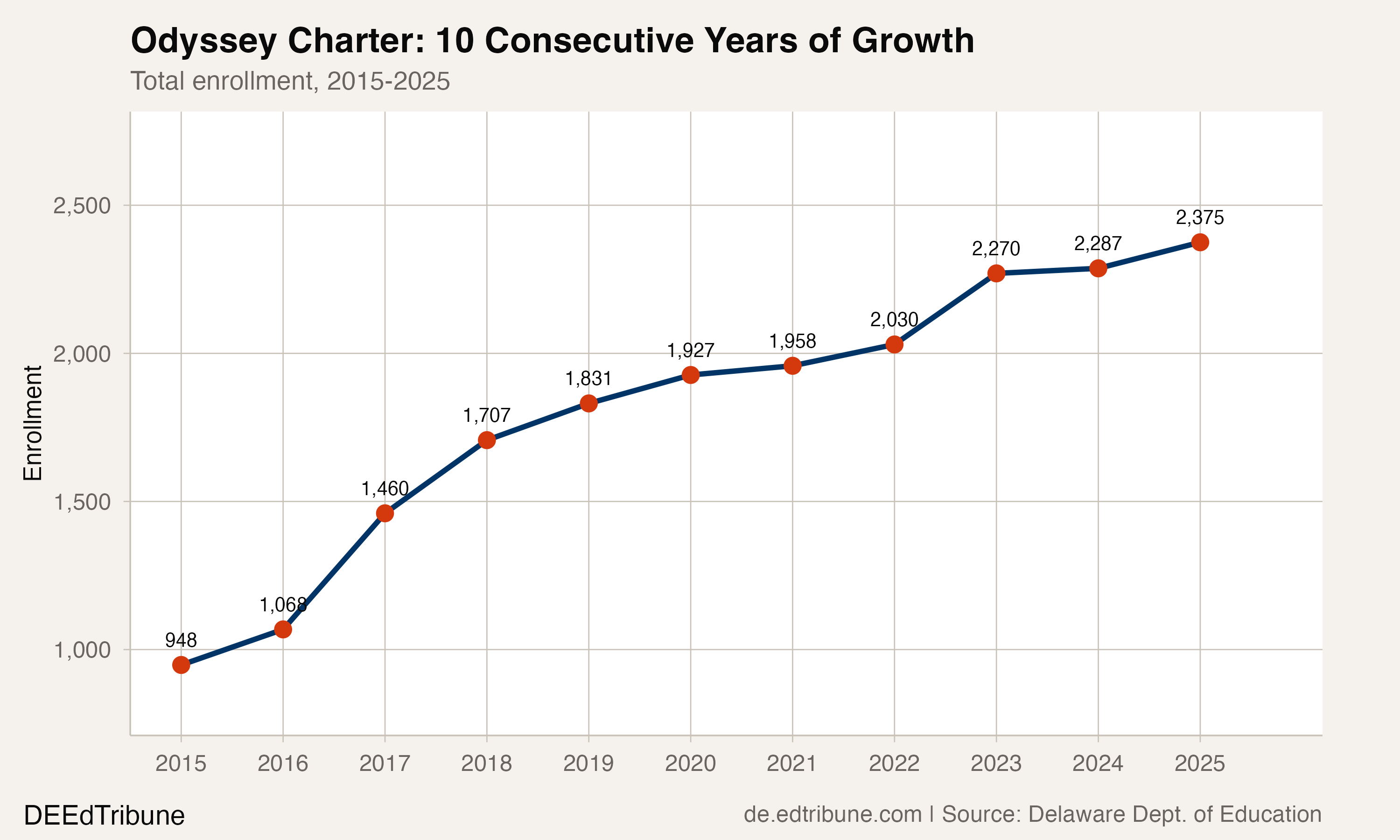
Growth in two acts
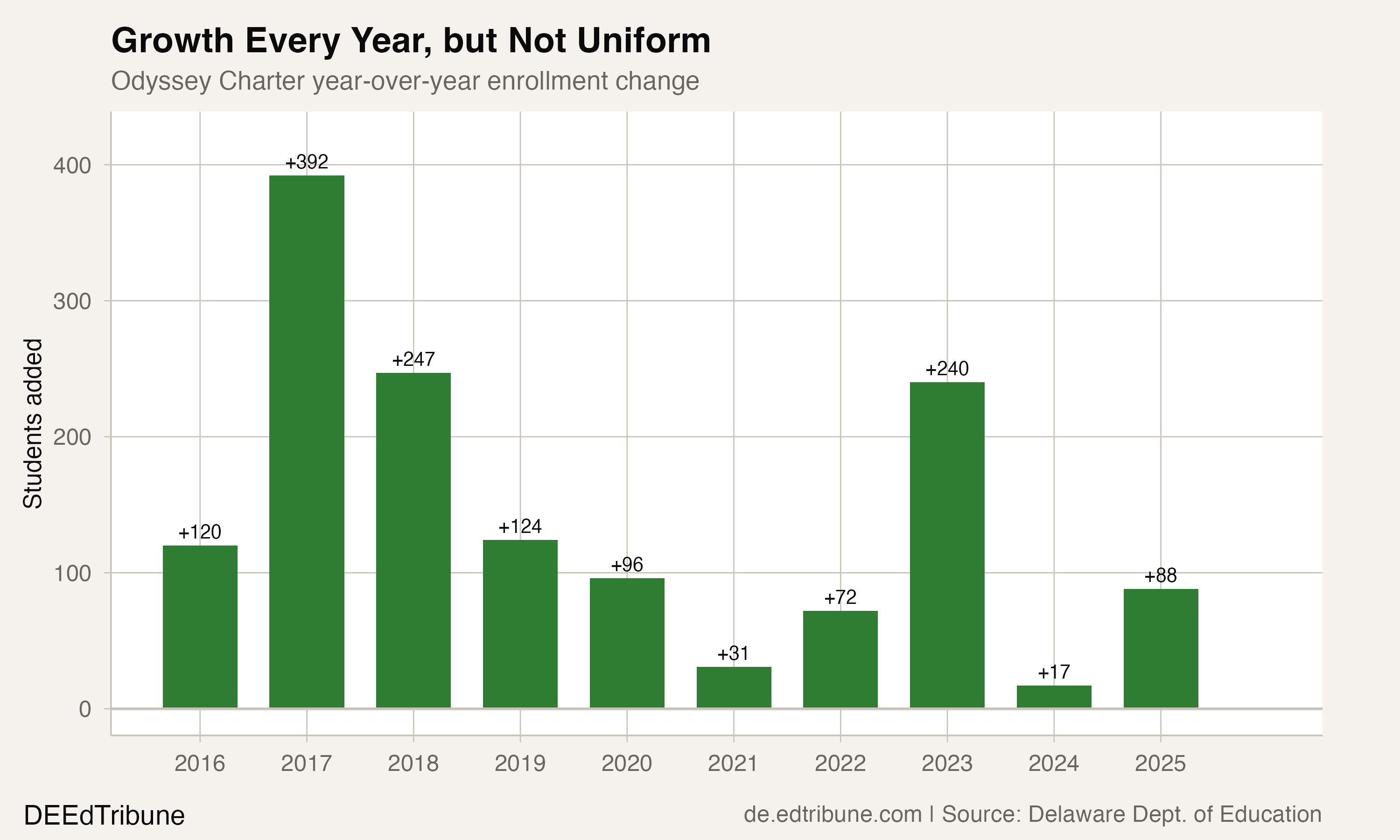
The growth trajectory has two distinct phases. From 2016 to 2018, Odyssey added 759 students in three years, a period of rapid facility-driven expansion that peaked at 392 new students in a single year (2016-17). Growth then decelerated through the pandemic, bottoming at just 17 new students in 2023-24.
The most recent year brought 88 new students, a 3.8% increase that suggests the school is constrained by physical capacity rather than demand. Building 27, a new facility partially opened in fall 2025, is scheduled for full completion in fall 2026 and will accommodate approximately 300 additional students.
The diversity crossover
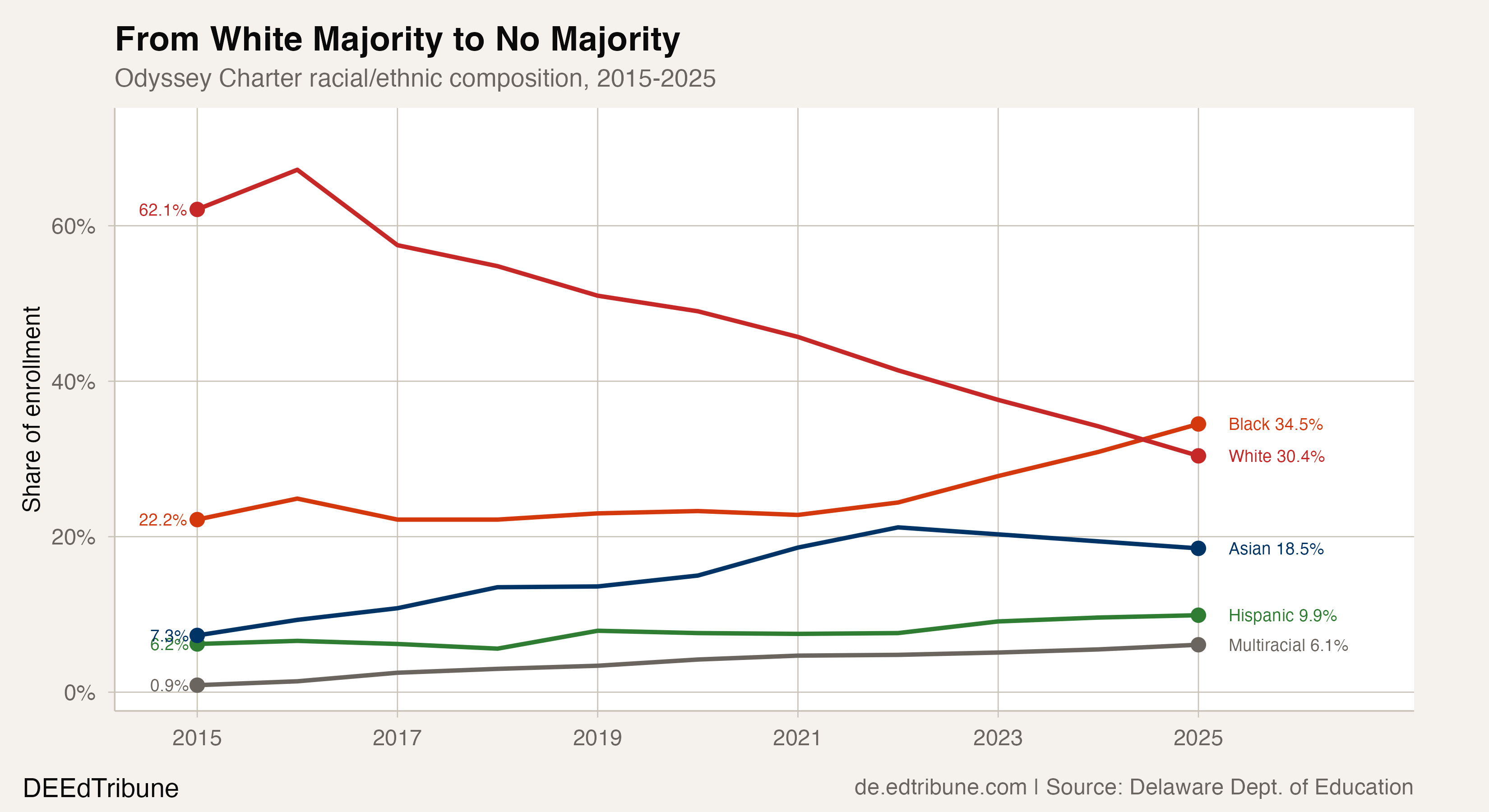
The enrollment story that the topline growth obscures is the demographic transformation. In 2014-15, white students made up 62.0% of Odyssey's enrollment. By 2019-20, white share had fallen below 50% for the first time (49.0%). By 2024-25, it reached 30.4%.
The most striking shift is in Black enrollment: from 210 to 819 students, a 290% increase that made Black students the school's largest racial group at 34.5%. Asian families followed close behind, growing from 69 to 439 (7.3% to 18.5%). Hispanic enrollment nearly quadrupled from 56 to 235 (5.9% to 9.9%).
The result is that Odyssey now has the highest racial diversity of any district in Delaware, measured by the Shannon diversity index (1.444 in 2025, up from 1.105 in 2015). The next most diverse districts, Appoquinimink↗ET (1.365) and Red Clay↗ET (1.360), are traditional districts with ten times the enrollment.
What a language program reveals about school choice
The demographic shift at Odyssey complicates two common narratives about charter schools. The first is that charters primarily serve as vehicles for white flight from diverse public schools. Odyssey's white share has fallen 31.6 percentage points in a decade; the school is diversifying faster than the traditional districts it draws from.
The second is that niche academic programs attract a narrow, self-selecting population. Odyssey's Greek immersion model is as niche as it gets, yet it has attracted families across every racial and ethnic group in northern Delaware. The school's appeal appears to be less about Greek specifically and more about the signal a demanding language program sends: this school takes academics seriously.
One plausible mechanism is that Odyssey's growth draws from the same pool of families leaving Christina School District↗ET, which lost 4,006 students (21.8%) between 2015 and 2025. Christina's white enrollment fell from 28.7% to 21.8% over the period, but its Black and Hispanic shares remained relatively stable, suggesting that families of all backgrounds are exercising choice options. Delaware's open enrollment system, which allows any family to apply to any public school or charter regardless of address, makes this kind of cross-district sorting structurally easy.
"Newark Charter is by far the largest at 3,156 K-12 students, with its 5-mile radius siphoning many of the suburban kids out of the Christina School District. Odyssey Charter, located west of Wilmington, has seen a 5% increase to 2,402 K-12 students." Source: WDEL News, 2025
Whether Odyssey is pulling students directly from Christina, from Red Clay (which lost 7.2% over the period), or from other charters is not discernible from enrollment data alone. Delaware does not publish transfer-level data linking individual students to their prior school.
The English learner surge
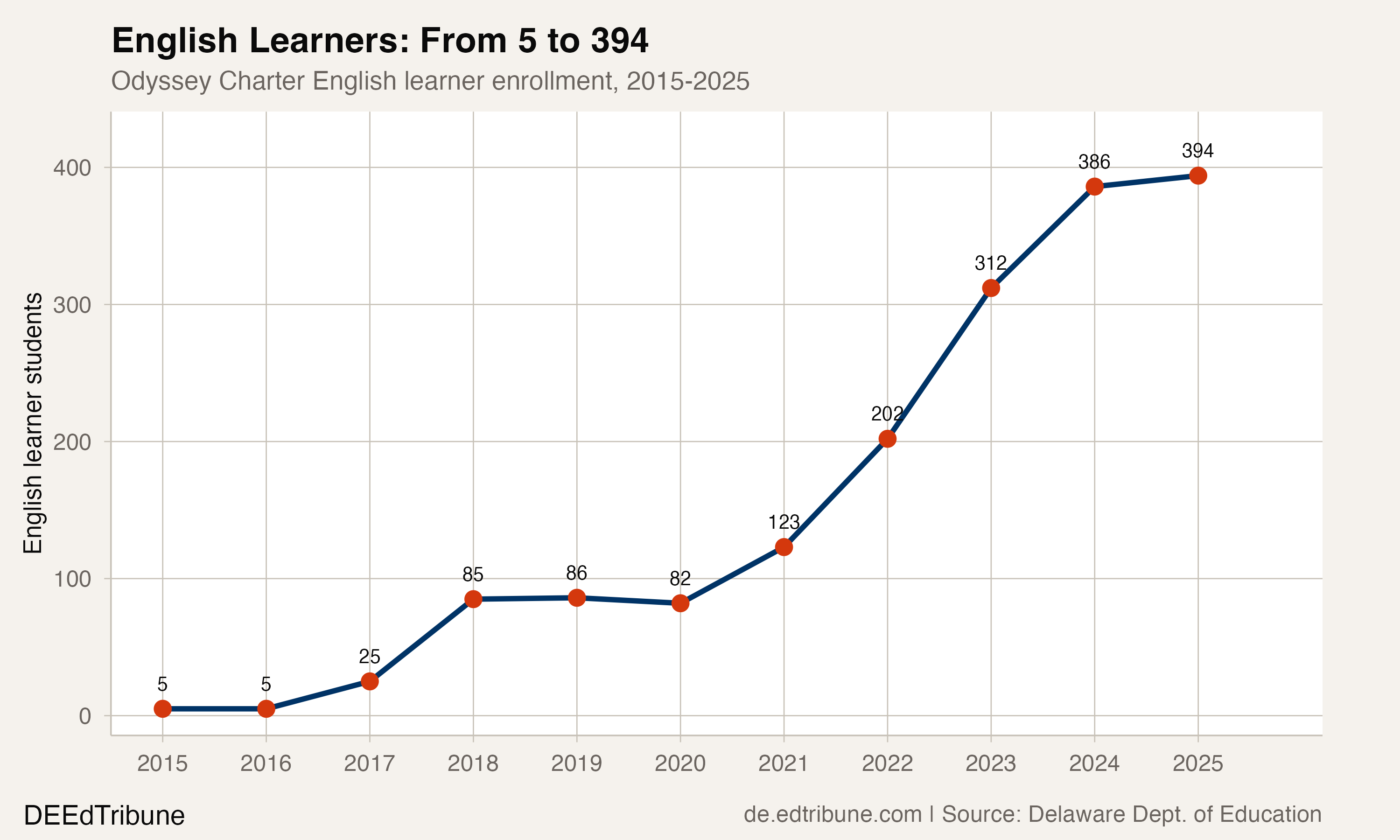
Separately from the racial composition shift, Odyssey's English learner population has undergone an even more striking change. In 2014-15, the school enrolled five English learners, 0.5% of its student body. By 2024-25, that figure was 394 students, 16.6% of enrollment.
The growth trajectory accelerated sharply after 2020, with English learner counts doubling from 82 to 202 between 2020 and 2022, then nearly doubling again to 394 by 2025. Whether this reflects new immigrant families choosing Odyssey for its language-intensive model, expanded identification of existing students, or both, the data cannot distinguish. The timing of the acceleration, coinciding with broader immigration trends in the mid-Atlantic region, suggests arrival-driven growth is at least part of the story.
Odyssey in context
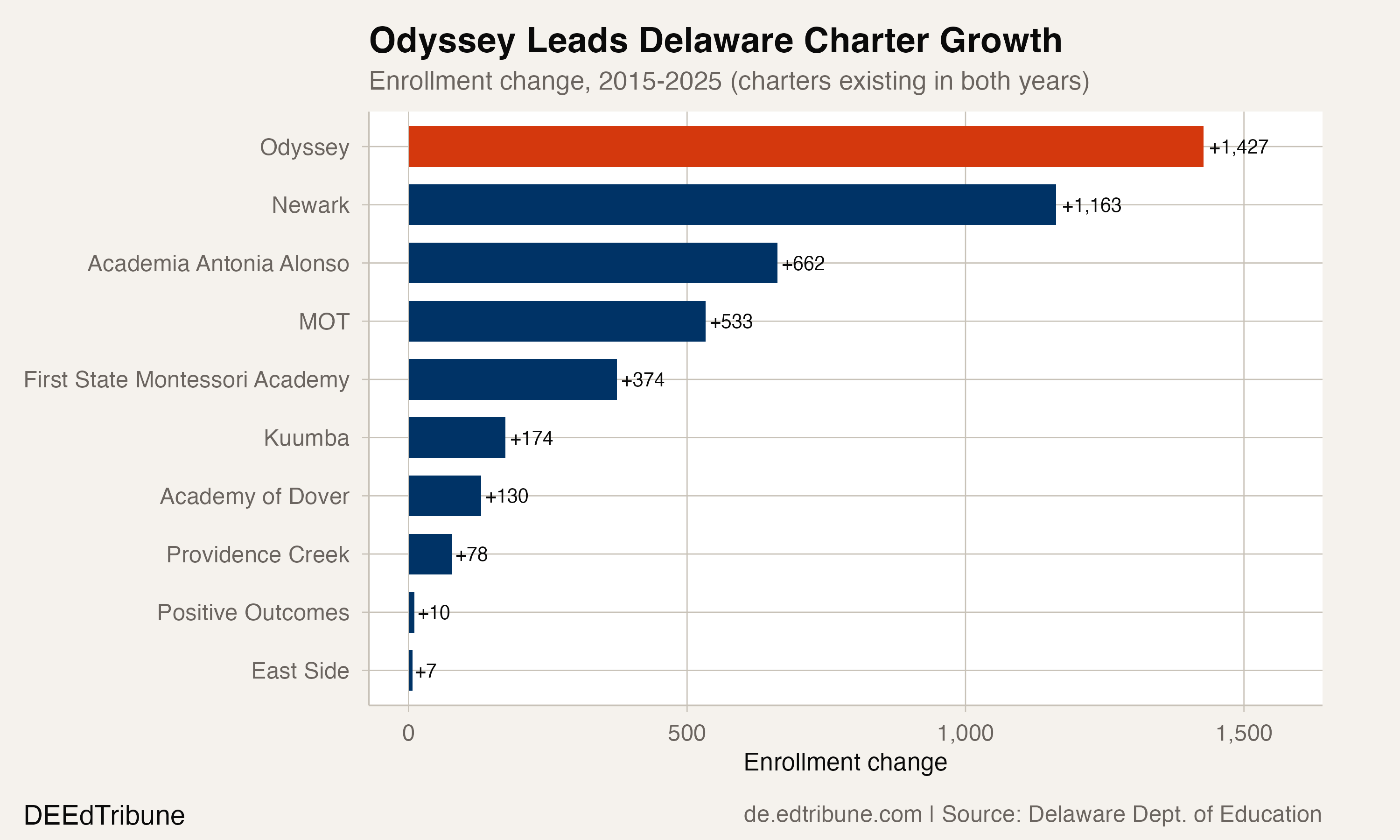
Odyssey's 1,427-student gain since 2015 is the largest of any Delaware charter school. Newark Charter↗ET added 1,163 over the same period, and Academia Antonia Alonso↗ET grew by 662. Among the 10 charter schools that existed in both 2015 and 2025, only one, Thomas Edison Charter↗ET, shrank.
The charter sector as a whole grew from 8,720 students (6.1% of public enrollment) in 2015 to 15,056 (9.9%) in 2025. Odyssey alone accounts for nearly a quarter of that growth.
The high school question
Odyssey's grade-level enrollment reveals a structural challenge. The school's K-8 grades are large and stable: kindergarten through eighth grade each enrolls between 194 and 244 students. But the high school is sharply smaller: 132 in ninth grade, 143 in tenth, 99 in eleventh, and just 78 in twelfth.
The pattern is common among charter schools that expanded upward from an elementary base. Students who entered Odyssey's Greek immersion track in kindergarten may stay through middle school, but high school brings competing pulls: specialized programs at vo-tech districts, AP course breadth at larger traditional high schools, and peer networks that extend beyond a single charter. Whether Odyssey can retain its students through graduation, or whether its high school will remain a fraction of its K-8 enrollment, is the question that will define its next decade.
The Building 27 expansion and the K-16 Greek pathway suggest the school's leadership is betting on retention. The next enrollment count will show whether 300 new seats fill from the waitlist or from students who would otherwise have left.
Detailed code that reproduces the analysis and figures in this article is available exclusively to EdTribune subscribers.
Discussion
Sign in to join the discussion.
Loading comments...