Delaware added 11,546 students over the past decade. Christina School District↗ET lost 4,006 of them.
That arithmetic defines the central tension facing Delaware's second-largest district. From 2014-15 to 2024-25, Christina's enrollment fell from 18,360 to 14,354, a 21.8% decline. Over the same period, statewide enrollment rose 8.3% to an all-time high of 150,591. No other traditional district in the state experienced anything close to Christina's losses: the next-largest decliner, Red Clay Consolidated↗ET, lost 1,393 students, or 7.2%.
Christina's 2024-25 enrollment of 14,354 is barely above its pandemic-era low of 13,777, set in 2020-21, yet it still carries the overhead of a district that once served more than 20,000. Nearly one in three of its remaining students receives special education services. And in December, a state commission voted to study whether Christina should even continue to exist as a standalone district.
Six years of freefall, then a partial recovery that stalled
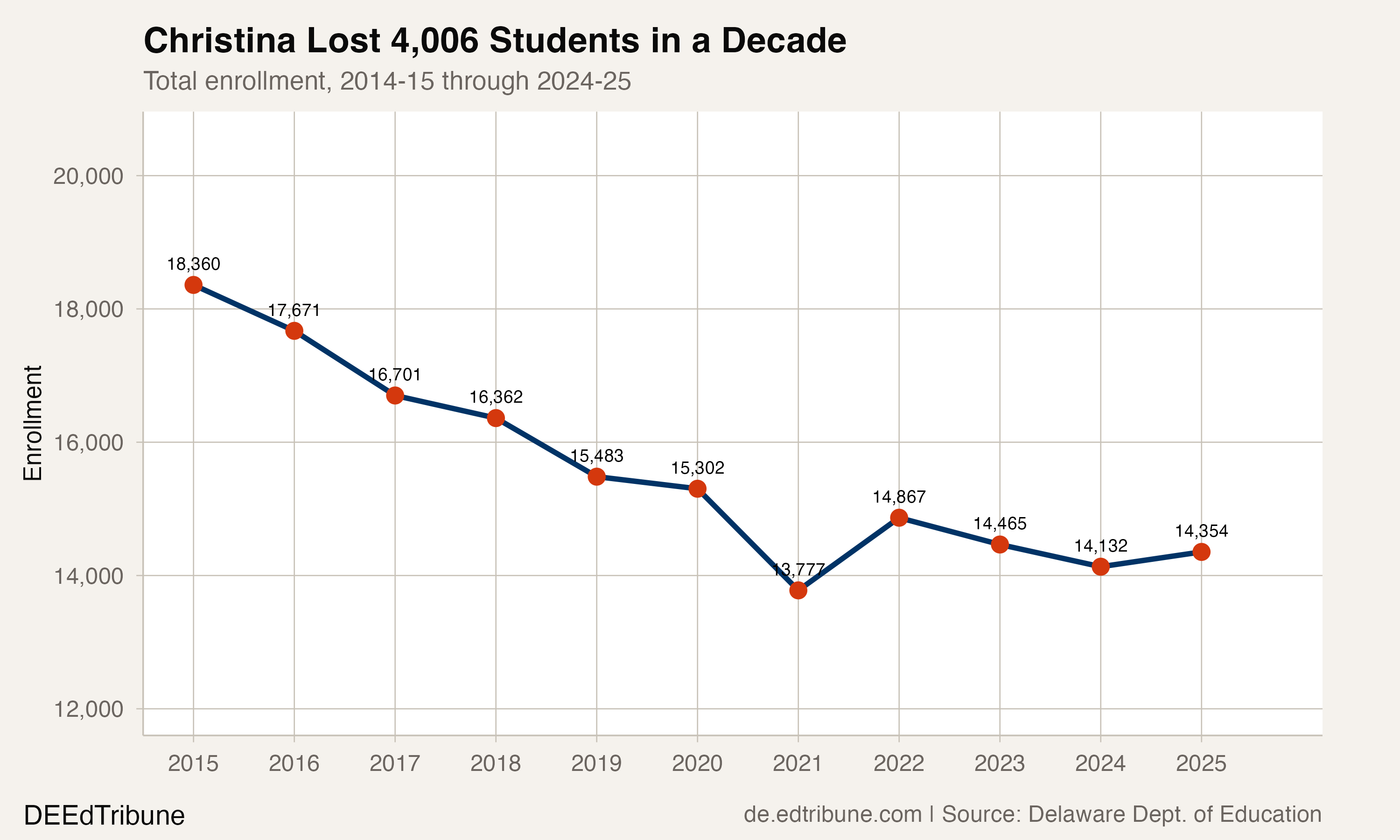
Christina lost students every year from 2015-16 through 2020-21, shedding 4,583 across six consecutive years. The worst single year was 2020-21, when enrollment plunged by 1,525 students, a 10.0% drop, as the pandemic compounded an already-accelerating decline.
The 2021-22 rebound brought back 1,090 students, but the recovery proved temporary. Christina lost another 735 students over the next two years before a modest 222-student gain in 2024-25.
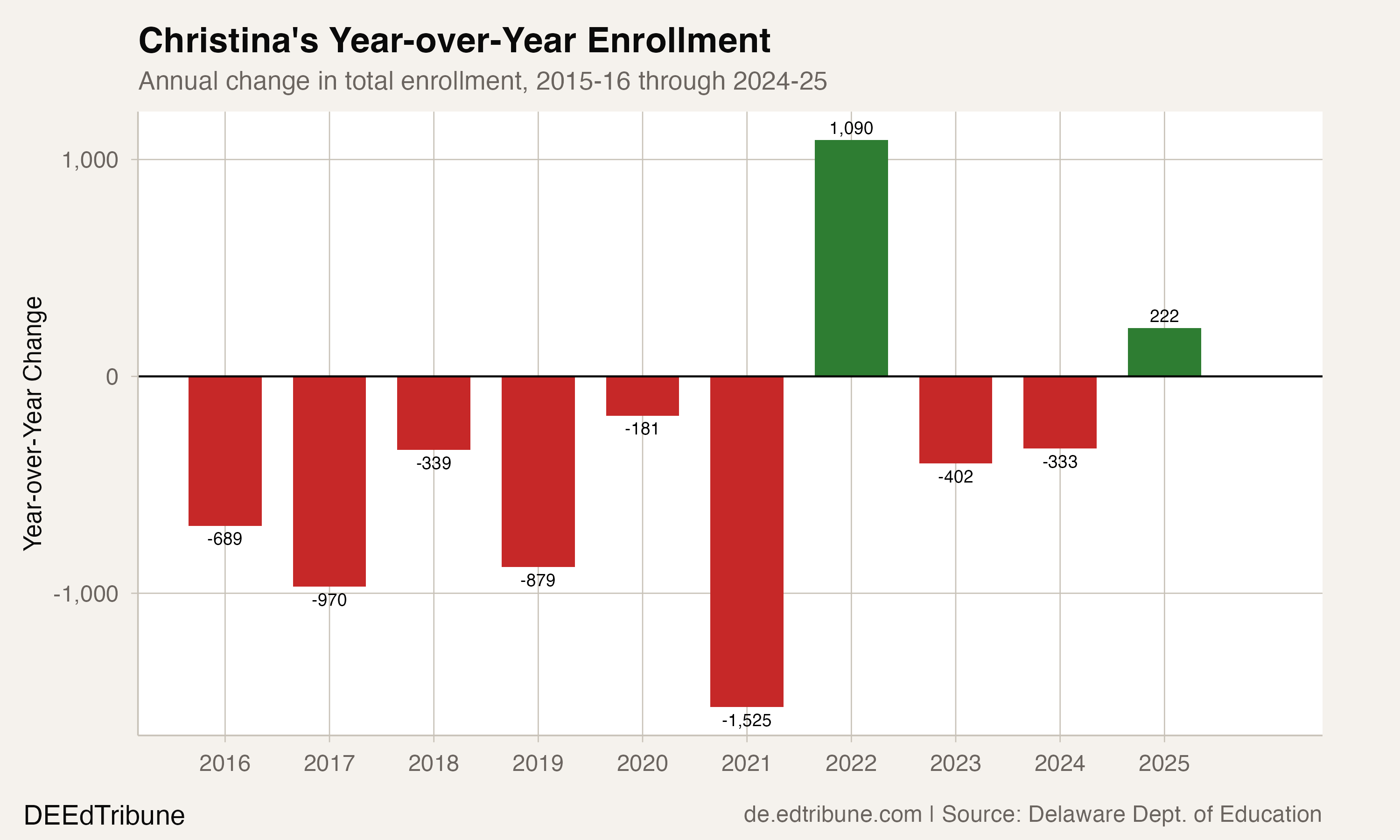
The pattern is distinctive: eight of ten year-over-year transitions were losses. Only 2021-22 and 2024-25 showed gains, and their combined 1,312-student recovery replaced just 29% of the 4,583 lost during the six-year streak.
Christina's share of statewide enrollment dropped from 13.2% to 9.5% over the decade. The district that was once roughly equal in size to Red Clay (18,360 vs. 19,284 in 2014-15) now trails by 3,537 students and faces Appoquinimink↗ET, a fast-growing southern New Castle County district that added 3,867 students (+39.9%) over the same period, closing to within 796 students of Christina's total.
The desegregation inheritance
Christina's decline cannot be understood without its geography. The district is non-contiguous: its main footprint surrounds Newark in southern New Castle County, but it also operates schools in a separate section of Wilmington, roughly 15 miles north. That unusual boundary is a direct consequence of the 1978 federal desegregation order that carved Wilmington's schools among four suburban districts to achieve racial balance.
"You are now asking for the needs in the city of Wilmington, in Christina's portion, being paid for by two tax bases instead of four." -- Lisa Lawson, Brandywine Superintendent, Spotlight Delaware, Aug. 2025
The non-contiguous structure creates logistical costs that compound the enrollment pressure. Roughly 1,600 Wilmington students enrolled in Christina must travel long distances to reach their assigned schools. One board member told Spotlight Delaware the arrangement "makes it really prohibitive for parents to even be involved."
A choice state bleeding students
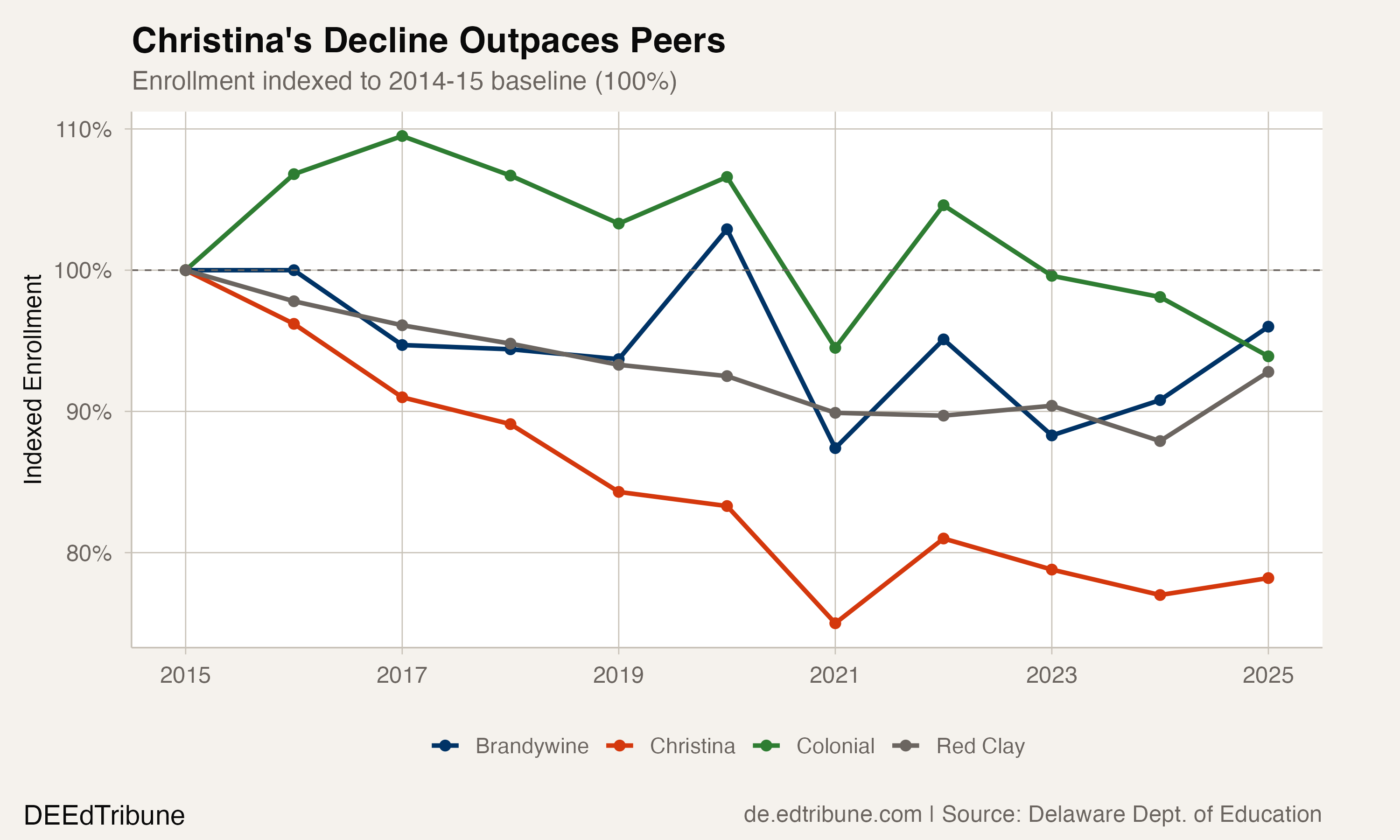
All four Wilmington-area districts lost enrollment over the decade, but the losses were not comparable. Brandywine↗ET dropped 4.0%. Colonial↗ET fell 6.1%. Red Clay declined 7.2%. Christina's 21.8% loss was three times the next-worst peer.
Delaware's open-enrollment system, which allows families to apply to any public school district, charter, or vocational-technical school statewide, is the most likely structural driver of that gap. Two charter schools in particular have expanded directly in Christina's service area. Newark Charter School↗ET grew from 1,952 to 3,115 students over the decade, a 59.6% increase. Odyssey Charter School↗ET, a Greek immersion program, grew from 948 to 2,375, more than doubling its enrollment. Together, these two charters added 2,590 students over the same period that Christina lost 4,006.
Statewide, the charter sector grew from 8,720 to 15,056 students, a 72.7% increase. Christina also competes with the New Castle County Vocational-Technical School District↗ET, which grew steadily from 4,663 to 4,917 over the decade, drawing high school students who might otherwise attend Christina's comprehensive high schools.
The connection between charter growth and Christina's decline is suggestive rather than proven by enrollment data alone. The data shows that charters in the area grew substantially while Christina shrank, but open enrollment also means students can choice into neighboring traditional districts, and demographic factors like declining birth rates contribute independently.
A district transforming from within
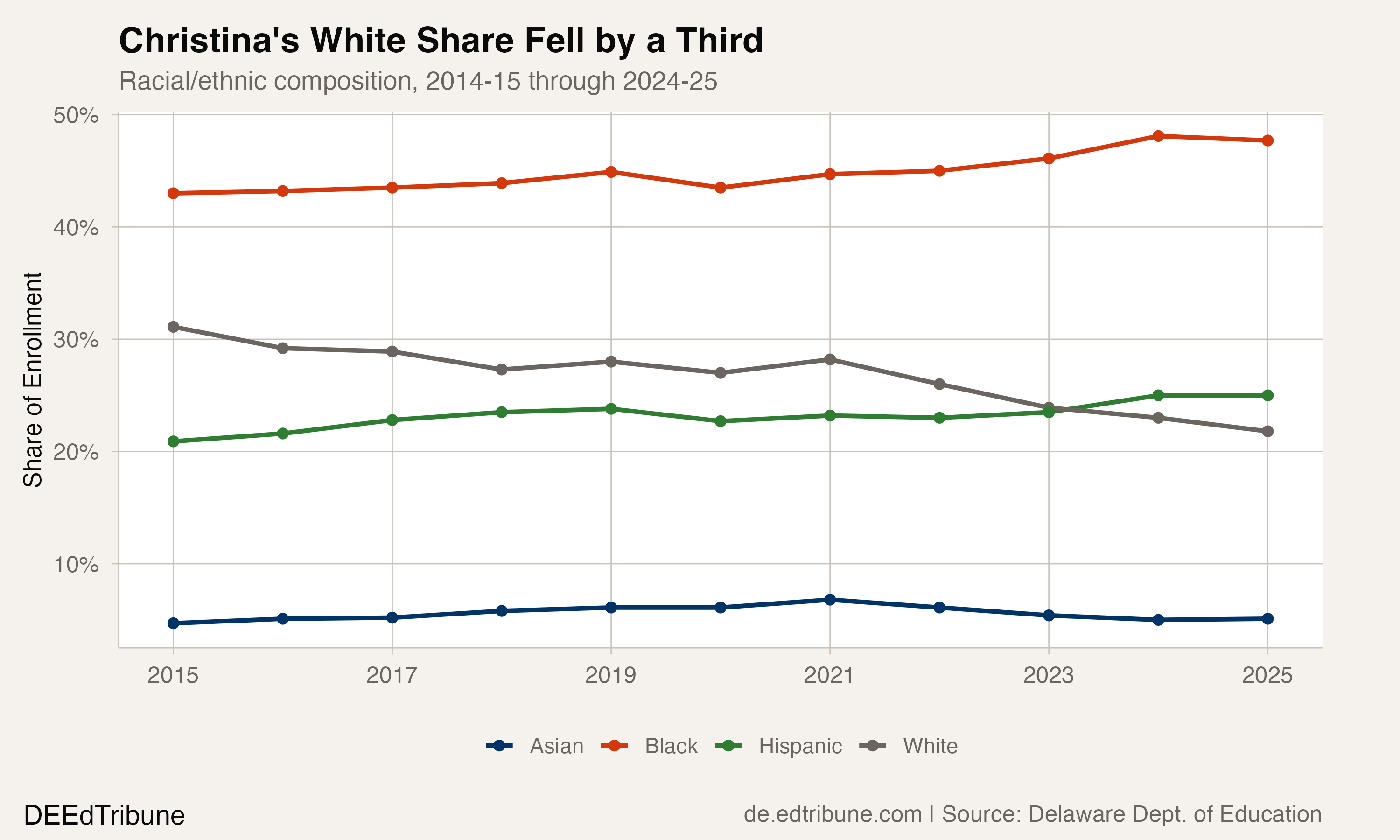
The students who left Christina were disproportionately white. White enrollment fell from 5,264 to 3,133 over the decade, a 40.5% drop that reduced the white share from 28.7% to 21.8%. Black enrollment also declined in absolute terms, from 7,508 to 6,852, but because the total shrank faster, the Black share rose from 40.9% to 47.7%. Hispanic students held roughly steady in count (3,594 to 3,587) while their share grew from 19.6% to 25.0%.
The compositional shift has fiscal and operational dimensions that go beyond demographics.
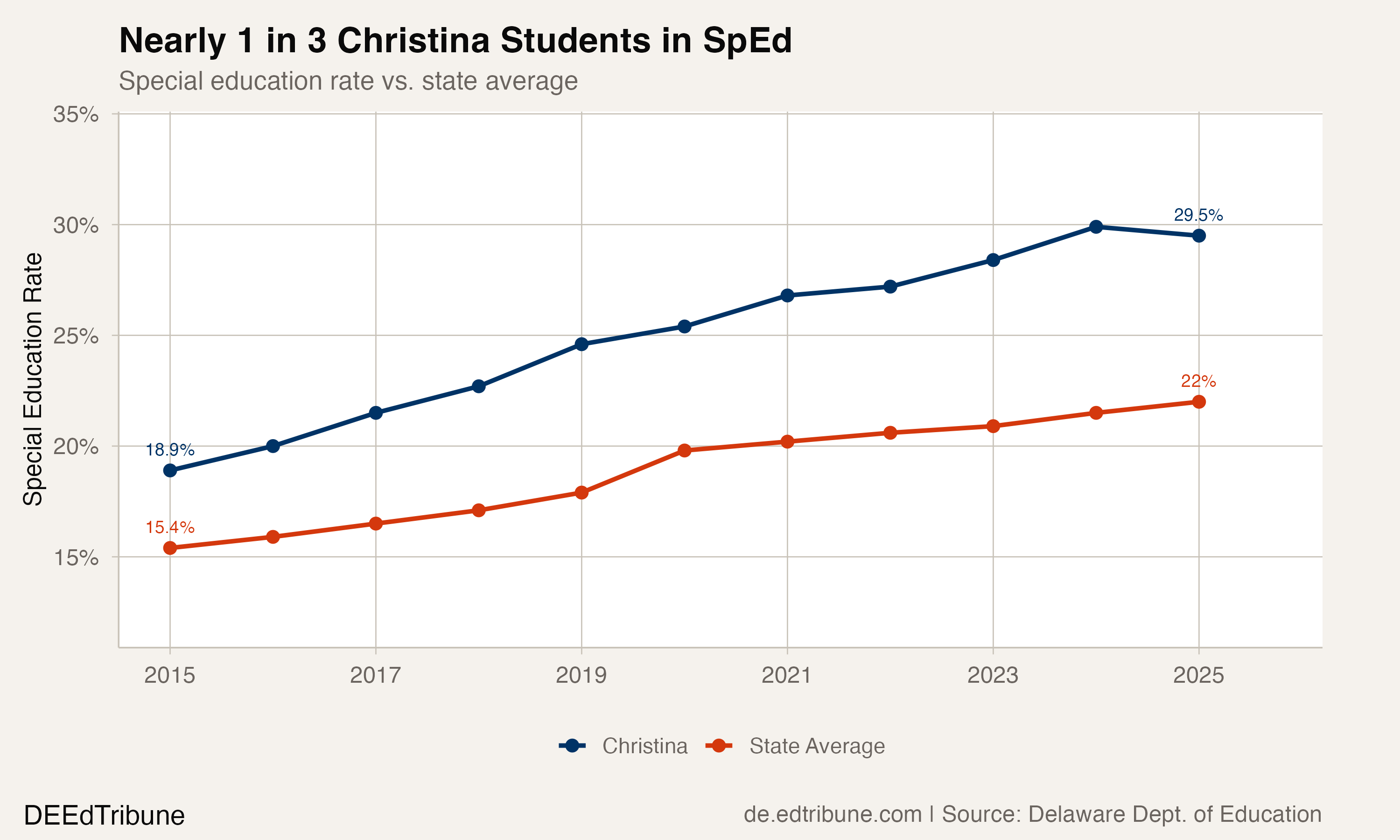
Christina's special education rate climbed from 18.9% to 29.5% over the decade, a 10.6 percentage-point increase that brought the district from modestly above the state average (15.4% in 2014-15) to 7.5 points above it (22.0% in 2024-25). In absolute terms, Christina added 767 special education students even as total enrollment fell by 4,006. The district now has 4,238 students receiving special education services.
Separately, English learner enrollment rose from 2,127 to 2,409, pushing the EL share from 11.6% to 16.8%.
The instructional programs these students receive carry higher per-pupil costs. Special education services, in particular, involve individualized education plans, specialized staff, and compliance requirements that scale with the number of students served, not with the district's total enrollment. A district that loses general-education students while gaining special-education students faces a structural mismatch: its fixed costs rise while the revenue base that supports them shrinks.
Leadership instability and deferred maintenance
Christina's enrollment pressures coincide with governance challenges. In July 2024, the district placed Superintendent Dan Shelton on administrative leave and appointed an interim replacement, creating a situation where the district was simultaneously paying two superintendents at a combined cost that could exceed $335,000 for the school year.
The district's facilities also reflect years of deferred investment. A capital referendum with a preliminary estimate of $165 million was under consideration to replace aging buildings, including a windowless middle school. But the board delayed a scheduled March 2025 operating referendum because of a court-ordered countywide property reassessment, choosing to wait for higher assessed values to generate additional revenue before asking voters for more.
The merger question
In December 2025, the Redding Consortium, a state body created to address the legacy of desegregation-era school boundaries, voted 19-2 to study merging Christina, Brandywine, Colonial, and Red Clay into a single Northern New Castle County Consolidated School District with over 45,000 students. The recommendation would, for the first time since the 1978 desegregation order, place all Wilmington students under a single district.
Christina's superintendent, Deirdra Joyner, was one of the two dissenting votes.
The proposal must still pass review by the State Board of Education, the General Assembly, and Governor Matt Meyer. Implementation, if approved, would take three to five years.
"I would have had a harder time if I truly believed that we did not have the capacity to seriously consider and pass such a plan." -- Sen. Elizabeth Lockman, co-chair of the Redding Consortium, Spotlight Delaware, Dec. 2025
What to watch next
Christina's kindergarten class fell from 1,656 to 1,281 over the decade, a 22.6% decline that outpaced the state's 7.0% kindergarten drop. If the pipeline continues to narrow, the district's total enrollment will resume its decline regardless of whether the recent 222-student gain persists.
The deeper question is whether Christina will still exist as a standalone district when the next decade's enrollment data arrives. The Redding Consortium's merger proposal, if it advances through the legislature, would dissolve the boundaries that created Christina in 1981. A district born from a desegregation order may end because the problems that order was meant to solve, concentrated poverty, unequal resources, and racial isolation, persisted within its borders for 45 years.
Detailed code that reproduces the analysis and figures in this article is available exclusively to EdTribune subscribers.
Discussion
Sign in to join the discussion.
Loading comments...