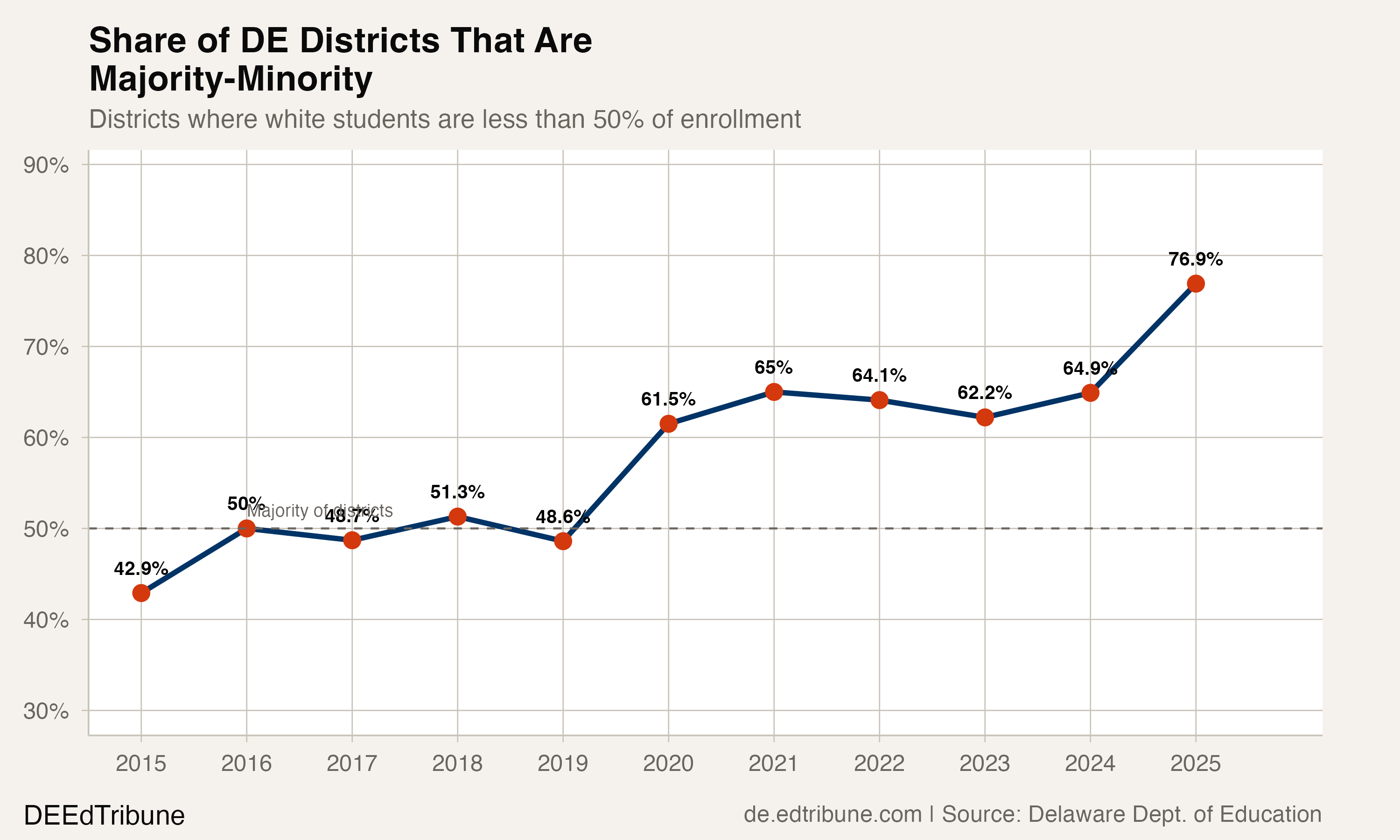
A decade ago, fewer than half of Delaware's school districts enrolled a majority of students of color. By 2024-25, 30 of 39 did. The shift from 41.2% to 76.9% majority-minority districts between 2014-15 and 2024-25 reflects a state where total enrollment grew by 11,546 students while white enrollment fell by 7,217, a combination that has reshaped nearly every corner of public education in the second-smallest state.
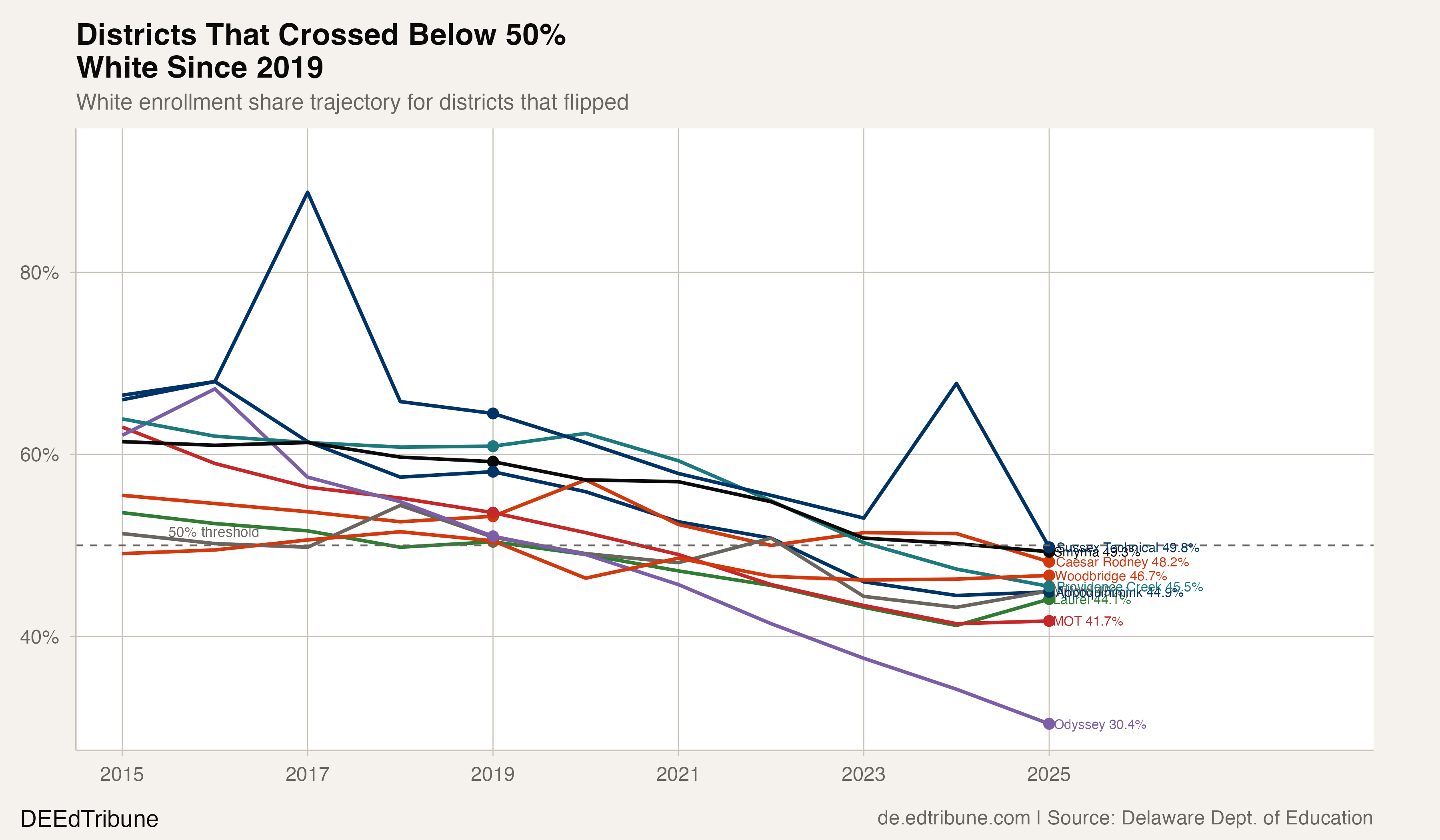
What makes Delaware's transformation distinctive is its speed. Twelve districts crossed the majority-minority threshold in just the past six years. Several had been comfortably above 55% white as recently as 2019.
The arithmetic of an 8-point drop
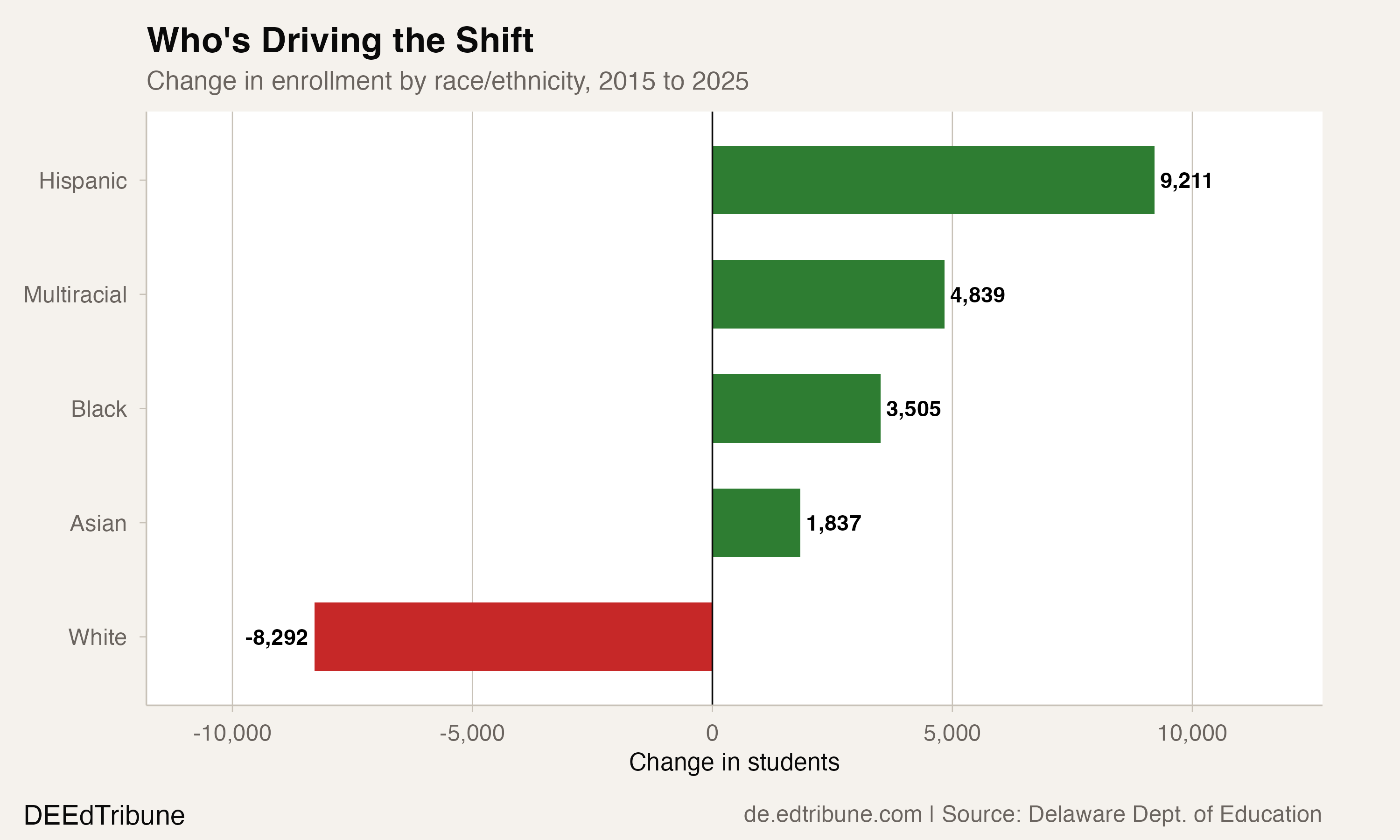
Delaware was already a majority-minority state in 2014-15, when white students made up 46.1% of statewide enrollment. By 2024-25, that figure had fallen to 37.8%, a decline of 8.3 percentage points. The state lost 7,217 white students even as overall enrollment climbed from 139,045 to 150,591, an 8.3% gain.
The growth came from every other major group. Hispanic enrollment rose by 9,633 students, a 44.8% increase that pushed Hispanic share from 15.4% to 20.7%. Multiracial enrollment more than doubled, adding 4,906 students to reach 5.9% of the total. Black enrollment, already the state's largest non-white group at 31.7%, added 4,139 students and held steady at 32.0%. Asian enrollment grew by 1,948 students, rising from 3.7% to 4.7%.
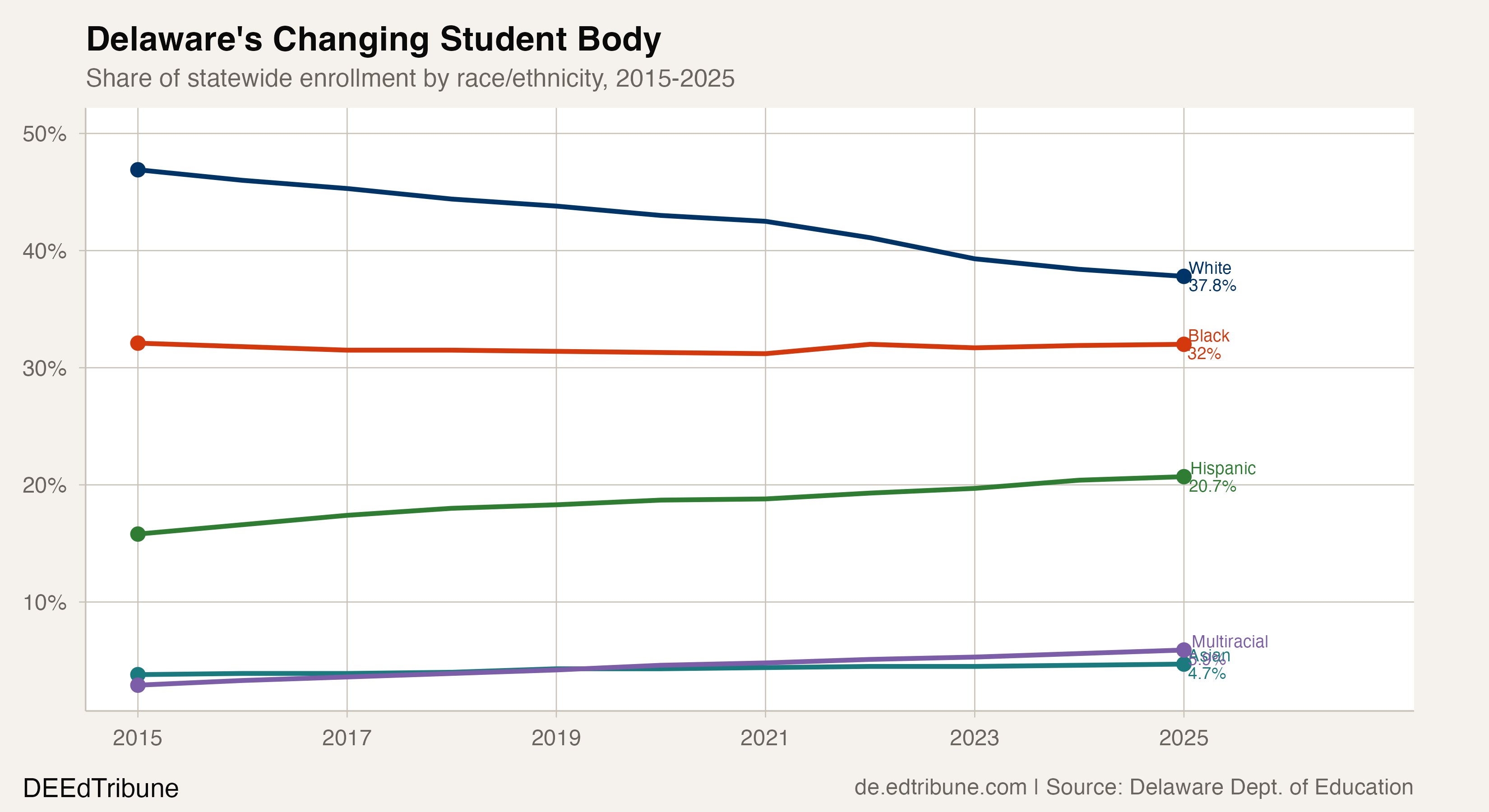
The gap between white and Black enrollment has narrowed sharply. In 2015, white students outnumbered Black students by more than 20,000. By 2025, that gap had shrunk to 8,688, as white enrollment fell to 56,893 while Black enrollment rose to 48,205. At the current pace, Black students will outnumber white students within five years.
The suburban wave
The most striking flips have occurred not in Wilmington or Dover, where majority-minority enrollment was already established, but in the fast-growing suburbs of central and southern New Castle County.
Appoquinimink↗ET, the state's fastest-growing traditional district, recorded the steepest white share decline of any district: 19.5 percentage points, from 64.4% in 2015 to 44.9% in 2025. The district grew by nearly 4,000 students over that span, driven by residential development along the Route 1 corridor. Asian enrollment more than quadrupled from 375 to 1,698 students, and Black enrollment rose from 2,641 to 4,316. White enrollment barely changed in absolute terms, falling from 6,244 to 6,090. The demographic shift here was driven almost entirely by who was moving in, not who was leaving.
Smyrna↗ET dropped from 60.6% to 49.3% white, crossing the threshold in 2024-25. Caesar Rodney↗ET fell from 54.4% to 48.2%. Indian River↗ET in Sussex County went from 52.3% to 44.4%. Sussex Technical↗ET, a vo-tech district that draws from across the county, dropped from 66.5% to 49.8%, barely crossing the line in 2025-26.
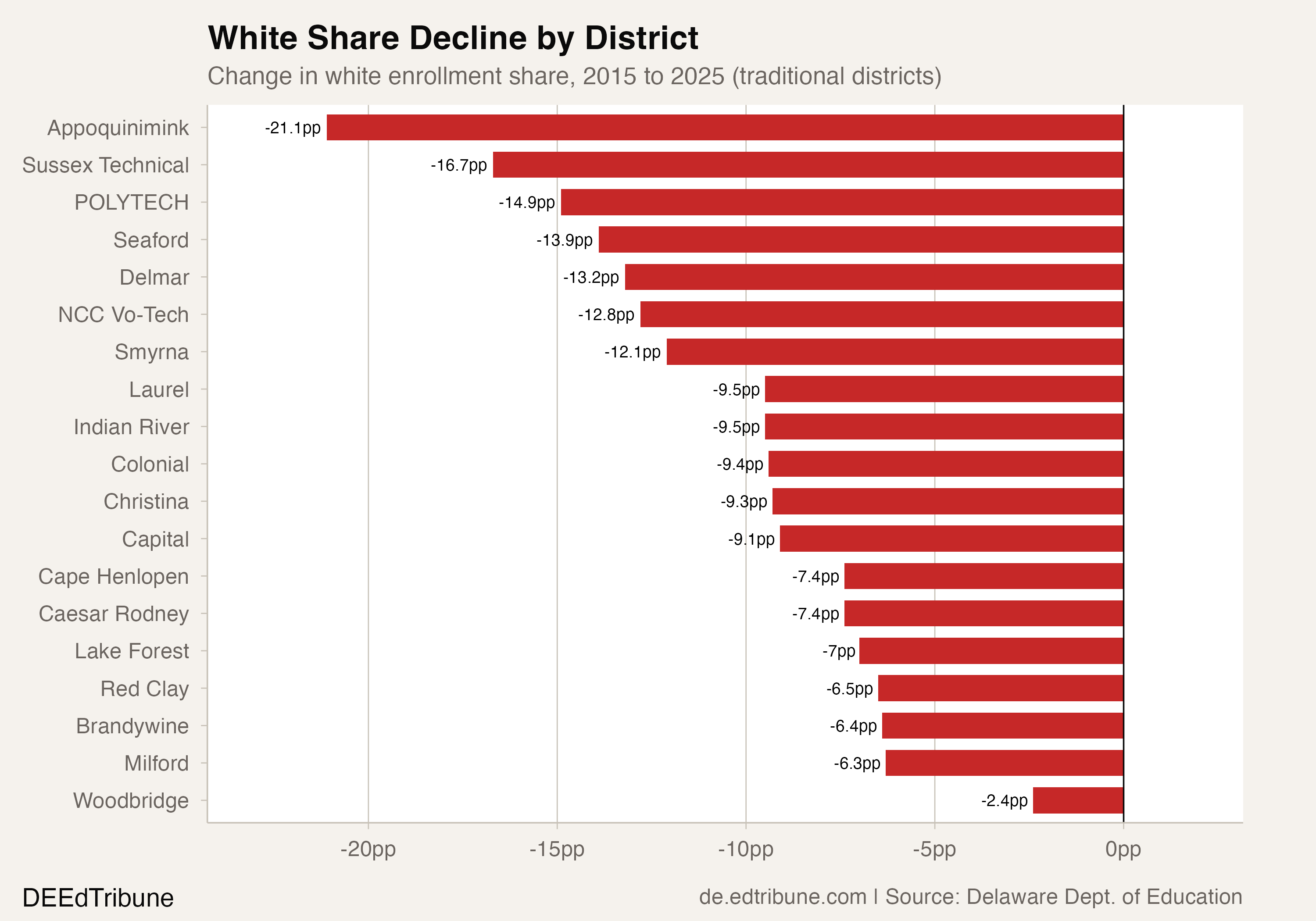
Even districts that remain white-majority are trending rapidly. Cape Henlopen↗ET, a Sussex County beach district, fell from 70.3% to 65.2% white over the decade. At that rate, it would cross the threshold within 15 years.
What is driving 12 flips in six years
Between 2019 and 2025, 12 districts that had been white-majority crossed below 50%. Several forces contributed, though no single mechanism explains the pace.
The most likely driver in central Delaware is the housing construction boom. Southern New Castle County and northern Kent County have added thousands of new housing units in communities like Middletown and Smyrna, attracting families from Philadelphia, New Jersey, and northern Delaware. Those new residents are substantially more diverse than the existing population.
Delaware's immigrant population has grown to 118,900, or 11.5% of the state's population, with Mexico, India, and Guatemala as the top three countries of origin. That growth is visible in enrollment data: English learner enrollment rose 69.5% statewide over the decade, from 11,354 to 19,247 students, reaching 12.8% of total enrollment.
In Sussex County, the poultry and agricultural industries have drawn Latino families for decades, but more recent arrivals include professionals in healthcare and education. A 2019 Delaware Community Foundation study found that Sussex County's Latino population was increasingly professional and second-generation, "filling in lots of slots in the education, healthcare industry, and professional jobs."
A competing explanation in some districts is classification change rather than population change. The multiracial category more than doubled statewide, from 4,010 to 8,916 students. Some of this growth likely reflects families choosing "two or more races" who would previously have selected a single category, which would inflate both the multiracial count and the non-white total without any underlying population shift.
The charter dimension
Charter schools are more diverse than traditional districts. In 2024-25, white students comprised 30.0% of charter enrollment versus 39.1% of traditional district enrollment. That 9.1-percentage-point gap widened substantially over the decade, from just 1.2 points in 2015.
Odyssey Charter School↗ET, originally a Greek-immersion program, illustrates the pattern. The school was 62.0% white in 2015. By 2025, it was 30.4% white as it grew from 948 to 2,375 students. Asian enrollment grew from 69 to 439, Black enrollment from 210 to 819, and Hispanic enrollment from 56 to 235. The school's curricular identity remained, but its student body transformed.
MOT Charter School↗ET dropped from 62.9% to 41.7% white over the same period. Providence Creek Academy Charter School fell from 63.9% to 45.5%.
The redistricting question
Delaware's demographic transformation is not just a statistical curiosity. It sits at the center of the state's most contentious education policy debate.
In December 2025, the Redding Consortium for Educational Equity voted 19-2 to study merging four northern New Castle County districts into a single system serving more than 45,000 students. The four districts in question, Brandywine↗ET, Christina↗ET, Colonial↗ET, and Red Clay↗ET, are all already majority-minority, with white shares ranging from 21.8% to 41.8%.
"I would have had a harder time if I truly believed that we did not have the capacity to seriously consider and pass such a plan." -- State Sen. Elizabeth Lockman, Redding Consortium co-chair, Spotlight Delaware, Dec. 2025
The consolidation plan's timeline has already slipped to 2027, but the underlying premise is that district boundaries drawn during desegregation no longer serve a student body that has fundamentally changed.
Where the money follows
Delaware's Opportunity Funding program reached $63 million in fiscal year 2025, meeting the full obligation of a 2018 legal settlement. The program provides weighted per-pupil funding for low-income students and English learners, roughly $1,000 per qualifying student, up from $300 in 2020.
As the share of students who qualify for those weights grows, the program's fiscal footprint will grow with it. English learner enrollment alone has risen 69.5% in a decade. Special education enrollment climbed from 15.4% to 22.0% of total enrollment, an increase of 11,728 students. (Service-population categories overlap substantially: many EL students are also counted as economically disadvantaged, and the totals should not be summed.)
Nine districts left
Only nine of Delaware's 39 districts remain white-majority. Three are small charters. Three are Sussex County districts that still draw from largely rural, white communities: Cape Henlopen at 65.2%, Delmar at 57.2%, and Lake Forest at 57.0%. POLYTECH, a vo-tech district, sits at 54.3%.
Newark Charter School, at 52.6% white, is the closest to flipping. Sussex Academy, at 70.0%, is the furthest away. Among the six that have existed long enough to measure the trend, five have a lower white share in 2025 than in 2015. The exception is First State Montessori Academy, which rose from 60.5% to 67.4% white as it matured from a startup into a stable program.
The question for Delaware is not whether majority-minority enrollment will become universal. It is whether the funding structures, staffing pipelines, and district boundaries built for a different student body can adapt to the one that actually exists.
Detailed code that reproduces the analysis and figures in this article is available exclusively to EdTribune subscribers.
Discussion
Sign in to join the discussion.
Loading comments...