In this series: Delaware 2024-25 Enrollment.
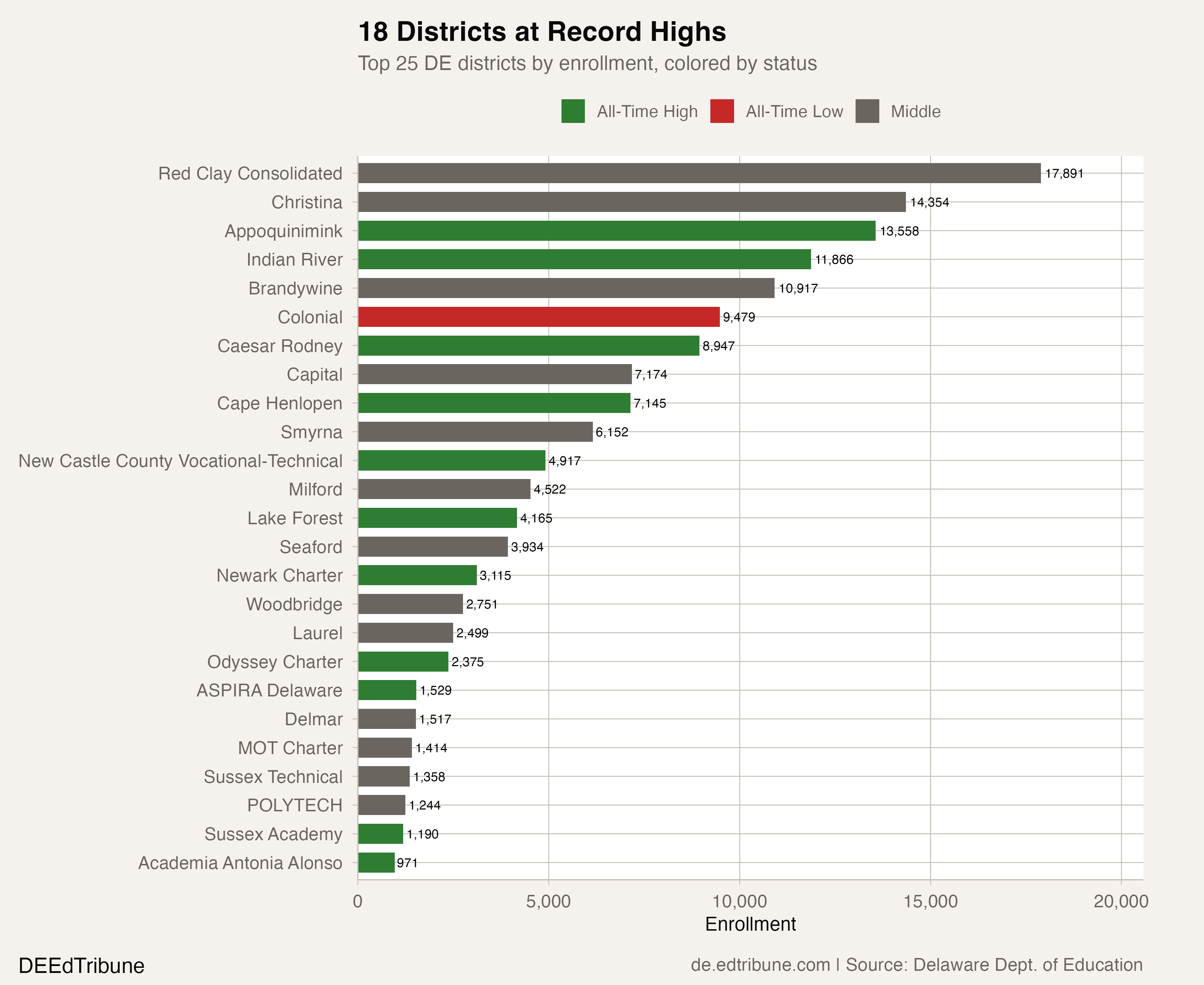
Fifteen of 41 Delaware school districts set enrollment records in 2024-25. Only three established districts hit all-time lows. (Two additional charters, ASPIRA Delaware and the Bryan Allen Stevenson School of Excellence, are technically at their lows, but both opened in 2024-25, so their first year is also their only year.) A 5-to-1 ratio of record highs to record lows is the mirror image of what enrollment data typically looks like across the country, where districts at all-time lows routinely outnumber those at highs by double digits. Delaware's ratio signals something unusual: a state where growth is the norm and decline is the exception.
Delaware's total public school enrollment reached 150,591 in 2024-25, the highest figure in the 11 years of available data and 8.3% above the 2014-15 baseline of 139,045. The state has added 11,546 students over that span, growing in every year except one.
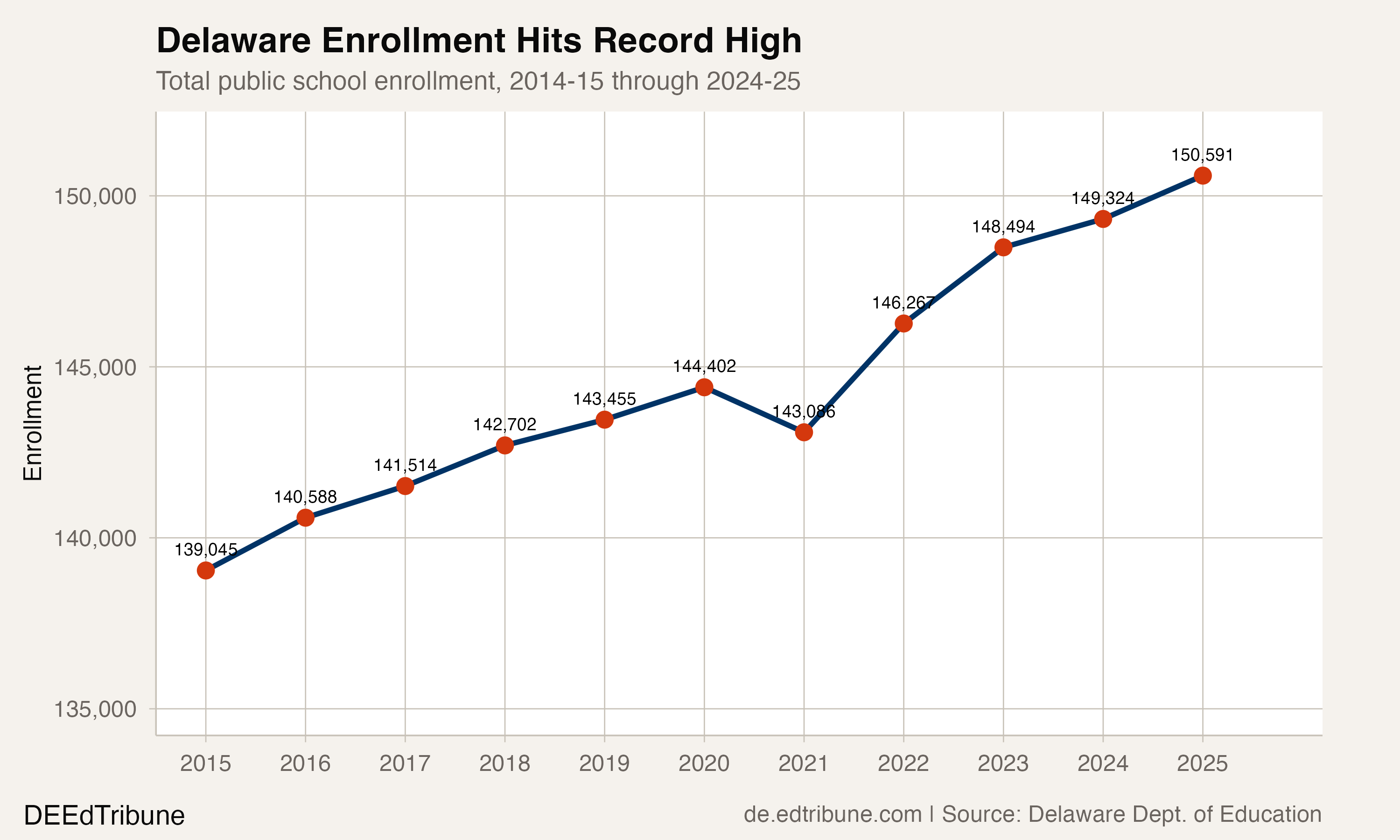
A one-year interruption in a decade of growth
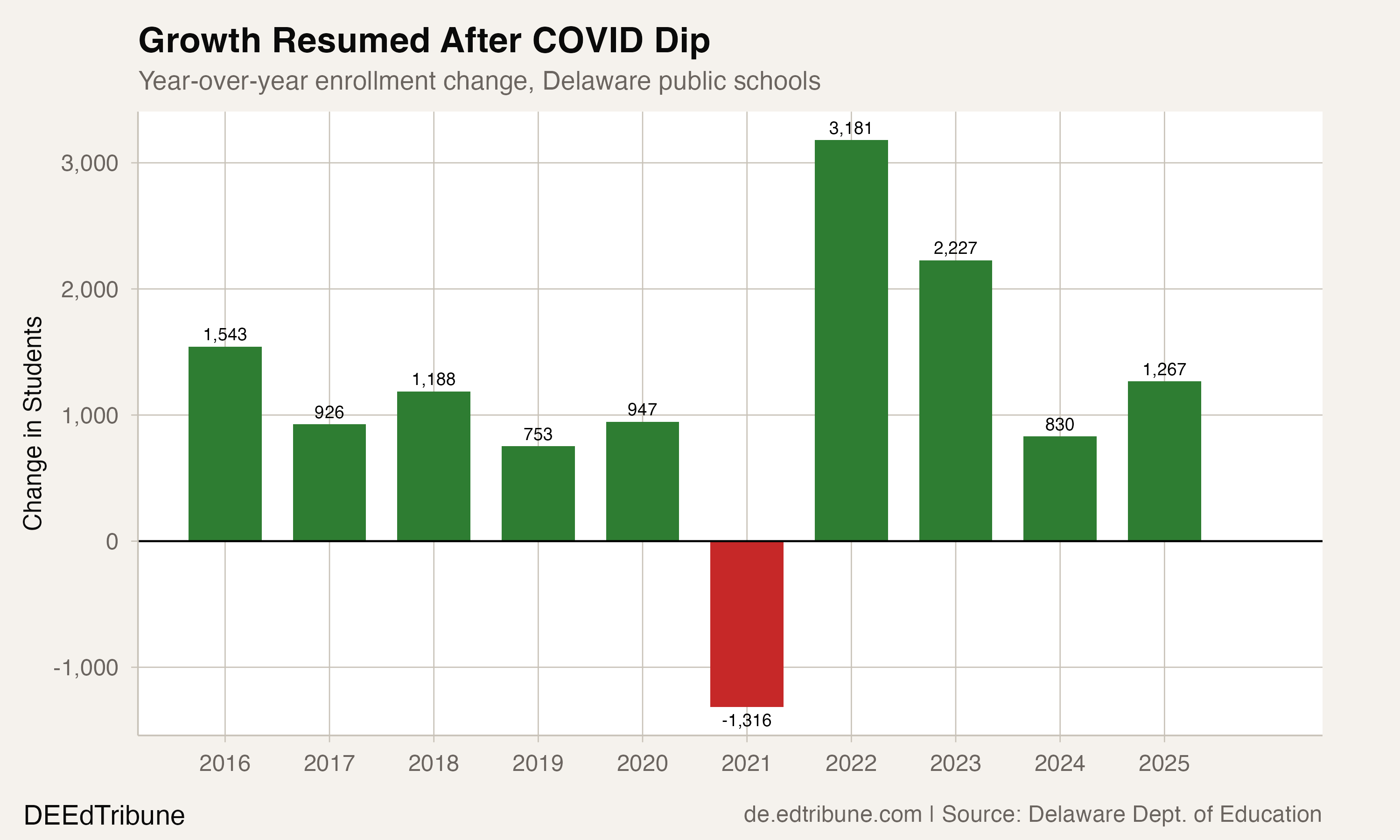
The only enrollment decline in Delaware's 11-year record came in 2020-21, when the state lost 1,316 students during COVID. The rebound was immediate and outsized: Delaware added 3,181 students the following year, more than doubling the loss. By 2024-25, enrollment sits 6,189 students above its pre-pandemic level, a 4.3% gain over five years.
That post-COVID trajectory stands apart nationally. Most states are still counting COVID losses they have not recovered.
The record-setters span both sectors
The 15 districts at all-time highs include six traditional public districts and nine charter schools. On the traditional side, Appoquinimink↗ET leads with 13,558 students, followed by Indian River↗ET at 11,866, Caesar Rodney↗ET at 8,947, and Cape Henlopen↗ET at 7,145. Among charters, Newark Charter↗ET (3,115 students), Odyssey Charter↗ET (2,375), and Academia Antonia Alonso↗ET (971) all set records.
The three established districts at all-time lows are Colonial↗ET School District (9,479 students), Edison Charter School↗ET (588), and Great Oaks Charter School↗ET (184). Colonial is the only traditional district in the state at its floor.
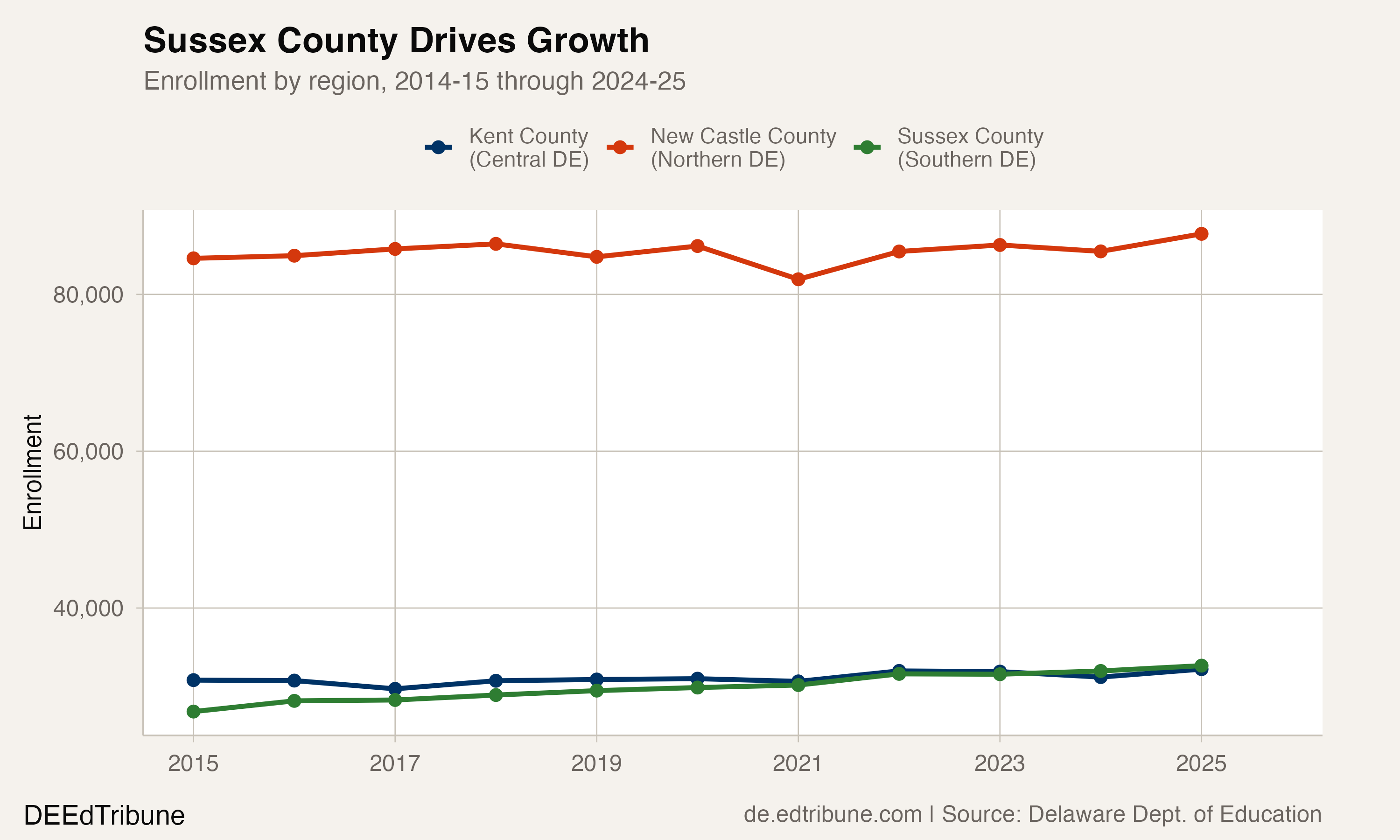
Sussex County is the engine
The geographic story is straightforward. Sussex County, in Delaware's southern reaches, grew its school enrollment by 21.9% over 11 years, from 26,794 to 32,651 students. Kent County in the center grew 4.5%. New Castle County in the north, home to Wilmington and its suburbs, grew just 3.7%.
Sussex's school growth tracks its population surge. Census estimates put Sussex County's population growth at 15.9% since the 2010 Census, and Edward Ratledge of the University of Delaware's Center for Applied Demography has described Sussex as "the only county that's growing significantly by net in-migration." Annual net migration to Delaware recently averaged 13,000 to 15,000 people, up from a historical norm of 7,000 to 9,000.
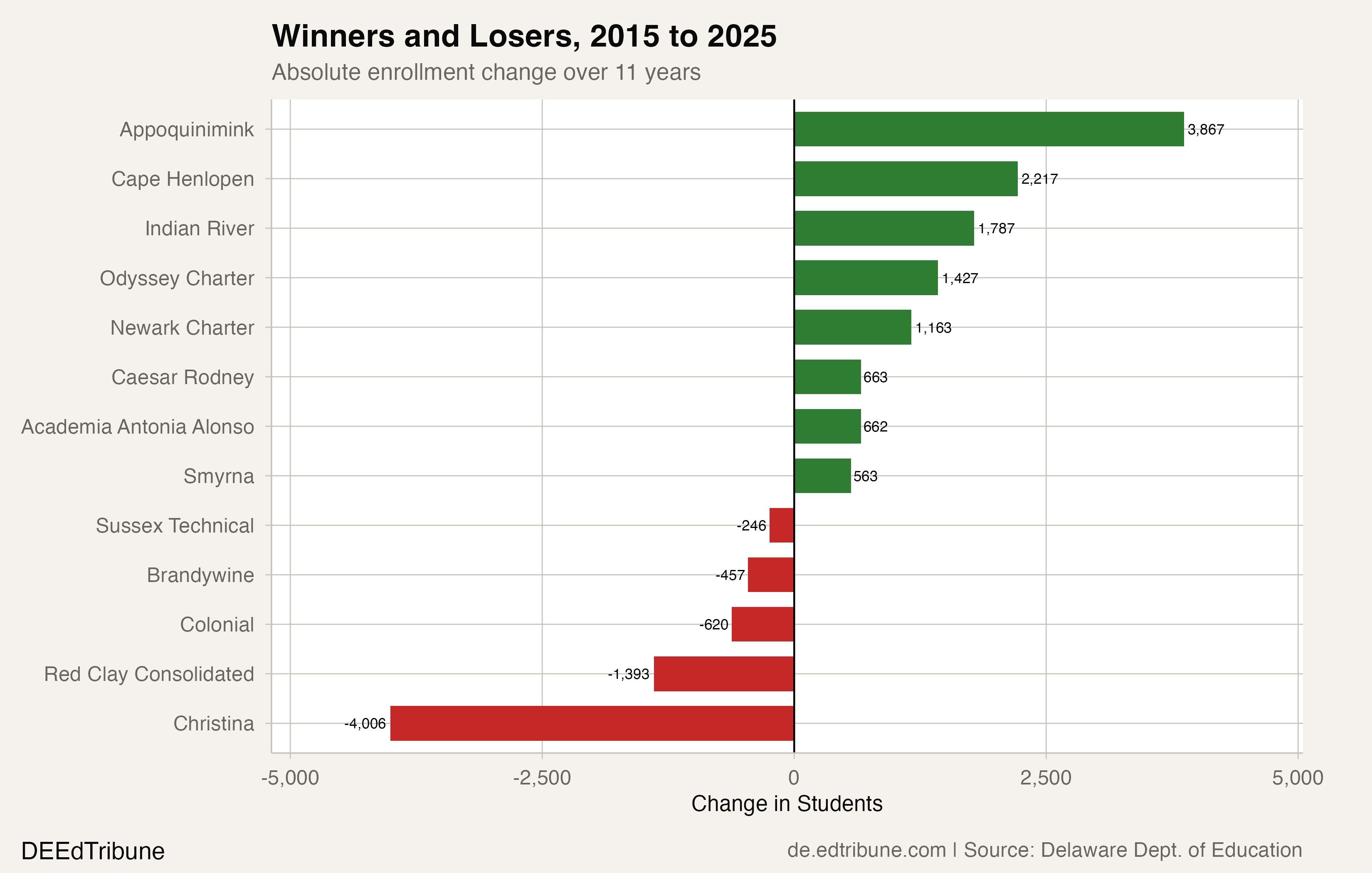
Cape Henlopen, which serves the Lewes-Rehoboth Beach corridor, grew 45.0% over the period, from 4,928 to 7,145 students. Indian River added 1,787 students, a 17.7% gain. Even smaller Sussex districts like Woodbridge (+6.9%) and Laurel (+7.3%) grew.
Appoquinimink: Delaware's fastest-growing district
Appoquinimink added 3,867 students since 2014-15, a 39.9% increase that accounts for a third of the state's total growth. The Middletown-Odessa-Townsend corridor the district serves has been one of Delaware's most active housing markets. The district has opened 14 new schools since 2000 and passed a $77.8 million referendum in April 2024 to finance a new middle school, high school, and elementary school.
Yet Appoquinimink's growth is decelerating. The district added just 159 students in 2024-25 after gaining 1,077 in 2022-23. Its two high schools operate at roughly 80% capacity, according to WDEL, suggesting the infrastructure build-out may be outpacing the population pipeline for now.
The Wilmington gap
The flip side of southern growth is northern strain. The four traditional districts serving Wilmington and its immediate suburbs, Christina↗ET, Red Clay↗ET, Colonial, and Brandywine↗ET, collectively lost 6,476 students since 2014-15. Christina alone shed 4,006, a 21.8% decline, falling from 18,360 to 14,354.
Christina's losses have multiple origins. The district is Delaware's only non-contiguous district, maintaining schools in downtown Wilmington while being headquartered in suburban Newark. The Redding Consortium, a body studying Wilmington school boundaries, has been weighing proposals that would eliminate Christina's Wilmington footprint entirely.
"This isn't about bashing Christina." State Sen. Elizabeth Lockman. Source: Spotlight Delaware, Aug. 2025
Charter competition plays a role as well. Newark Charter, located squarely in Christina's suburban attendance area, has grown from 1,952 to 3,115 students over the same period Christina contracted. Delaware's open enrollment system allows families to apply to any public school regardless of address.
The charter sector crossed 10%
Charter enrollment grew from 8,720 to 15,056 students over the period, a 72.7% increase that pushed the charter share from 6.3% to 10.0% of statewide enrollment. Traditional districts also grew, adding 4,045 students. This is not a zero-sum story at the state level: both sectors expanded, though charters grew at 29 times the traditional rate (72.7% versus 2.5%).
Nine of 19 charter schools in 2024-25 are at all-time highs. Several have been on unbroken growth streaks since the data begins: Odyssey Charter, Newark Charter, and Academia Antonia Alonso have set enrollment records in all 11 years.
What to watch
Delaware's growth story is real, but it is not uniform. The state added 1,267 students in 2024-25 after adding just 830 the year before, suggesting the pace remains healthy but no longer accelerating. The question is whether Sussex County's housing boom can sustain the kind of school enrollment gains that have made Delaware a national outlier, or whether the state's demographics, with deaths now exceeding births, will eventually drag enrollment down even as migration continues.
For the Wilmington-area districts, the stakes are more immediate. The Redding Consortium voted in December 2025 to pursue consolidation, but the detailed plan is now expected by the end of 2026. If the plan redistricts Christina out of Wilmington, the resulting boundary changes would reshape enrollment patterns across New Castle County.
Detailed code that reproduces the analysis and figures in this article is available exclusively to EdTribune subscribers.
Discussion
Sign in to join the discussion.
Loading comments...