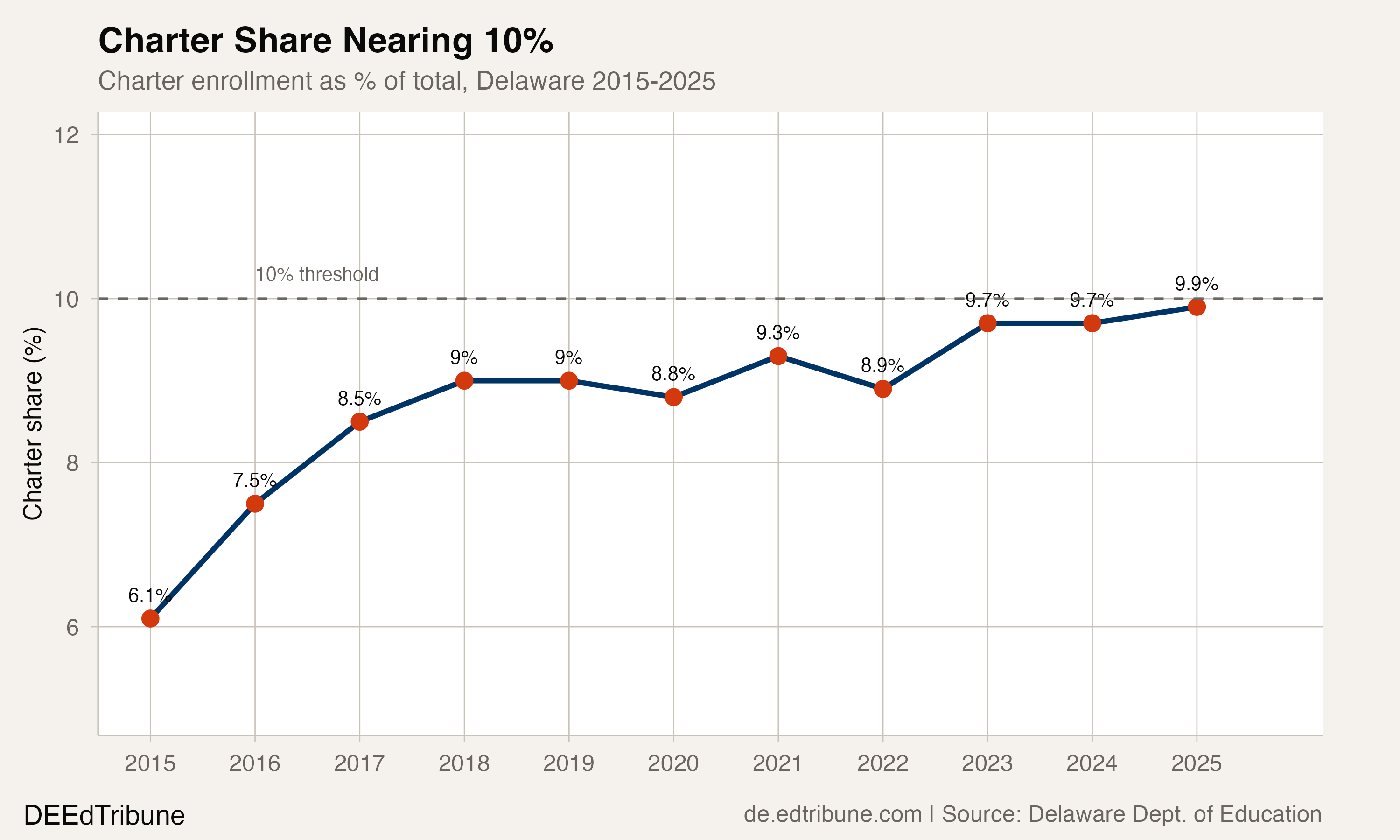
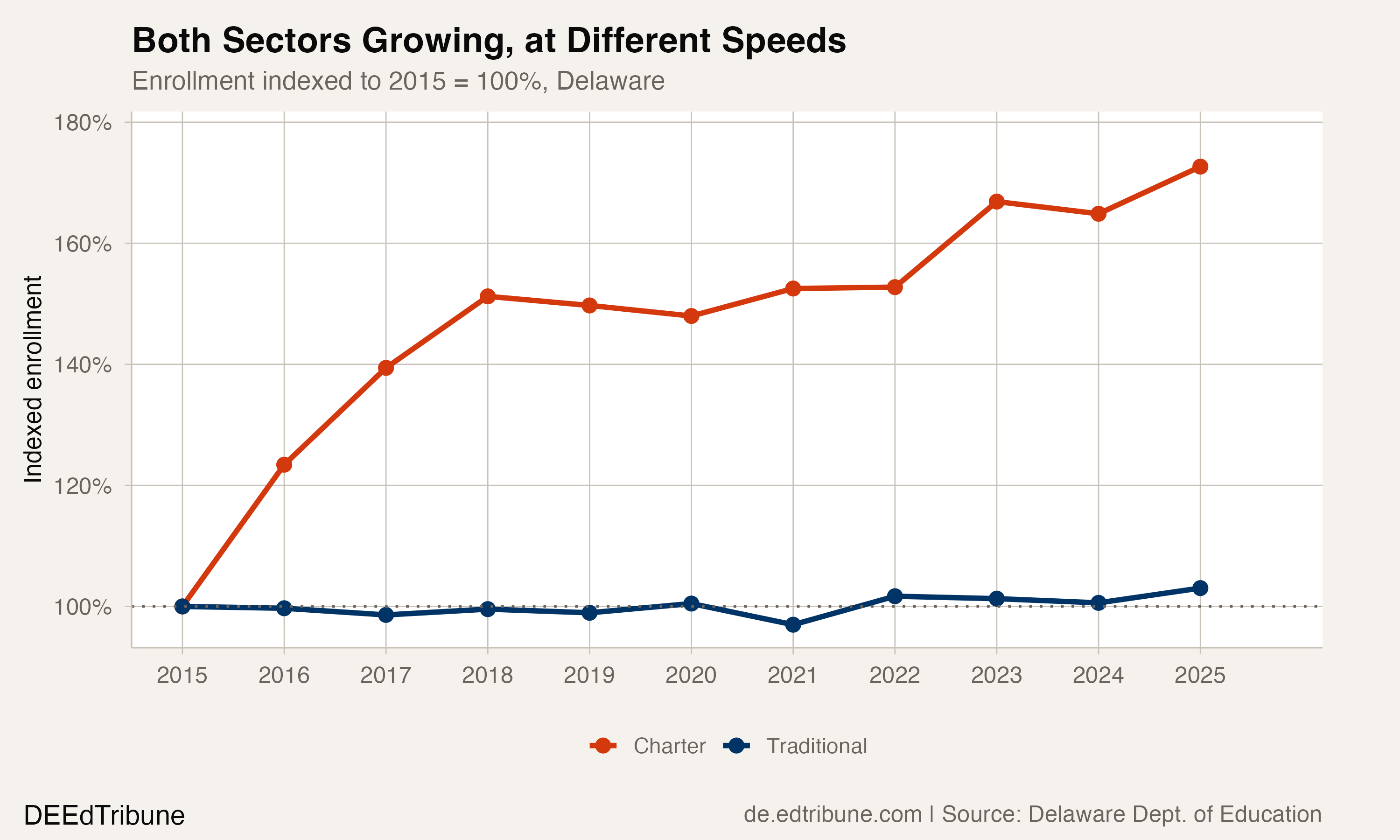
Delaware's charter sector has grown 72.7% over the past decade, from 8,720 students in 2014-15 to 15,056 in 2024-25. Charter enrollment now accounts for 10.0% of the statewide total of 150,591 students. At the same time, traditional district enrollment also rose, gaining 3.0% to reach 137,520. Both sectors grew. That almost never happens.
Nationally, charter growth almost always coincides with traditional district losses. Delaware's version of the charter story is a parallel expansion, driven by distinct forces in each sector: housing booms feeding traditional districts in the south, curricular specialization and open enrollment feeding charters in the north.
Three charters, three models
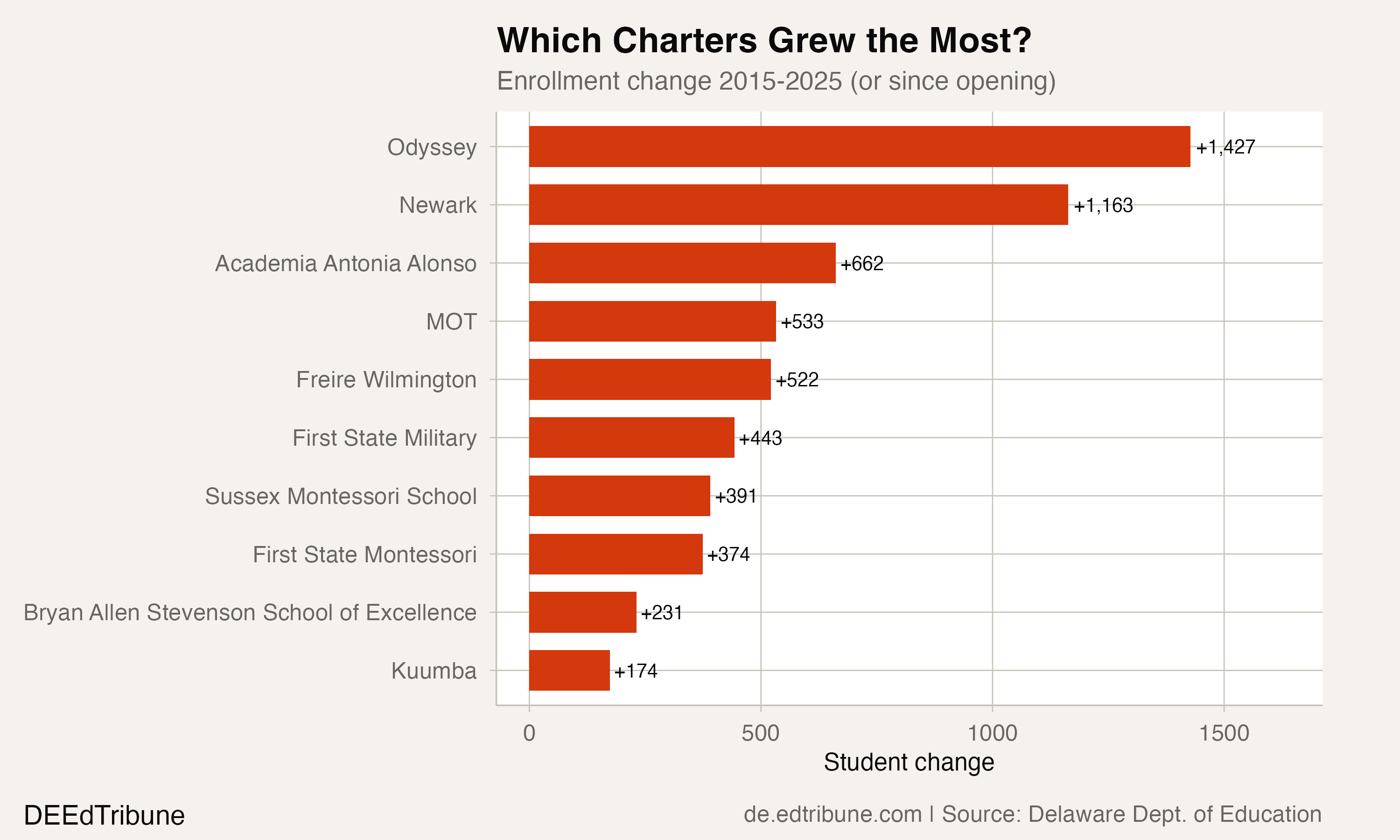
The charter sector's 6,336-student gain since 2015 is concentrated in a handful of schools, each growing through a different playbook.
Newark Charter School↗ET is the largest, with 3,115 students in 2024-25, up 59.6% from 1,952 a decade ago. It operates K-12 across two campuses using the Core Knowledge curriculum and purchased an adjacent warehouse in 2019 to build a new junior high facility. Its student body is 52.6% white and 17.6% Asian, with an economically disadvantaged rate of just 10.7%, roughly a third of the statewide average.
Odyssey Charter School↗ET has grown even faster in percentage terms, from 948 students to 2,375, a 150.5% increase. The school offers mandatory Greek language instruction at every grade level, one of the few programs of its kind in the country. Under director Elias Pappas, Odyssey expanded from four to six buildings and maintains a waitlist of more than 1,000 students, with a new building scheduled for completion in fall 2026 that would add capacity for 300 more.
Academia Antonia Alonso↗ET, a dual-language Spanish-English immersion school, has more than tripled enrollment since opening in 2014, from 309 to 971 students. It serves the most distinct population of any Delaware charter: 85.0% Hispanic, 60.0% English learners, 36.9% economically disadvantaged. No other charter in the state comes close to those service ratios.
Growth is not zero-sum here
The traditional sector's parallel growth makes Delaware an unusual case study in school choice. Since 2015, traditional districts collectively added 4,045 students, a 3.0% gain. But that average masks sharp internal divergence.
Appoquinimink School District↗ET, anchored in the booming Middletown corridor, grew by 3,867 students (39.9%), the single largest gain among any Delaware district or charter. The population of Middletown expanded from roughly 3,800 to 23,000 residents over two decades, with residential construction driving the district's growth. Cape Henlopen (+2,217, or 45.0%) and Indian River (+1,787, or 17.7%) also expanded significantly, reflecting growth in Sussex and Kent Counties.
Meanwhile, Christina School District↗ET lost 4,006 students, a 21.8% decline from 18,360 to 14,354. The district's unusual geography contributes to the problem: its boundaries sit mostly around Newark but also contain a noncontiguous section centered on downtown Wilmington. For some Wilmington families, the assigned high school can be 15 miles away. Legislators have considered proposals to detach the Wilmington portion, which would move roughly 1,600 students to other districts.
"They may have taken that job because Christina School District has a certain set of policies, or a certain pay, a certain stability, a certain leadership that they like." Board member Doug Manley, on the potential impact of redistricting on staff. Source: Spotlight Delaware, August 2025
Who attends charters?
The charter sector enrolls a disproportionately high share of Black students: 41.8%, compared to 31.8% in traditional districts. White students account for 30.0% of charter enrollment versus 38.2% of traditional enrollment. Hispanic students are underrepresented in charters at 10.8%, roughly half the traditional rate of 21.5%.
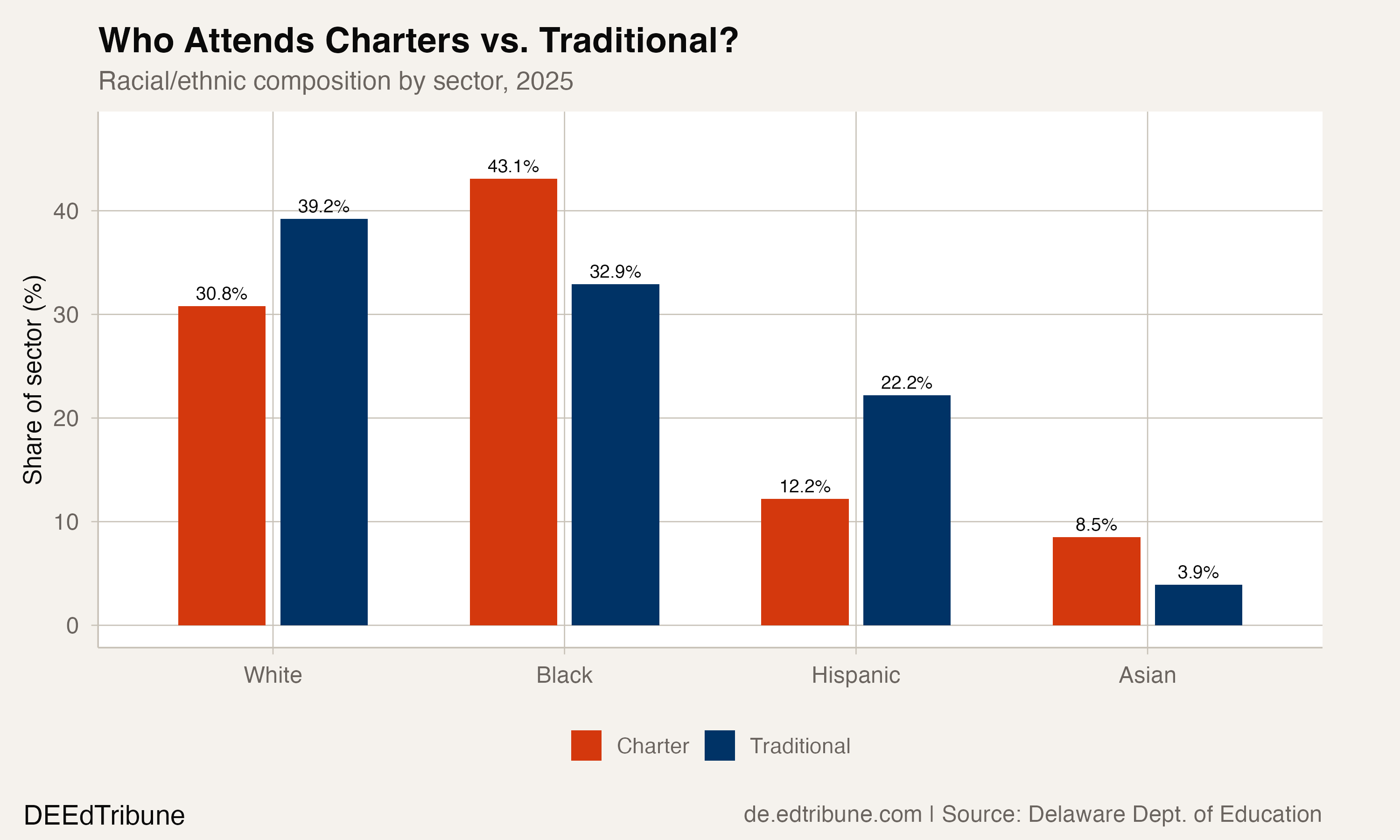
That aggregate picture, though, flattens wildly different schools into a single average. Newark Charter is majority-white and serves few low-income families. Academia Antonia Alonso is 85% Hispanic with a 60% English learner rate. Kuumba Academy, in Wilmington, is a historically Black charter. The charter sector is not monolithic. Individual schools are often more racially concentrated than their traditional counterparts, even as the sector as a whole mirrors statewide demographics more closely than any single school does.
Research has documented this tension in Delaware specifically: while the charter sector collectively serves a diverse population, individual schools tend to enroll largely homogeneous student bodies. The mechanism is straightforward. Specialty programs attract families who share an interest, and those interests tend to correlate with demographic background.
A service gap that is narrowing
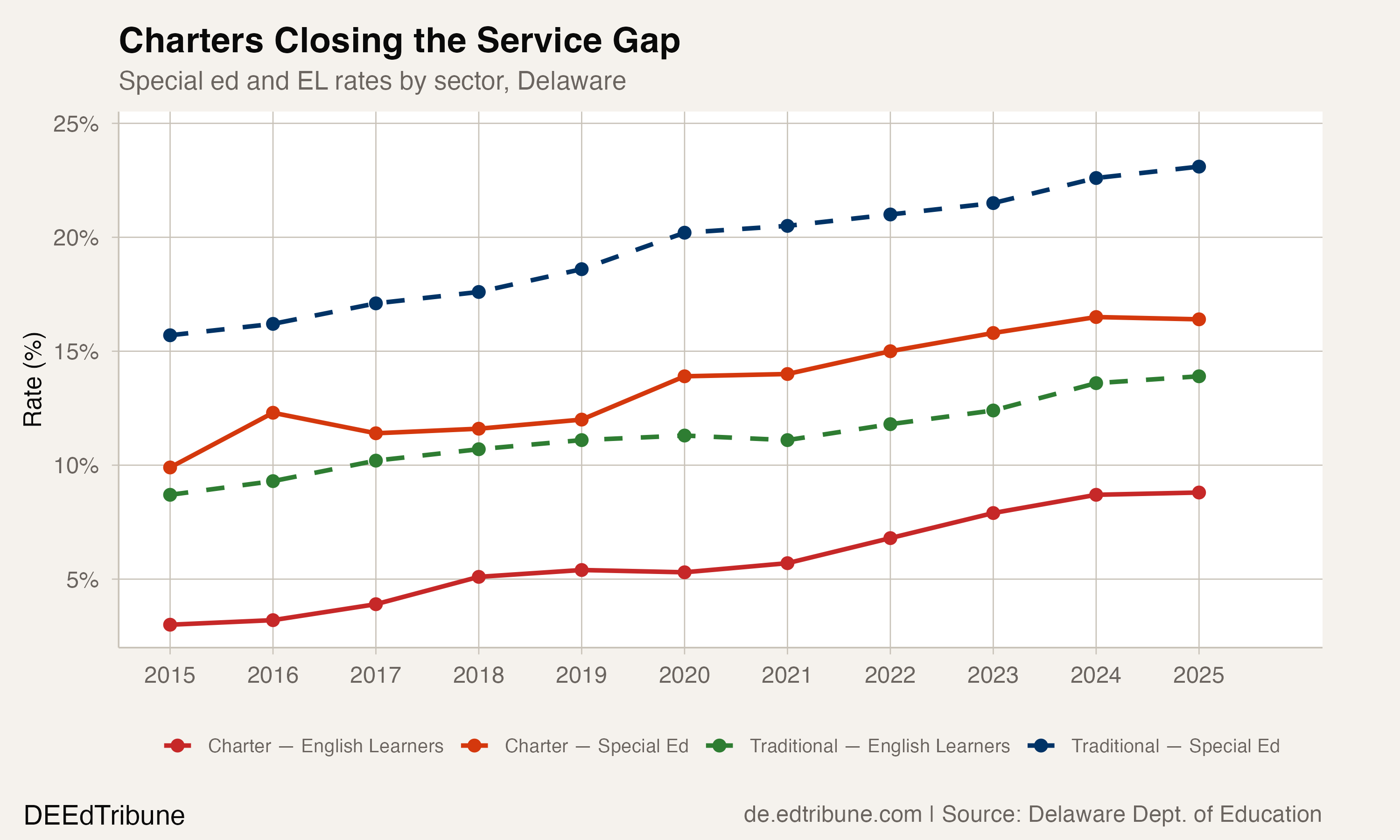
One of the oldest criticisms of charter schools is that they underserve students who receive specialized instruction. In Delaware, that gap is closing, though it has not closed.
Charter special education enrollment has risen from 9.9% to 16.4% of the sector's total since 2015. Traditional districts sit at 23.1%. The absolute gap between the two sectors widened slightly, from 5.8 to 6.7 percentage points, because both sectors identified more students for services and the traditional rate climbed faster. But in proportional terms, the charter rate grew 65.7% compared to 47.1% for traditional districts, a sign that charters are moving toward parity rather than away from it.
The English learner picture is similar. Charter EL rates tripled from 3.0% to 8.8%, compared to traditional districts' increase from 8.7% to 13.9%. Much of the charter EL growth traces to Academia Antonia Alonso and Odyssey Charter, whose language immersion models attract multilingual families by design.
Economically disadvantaged rates are now nearly identical: 30.3% in charters versus 31.6% in traditional districts. That convergence is the most direct rebuttal to the argument that Delaware's charters cream higher-income students.
What the 10% threshold means
The 10% figure is psychologically significant more than operationally significant. Delaware's school choice program already allows families to apply to any public school, charter or traditional, regardless of address. Per-pupil funding follows students across district and charter lines. The infrastructure for a choice-driven system is already in place.
The operational question is whether the non-zero-sum dynamic can hold. Traditional district growth has been driven largely by housing booms in southern Delaware and the Middletown corridor, forces that have nothing to do with the charter sector. If those housing markets cool while charter applications continue to climb, what has been a parallel expansion could become the familiar competition for a shrinking pool.
One early signal: the traditional sector lost 4,662 students during the pandemic year of 2020-21 while charters gained 396. Traditional districts recovered that ground by 2022, but the asymmetry during the disruption suggests that charters may have a structural advantage during enrollment shocks.
The charter sector added five new entities since 2015, growing from 14 to 19 schools. The newest, Bryan Allen Stevenson School of Excellence, opened in fall 2024 in Sussex County with 231 students. Whether the next wave of applications pushes past 10% in 2025-26 depends on whether schools like Odyssey Charter and Academia Antonia Alonso can translate their waitlists into seats.
Detailed code that reproduces the analysis and figures in this article is available exclusively to EdTribune subscribers.
Discussion
Sign in to join the discussion.
Loading comments...