Correction (July 21, 2026): The original article said Delaware's 12th-grade rate stayed below 11th grade for five consecutive post-2020 reporting years. In 2023, both rates round to 25.7%, but the unrounded 12th-grade rate was 0.02 point higher. The state package also does not return the grade-level subgroup rows used in the original article. This version corrects the streak, removes those subgroup figures and removes unsupported claims about dropouts, returning students and causes.
In 2024-25, 20.3% of Delaware's 12th graders were chronically absent, compared with 21.6% of 11th graders. The unrounded difference was a 1.4 percentage-point advantage for 12th grade.
That result continued a post-2020 shift, but not the uninterrupted five-year streak originally reported. The 12th-grade rate was lower in four of the five reporting years from 2021 through 2025. In 2023, the 12th-grade rate was 25.69% and the 11th-grade rate was 25.67%, a 0.02-point excess that disappears when both are rounded to 25.7%.
A clear change from the earlier series
In each of the five reporting years from 2015 through 2019, the 12th-grade rate exceeded the 11th-grade rate. In 2015, the rates were 25.0% and 20.6%, a 4.4-point gap. In 2017, the gap was 3.5 points. In 2019, the rates were 21.1% and 19.5%, a 1.6-point gap. Across those five years, the average gap was 2.9 points.
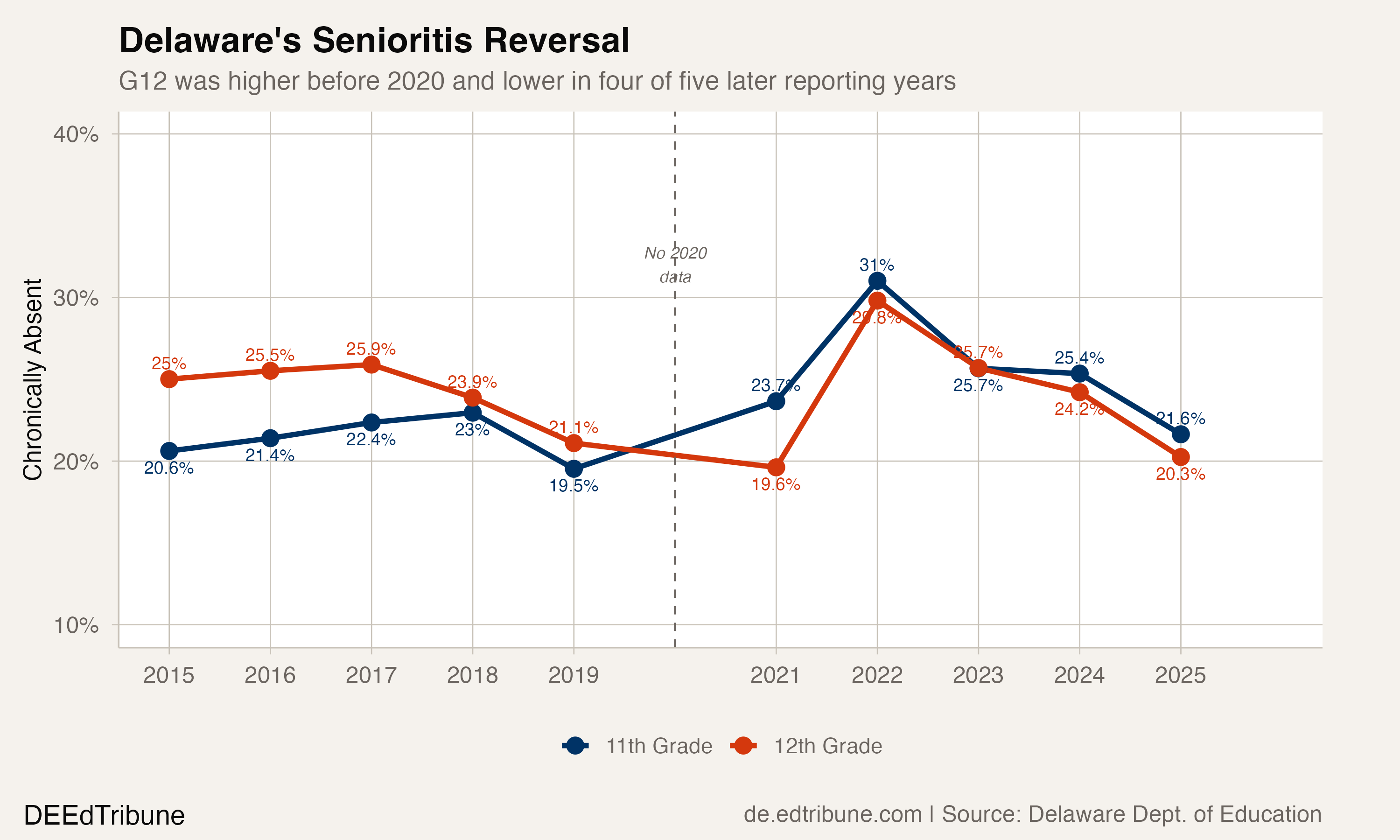
In 2021, the 11th-grade rate was 23.7% and the 12th-grade rate was 19.6%, a 4.0-point reversal. The 12th-grade rate remained lower by 1.2 points in 2022, was higher by 0.02 point in 2023, then was lower by 1.1 points in 2024 and 1.4 points in 2025.
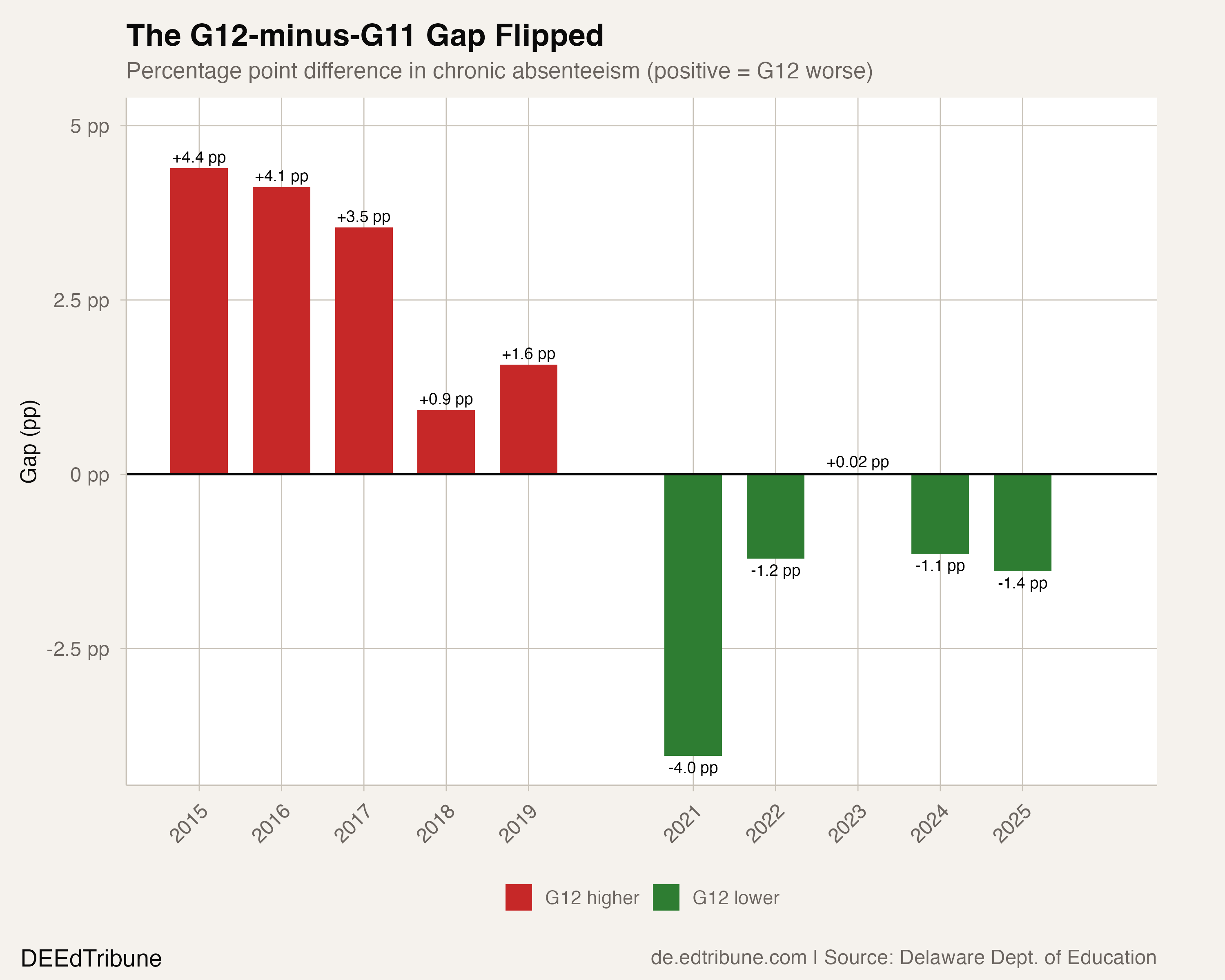
The attendance file establishes the change in the grade-level pattern. It does not identify the students in each annual grade total or explain why the lines crossed.
Reported grade counts also changed
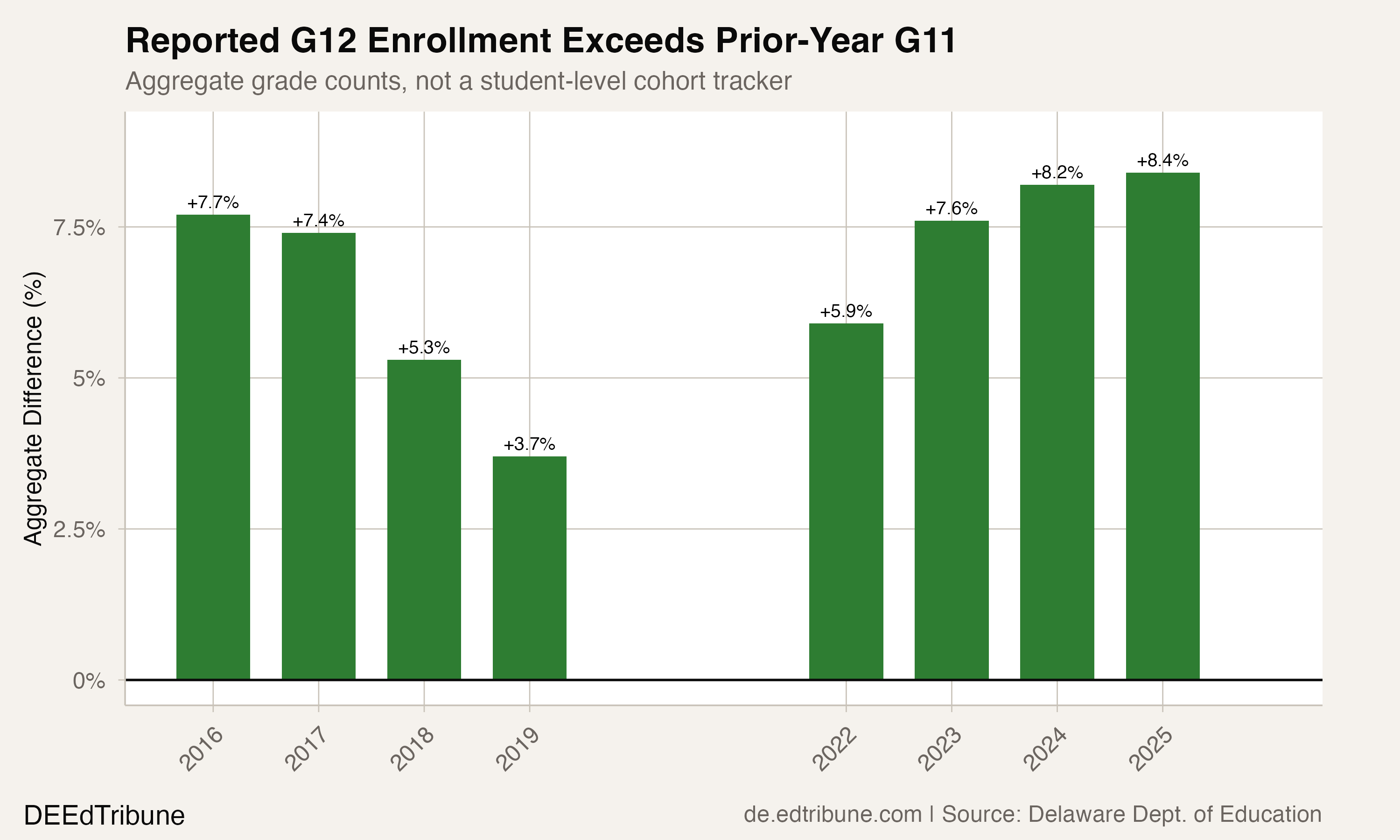
The package's aggregate 12th-grade count exceeded the prior year's 11th-grade count in all eight adjacent-year comparisons available in the panel. The comparison excludes 2021 because the package has no 2020 grade series.
In 2019, 12th-grade enrollment was 10,203, compared with 9,836 students in 11th grade one year earlier: 367 more students, or 3.7%. In 2022 the difference was 611 students, or 5.9%; in 2023 it was 782, or 7.6%; and in 2024 it was 863, or 8.2%. In 2025, the package reports 11,860 12th graders, compared with 10,941 11th graders in 2024, a difference of 919 students or 8.4%.
Those are aggregate grade counts, not a student-level cohort tracker. The difference cannot be assigned to returning students, transfers, retention, reporting changes or any other route with this file alone.
The 2024-25 high school staircase
Delaware's 2024-25 high-school rates did not rise steadily by grade. Ninth grade was highest at 23.4%. The rate fell to 20.5% in 10th grade, rose to 21.6% in 11th and fell to 20.3% in 12th.
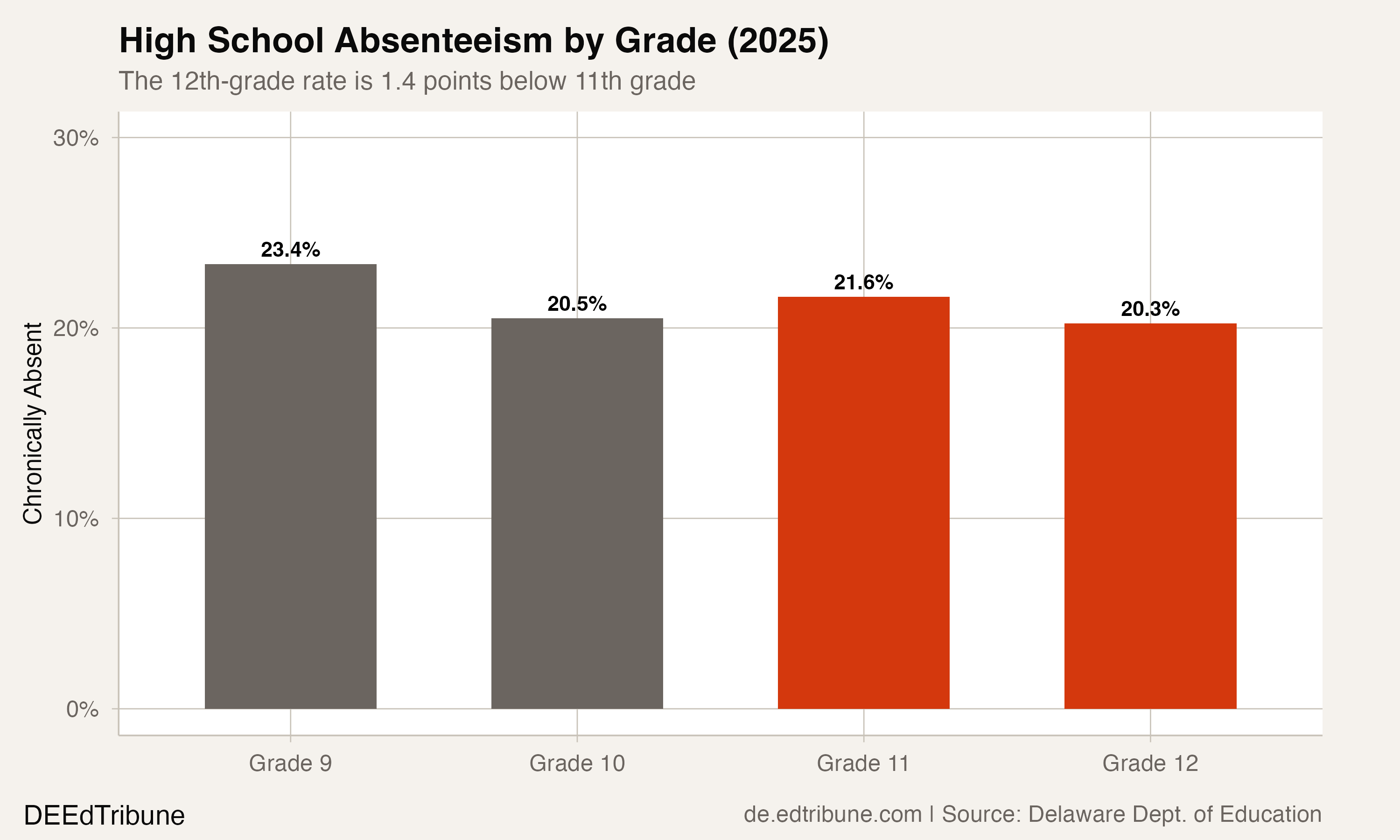
The pattern is descriptive. Calling the 9th-grade result a transition effect, the 11th-grade result a junior-year effect or the 12th-grade result a persistence effect would require evidence not present in the package.
What this does not resolve
The package compares annual grade-level aggregates, not the same students as they move from 11th to 12th grade. It therefore cannot show whether individual attendance improved, whether the composition of the grade changed or whether reporting practices changed.
The verified result is narrower: Delaware's 12th-grade chronic absenteeism rate exceeded 11th grade in all five pre-2020 reporting years, then fell below it in four of the five reporting years from 2021 through 2025. The 2023 near-tie is important because it prevents a false streak from replacing that more precise pattern.
Detailed code that reproduces the analysis and figures in this article is available exclusively to EdTribune subscribers.
Discussion
Sign in to join the discussion.
Loading comments...